

Launching a customer loyalty program is a pivotal strategic move for any brand aiming for sustainable growth. In a competitive marketplace, fostering genuine brand loyalty is essential. However, before you can improve the customer experience and reap the rewards, you must address a fundamental question: "What is the total investment?" Understanding the full financial picture, from initial setup to long-term returns, is the first step toward building a program that drives profitable growth and lasting customer relationships.
A loyalty program is a structured marketing strategy designed to encourage customers to continue shopping with or using a business's services. It's a formal system that rewards purchasing behavior, creating a mutually beneficial relationship between the brand and its customers. Program members receive incentives such as discounts, free products, or exclusive access, which in turn motivates them to choose your brand over competitors'. When considering implementation, the average cost to implement a digital loyalty program can range from $50 to $200 per month for basic software platforms, with more comprehensive or custom solutions potentially costing several thousand dollars, depending on features, scale, and provider.
Far more than a simple discount channel, a well-designed rewards program acts as a sophisticated engine for building customer loyalty. It systematically encourages actions that align with your business goals, turning one-time buyers into repeat customers and, eventually, passionate brand advocates. The core function is to give your customers a compelling reason to come back, thereby strengthening their connection to your brand and increasing their overall value over time.
When planning and allocating your budget for a loyalty program in 2026, consider factors such as projected member enrollment, anticipated reward redemptions, marketing efforts, and technology costs. Start by setting clear objectives for your program, estimating the costs of rewards, administration, and promotion, and reserving a portion of your budget for ongoing optimization and analytics. Careful budgeting ensures your loyalty program delivers maximum value while remaining sustainable.
Viewing a loyalty program merely as an expense is a common but short-sighted perspective. Instead, it should be seen as a foundational business investment in your most valuable asset: your existing customers. Effective program management shifts your focus from costly, short-term customer acquisition to more profitable, long-term customer retention. This strategic pivot is crucial for sustainable growth in any market.
These programs are powerful marketing strategies that systematically boost customer engagement and protect your profit margins. By rewarding repeat business, you create a strong incentive for customers to remain within your brand’s ecosystem rather than defecting to a competitor. The data and insights gathered from member behavior also enable more effective personalization, making your marketing efforts more efficient and impactful. Ultimately, a loyalty program is an investment in stable, predictable revenue.
Also Read: What are the Best Loyalty Apps for Shopify Growth?

The strategic values of a loyalty program include enhancing customer retention, increasing lifetime value, fostering brand advocacy, and providing valuable insights into consumer behavior. By effectively leveraging these aspects, businesses can build stronger customer relationships and drive long-term profitability.
A loyalty program significantly increases customer lifetime value by encouraging repeat purchases and deeper engagement over time. When customers feel recognized and rewarded, they are more likely to continue choosing your brand, leading to consistent spending. Additionally, loyalty programs enable better customer segmentation through data insights, allowing businesses to personalize offers and further boost long-term value. This creates stronger emotional connections with customers, making them less likely to switch to competitors. Over time, even small increases in retention can lead to substantial growth in overall revenue.
Loyalty programs are designed to drive repeat purchases by giving customers a strong incentive to return. Features like point reminders, limited-time bonuses, and progress-based rewards create a sense of urgency and motivation to shop again. Over time, this transforms one-time buyers into regular customers, building a stable and predictable revenue stream for the business. It also keeps your brand top of mind, increasing the likelihood of future purchases. Consistent engagement through rewards helps build long-term buying habits among customers.
An effective loyalty program can increase the amount customers spend per order by encouraging them to reach reward thresholds or unlock better benefits. Customers are often motivated to add more items to their cart to earn bonus points or qualify for exclusive perks. This not only enhances the shopping experience but also directly contributes to higher revenue per transaction. It also promotes product discovery as customers explore additional items to meet reward criteria. Over time, this behavior leads to larger and more valuable shopping baskets.
Loyalty programs help reduce the cost of acquiring new customers by focusing on retention and turning existing customers into advocates. Referral programs within loyalty systems encourage satisfied customers to refer new customers at a lower cost than traditional marketing channels. This results in more efficient spending while still expanding the customer base. It also improves marketing ROI by maximizing the value of existing customers. As referrals grow, businesses can rely less on expensive paid acquisition channels.
Loyalty programs provide access to valuable customer data, including preferences, purchase behavior, and engagement patterns. This data can be used to create personalized marketing campaigns, improve product offerings, and optimize the overall customer experience. Over time, these insights become a strategic asset that supports better decision-making across the business. It also helps identify high-value customers and tailor experiences specifically for them. With continuous data analysis, businesses can refine their strategies and stay aligned with evolving customer needs.
Also Read: How Squaties Scaled Order Volume via Performance Bundling.
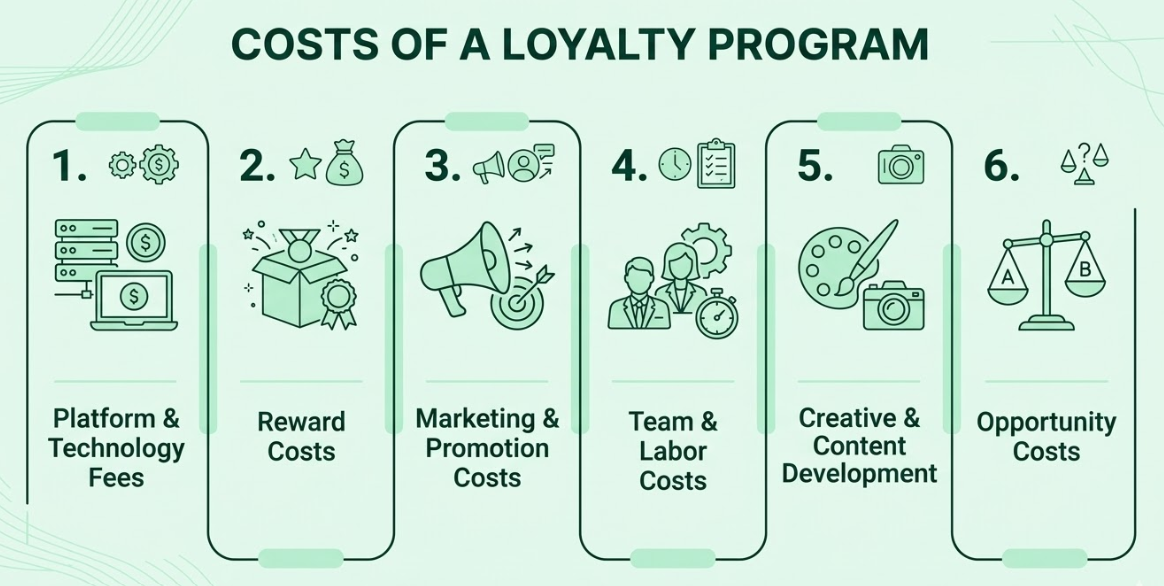
A comprehensive loyalty program cost calculation goes beyond the obvious expenses. The total investment is a combination of direct costs, which are the tangible line items on your budget, and indirect costs, which involve your team’s time and operational resources for program management.
Let's break down each of these components to build a complete financial picture.
Loyalty programs rely on software platforms, usually offered through a SaaS model, that handle everything from tracking points to managing rewards and integrations. These platforms typically charge monthly or annual subscription fees, which may vary based on features, customer size, or order volume. Some providers also include one-time setup costs for onboarding, configuration, or data migration, especially for advanced or enterprise-level solutions. As your business grows, pricing often scales through tiered plans, making it important to understand the full cost structure upfront.
Reward costs are often the largest and most variable expense in a loyalty program, as they represent the actual value given back to customers. This could include discounts, free products, or free shipping, all of which directly impact your margins. The cost depends on the type of reward, such as the revenue lost through discounts or the production cost of free items. While experiential rewards like exclusive access may have lower direct costs, they still need to be considered as part of your overall strategy. Balancing attractive rewards with sustainable costs is key to maintaining profitability.
To make a loyalty program successful, businesses must invest in marketing and promotion to drive awareness and engagement. Initial launch campaigns often require the most effort, using channels like email, social media, and on-site banners to encourage sign-ups. After launch, ongoing communication is essential to keep customers engaged with updates, rewards, and reminders. These activities may involve additional costs such as campaign creation, increased messaging volume, or paid promotions. Consistent marketing ensures the program remains active and valuable to customers.
Running a loyalty program requires continuous effort from your internal team, making labor costs an important consideration. Your marketing or ecommerce team will need to manage the program, analyze performance, and optimize strategies over time. Additionally, customer support teams must handle queries about points, rewards, and redemptions, which adds to their workload. Even if you use a SaaS platform, your team still plays a crucial role in execution and maintenance. Factoring in the time and resources your team spends is essential for accurate cost evaluation.
A successful loyalty program requires strong branding and engaging content to create a seamless and appealing user experience. This includes designing loyalty tiers, naming structures, and visual elements that align with your brand identity. Your team will also need to create content such as landing pages, emails, and FAQs to explain and promote the program. Ongoing updates and campaign creatives further add to this effort. These creative and content tasks contribute to the overall cost and play a key role in customer engagement.
Opportunity costs are the value of other initiatives you may have to forgo when investing in a loyalty program. Time, money, and resources allocated to loyalty efforts could otherwise be used for marketing campaigns, product development, or other growth strategies. While not directly visible in budgets, these costs are important for strategic decision-making. Evaluating opportunity costs helps ensure that your loyalty program delivers better returns compared to alternative investments. It ultimately ensures you are making the most effective use of your resources.
Also Read: How Minimal Home Redefined Interior Elegance through Strategic Upselling.

A precise calculation of loyalty program costs is the foundation of a sustainable and profitable rewards strategy. Without a clear understanding of all expenses, from initial setup to ongoing maintenance, you risk launching a program that is financially unviable or fails to deliver a positive return on investment.
Let's examine why this calculation is so critical for success.
Calculating loyalty program costs helps ensure your investment aligns with your overall business objectives, such as improving retention, increasing purchase frequency, or boosting profitability. With a clear understanding of expenses, you can design rewards and marketing strategies that directly support these goals. It also helps you allocate budgets effectively across different program components. This alignment turns your loyalty program into a strategic investment rather than just an added expense.
A proper cost calculation is essential to ensure that your loyalty program remains profitable as it scales. By understanding both fixed and variable costs, you can design a reward structure that maintains healthy margins even as your customer base grows. It also helps you avoid situations where increasing participation leads to higher losses. With accurate forecasting, you can build a program that delivers consistent value to both customers and your business over time.
Breaking down loyalty program costs allows you to identify where your budget is being spent and where improvements can be made. This visibility helps you reallocate resources to high-performing areas, such as better rewards, marketing campaigns, or automation tools. It also enables you to reduce inefficiencies and control unnecessary expenses. As a result, every dollar spent contributes more effectively to program success and customer engagement.
Understanding costs alongside performance metrics allows you to make smarter, data-driven decisions about your loyalty program. By analyzing customer behavior in relation to reward costs, you can identify which strategies deliver the best return on investment. This helps you refine your program by focusing on what works and eliminating what doesn’t. Over time, this approach leads to a more efficient and profitable loyalty strategy.
Also Read: How to Master Your Loyalty Program ROI for Success?
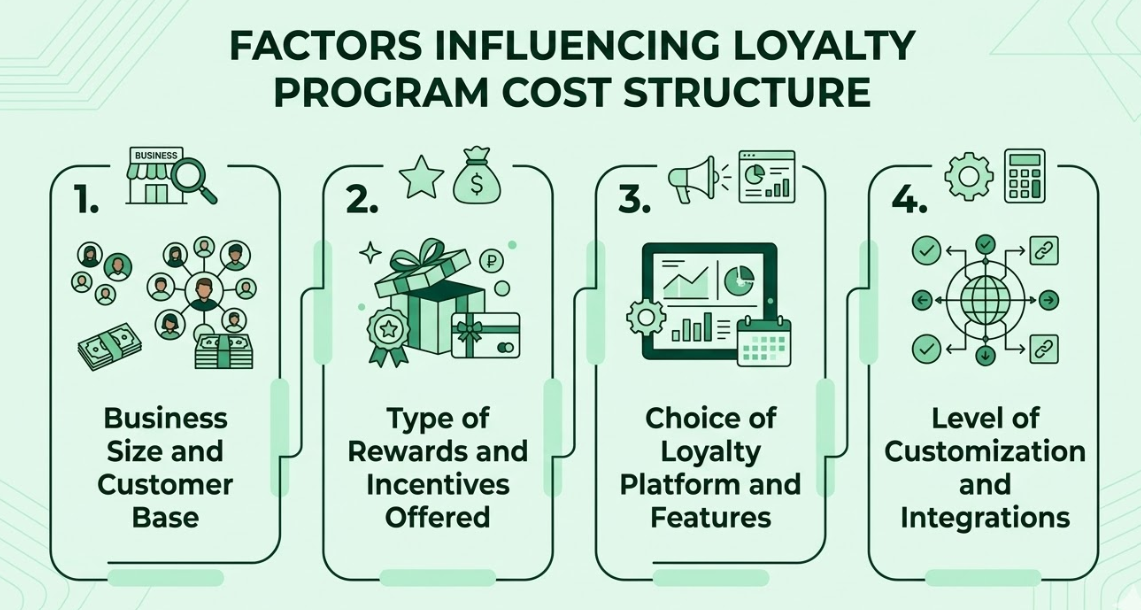
The cost structure of a loyalty program is not one-size-fits-all. Several key factors will significantly influence your final loyalty program cost calculation, from your business size to the technology you choose. A small startup with a niche customer base will have a very different budget than a large enterprise with millions of customers.
Let's explore the primary factors that determine a program's cost.
The size of your business and customer base plays a major role in determining the overall cost of a loyalty program. Larger businesses with more customers typically incur higher costs for platform usage, rewards, and customer support, while smaller businesses can start with more basic, affordable setups. Startups often focus on simple programs to test effectiveness and gather data before scaling. As the business grows, the need for more advanced features and dedicated resources increases, impacting the overall cost structure.
The rewards you offer directly affect both the cost and the effectiveness of your loyalty program. Discounts and points-based systems are easier to manage and cost predictably, whereas rewards such as free products or high-value incentives can significantly increase expenses. On the other hand, experiential rewards such as exclusive access or special perks can deliver strong value at a lower cost. Striking the right balance between attractive rewards and sustainable spending is key to maintaining profitability.
The platform you choose has a direct impact on both initial and ongoing costs of your loyalty program. SaaS-based solutions are generally more affordable and quicker to implement, while custom-built platforms require a higher upfront investment and ongoing maintenance. The features included, such as analytics, fraud prevention, and gamification, also influence pricing. Choosing the right platform means balancing cost with the capabilities needed to drive meaningful results.
The degree of customization and the number of integrations required can significantly affect your loyalty program costs. Basic programs with minimal customization are more affordable, while highly tailored solutions with unique branding and features require more investment. Integrating the loyalty program with tools like ecommerce platforms, CRM systems, and marketing software can also add complexity and cost. However, these integrations are important for delivering a seamless and personalized customer experience.
Also Read: How to Master Your Loyalty Program ROI for Success?
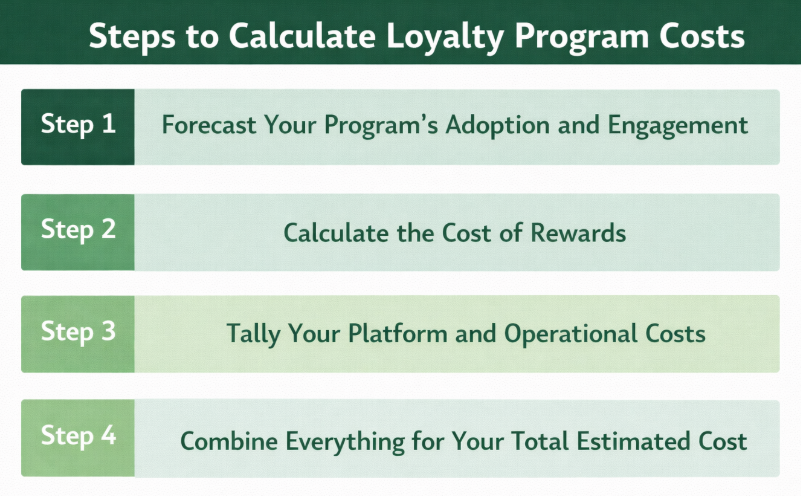
A methodical approach is essential for accurately calculating loyalty program costs. By breaking down the process into clear steps, you can create a realistic budget and set clear financial expectations for your rewards program. This structured process helps ensure you account for all potential expenses, from rewards to operational overhead.
Let’s walk through the four key steps to estimating your total program costs.
The first step in any cost calculation is to forecast how many customers will join your program and how active they will be. You cannot calculate reward costs without estimating the number of program members and their level of customer engagement. A reasonable starting point for the first-year adoption rate is 10-25% of your total customer base.
Next, project the redemption rate, the percentage of issued points that will actually be used. Industry averages often hover between 15% and 30%. This is a crucial forecast; a higher-than-expected redemption rate can strain your budget, while a very low rate suggests your rewards aren't compelling. Use analytics tools and customer segmentation to refine this estimate if possible.
Finally, estimate the average number of points customers will earn per purchase based on your earning rules and current AOV. This forecasting is vital to calculating the total cost of launching a loyalty program for your business, as it lays the foundation for your largest variable expense.
With your forecasts in hand, you can now calculate your estimated reward costs. This calculation is one of the most critical steps involved in calculating loyalty program costs for ecommerce stores, as it will likely be your largest ongoing expense. The formula is straightforward: multiply the total number of points you expect to issue by your projected redemption rate, then multiply that by the monetary value of each point.
For example, imagine you issue 6,000,000 loyalty points in a year. If you project a 25% redemption rate, loyalty program members will redeem 1,500,000 points. If each point is worth $0.01, your total annual reward cost would be $15,000.
It is essential to model this calculation carefully. Your assumptions about customer behavior, particularly the redemption rate, will have a direct and significant impact on your budget. Consistently monitoring actual redemption rates against your forecast will be a key task once the program is live.
Once you've estimated your reward costs, the next step is to tally your fixed and semi-variable operational costs. These are the ongoing fees and monthly costs associated with running a loyalty program. Start with your technology expenses, primarily the recurring platform fees for your loyalty software.
Next, add your estimated labor costs. This includes the portion of salaries for the team members who will manage the program, as well as the time your customer support staff will spend assisting members. Do not forget to allocate a specific marketing budget for both the initial launch promotion and the ongoing campaigns required to keep members engaged.
For example, if your platform fees are $6,000 annually, you allocate $8,000 for labor, and your marketing budget is $4,000, your total operational costs would be $18,000. These predictable expenses form the other major part of your total program cost.
The final step is to combine all your calculated expenses to arrive at your total estimated cost. This figure provides a comprehensive and realistic budget for your loyalty program's first year. This is the ultimate answer to the question, "How can I calculate the total cost of launching a loyalty program for my business?"
To do this, simply add your total estimated rewards cost (your primary variable cost) to your total platform and operational costs (your fixed and semi-variable costs). In our running example, this would be $15,000 in rewards plus $18,000 in operational costs, for a total cost of $33,000.
This final number represents your total initial investment. It encompasses your direct expenses, such as rewards and software, as well as your indirect costs, such as labor. Having this complete picture is essential for managing your profit margins and accurately measuring the program's future return on investment.
Also Read: How Puur Scaled Average Order Value via Intelligent Accessory Pairing.

Once your loyalty program is live, the focus of program management shifts to optimization. An effective loyalty program cost calculation is not a one-time event; it's an ongoing process of refinement to maximize ROI. The goal is to control costs without sacrificing the customer engagement that drives customer retention.
Let's explore some key strategies for cost optimization.
One of the most effective ways to manage reward costs is to design a structure that balances a high value proposition for the customer with sustainable profit margins for your business. Not all rewards have to be direct discounts that eat into your revenue.
Consider incorporating non-financial rewards that have a high perceived value but a low direct cost. These can be some of the most powerful tools for customer retention. Smart, cost-effective rewards include:
These types of incentives can be more memorable and build a stronger emotional connection than a simple discount. When evaluating the hidden costs of developing a loyalty program, failing to leverage cost-effective rewards is a common missed opportunity that can unnecessarily inflate your expenses.
Manual program management can quickly become a significant drain on your resources, driving up operational costs. Leveraging automation is a key strategy to reduce the labor and effort required for ongoing maintenance, freeing your team to focus on more strategic initiatives.
Modern loyalty platforms offer powerful automation features. You can automate triggered emails for member birthdays, point-balance updates, and tier-progression notifications. This ensures consistent communication without manual intervention. Automation can also handle the routine tasks of point allocation and reward fulfillment.
Investing in a platform with robust automation and analytics tools directly contributes to a higher ROI. When estimating the ROI of a loyalty program relative to its cost, the savings from reduced operational effort should be factored in. By minimizing manual tasks, you make your program management more efficient and scalable.
Your customer data is your most valuable asset for optimizing reward allocation and controlling costs. Through data analytics, you can gain deep insights into which rewards are most effective at driving desired customer behavior and which simply add to your expenses without impacting program performance.
For example, by analyzing customer data, you might discover that a $5 coupon is just as effective at driving repeat purchases as a $10 coupon in a specific customer segment. By adjusting your reward allocation accordingly, you can cut your reward costs for that segment in half without negatively affecting engagement.
When budgeting for a new loyalty program, it's crucial to factor in your platform's ability to support data-driven decision-making. The ability to test, measure, and optimize your reward strategy based on actual customer behavior is fundamental to running a financially efficient and successful program.
Also Read: How to Boost Sales with Brand Loyalty Ecommerce Tips?
While a healthy redemption rate indicates an engaged member base, a large volume of unused rewards or expired rewards represents a financial liability on your books. Implementing strategic policies to manage this liability is essential for protecting your profit margins. One common strategy is to set point expiration dates.
For example, points could expire after 12 months of inactivity. This not only reduces your long-term liability but also creates a sense of urgency, encouraging members to re-engage with your brand and make a purchase before their points are lost. This tactic can positively influence customer behavior and boost sales.
This liability management is a key factor to consider when calculating the total cost of launching a loyalty program for your business. A well-designed expiration policy can significantly reduce the risk of a sudden spike in redemptions that could negatively impact your financial forecasts and profitability.
A loyalty program should never be a "set it and forget it" initiative. The most successful programs are those that are continuously tested and improved based on program performance data and direct customer feedback. This iterative approach is crucial for ongoing maintenance and long-term success.
Use your analytics tools to run A/B tests on different aspects of your program. You can test different reward values, earning rules, or marketing strategies to see what resonates most with your audience. For example, does a "double points weekend" drive more incremental revenue than a "20% off" coupon? Only testing can provide the answer.
This commitment to continuous improvement is vital for maximizing your return. As you estimate the ROI of a loyalty program compared to its cost, remember that optimization is not a one-time task. The insights you gain from testing allow you to refine your program, making it more engaging for customers and more profitable for your business over time.
Also Read: How Metalbird drove consistent growth across 8 stores.
Optimizing your rewards program for cost efficiency while enhancing member value is a core challenge in loyalty program management. With Kefi Loyalty Program, VIP Tier, you can strategically leverage features like a VIP tier to achieve this balance. A tiered structure allows you to concentrate your most valuable and often most expensive rewards on your highest-spending customers, ensuring your budget is allocated for maximum impact.
Instead of offering the same costly benefits to all members, a VIP tier allows you to provide exclusive perks like free shipping, early access, or high-value discounts only to those who have demonstrated significant loyalty. For other members, you can offer more cost-effective rewards, such as points or smaller discounts. This segmentation, powered by data analytics, ensures your rewards program is both aspirational for customers and financially sustainable for your business, driving a stronger overall ROI.
Book a Demo to see how Kefi Loyalty Program, VIP Tier works.
Mastering the calculation of loyalty program costs is essential for businesses aiming to enhance customer retention and maximize profitability. As we've explored, understanding the various components of loyalty program costs, from platform fees to reward expenses, enables you to craft a strategy that aligns with your business goals. By continuously monitoring and optimizing these costs, you can ensure long-term success and create value for both your customers and your bottom line. If you're ready to take the next step in optimizing your loyalty program, consider diving deeper into our resources or scheduling a consultation with our experts to help guide you on this journey.
To estimate ROI, first complete your loyalty program cost calculation. Then, use data analytics to measure the incremental profit generated by members (e.g., increased customer lifetime value, higher AOV). The ROI formula is [(Financial Gain - Program Costs) / Program Costs] * 100. Positive ROI demonstrates strong program performance.
When budgeting, consider your business size and customer base, the type and generosity of your rewards, platform subscription fees, a dedicated marketing budget for promotion, and the internal operational costs for program management and support. Your reward costs will likely be your largest variable expense.
Evaluating cost-effectiveness depends on your business's specific needs. In-house programs may offer control and customization, while external providers can reduce startup costs and implementation time. Analyze long-term expenses, scalability, and resource availability before making a decision.
Yes, loyalty programs often incur ongoing fees such as software subscriptions, transaction processing costs, and marketing expenses. Additionally, businesses may need to allocate resources to customer support and program management, thereby increasing monthly operational costs. Understanding these fees is crucial for effective budget planning.
Loyalty program cost calculation refers to estimating all expenses involved in running a loyalty program, including software, rewards, marketing, and operations. It works by breaking down both fixed and variable costs to get a clear financial picture. This helps businesses plan budgets and avoid overspending.
The cost of a loyalty program depends on the tools and features you choose, with some platforms offering free plans and others charging monthly fees. Costs can increase with advanced features, larger customer bases, and higher reward usage. It’s important to align costs with your business goals and growth stage.
Loyalty programs cost more as your business grows due to increased reward redemptions, higher platform tiers, and added integrations. However, scalable pricing models help manage this growth efficiently. The key is to ensure that rising costs are balanced by higher customer lifetime value.
The cost of customer loyalty programs includes platform fees, reward expenses, promotional campaigns, and internal team effort. These costs can vary based on program complexity and customer engagement levels. A well-structured program ensures these costs translate into higher retention and revenue.
The cost of implementing a loyalty program typically includes setup fees, software subscription, and initial marketing to drive adoption. Some platforms may also charge for customization or data migration. Planning these costs upfront helps ensure a smooth and effective launch.
To calculate the cost of a loyalty program, you need to account for platform fees, rewards, marketing, and operational expenses. This is important because it helps you understand profitability and measure return on investment. Without proper calculation, a program can quickly become expensive without delivering results.
.svg)
