
Your traffic is up, and conversions are decent, but your revenue isn't scaling as it should. The problem is not how many people are buying. It is how much they are spending when they do. If you are not actively optimizing for average order value, you are leaving real money on the table every single day.
With US customer acquisition costs jumping more than 60% in the last two years, acquiring new shoppers is becoming more expensive, not less. The smartest Shopify merchants in 2026 are not just chasing more traffic. They are generating more revenue from the traffic they already have. AOV is the lever that makes that possible.
In this guide, you will learn exactly what average order value is, how to calculate it, why it is one of the most important metrics in your store, and the proven tactics, including AI-powered bundling, loyalty programs, and smart upsells, that top Shopify merchants use to grow it consistently.
Average order value (AOV) is the average amount a customer spends per order in your store. You calculate it by dividing your total revenue by the total number of orders over a given period. It's one of the most important metrics in e-commerce because it directly impacts revenue without requiring more traffic.
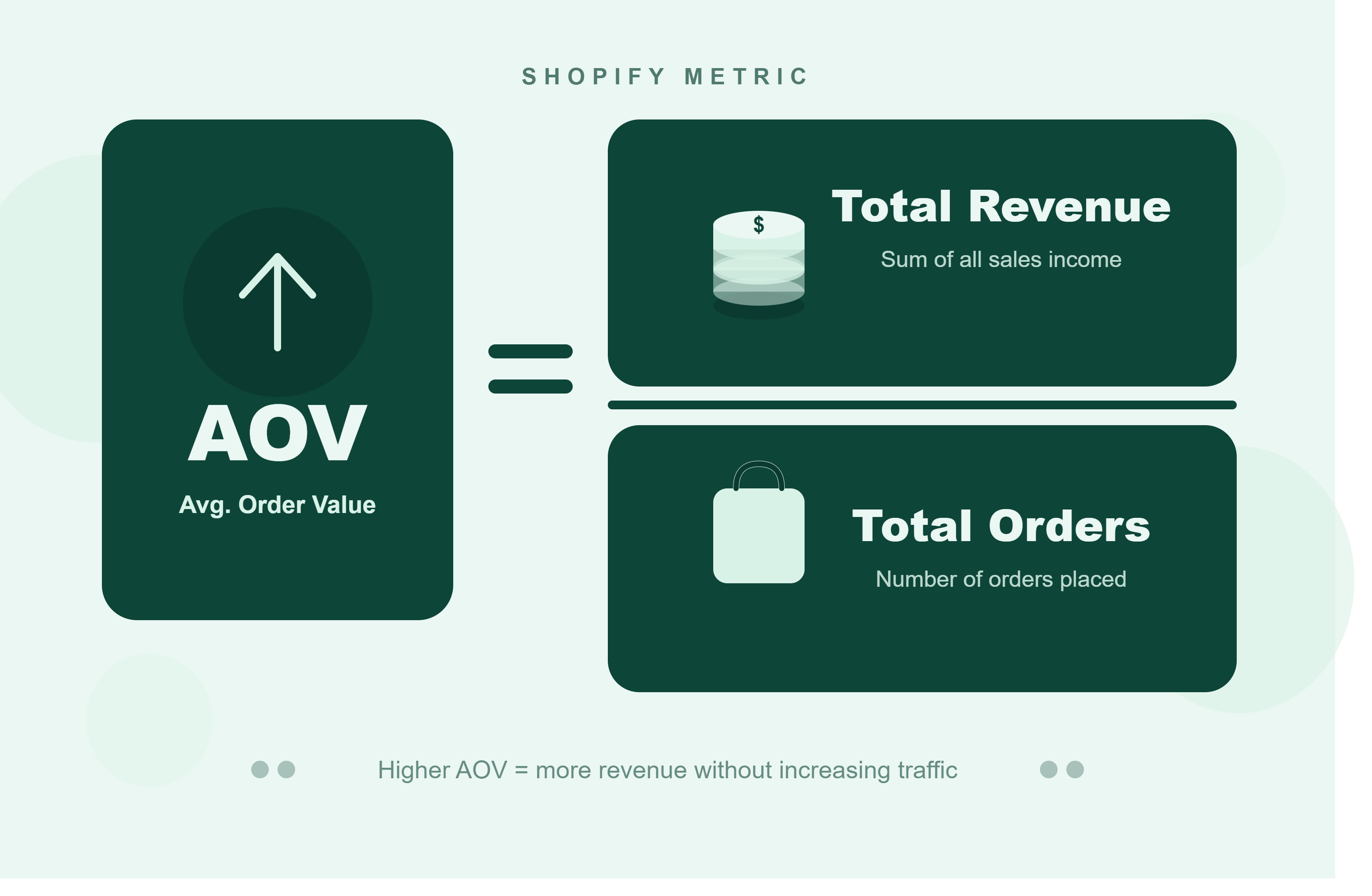
Example for average order value calculation: Say your store generated $15,000 in revenue last month from 300 orders. Your average order value would be $50. The calculation is straightforward.
A few things are worth keeping in mind. It is better to track AOV by calculating it weekly or monthly rather than daily because short-term spikes from flash sales or promotions can distort the numbers and lead to inaccurate conclusions.
If you use Shopify, you do not need to calculate it manually. Simply go to Reports > Customers in your Shopify admin to find your average order value.
Once you know your AOV, you have a clear benchmark. From there, you can start testing strategies to increase it and drive more revenue from every order.
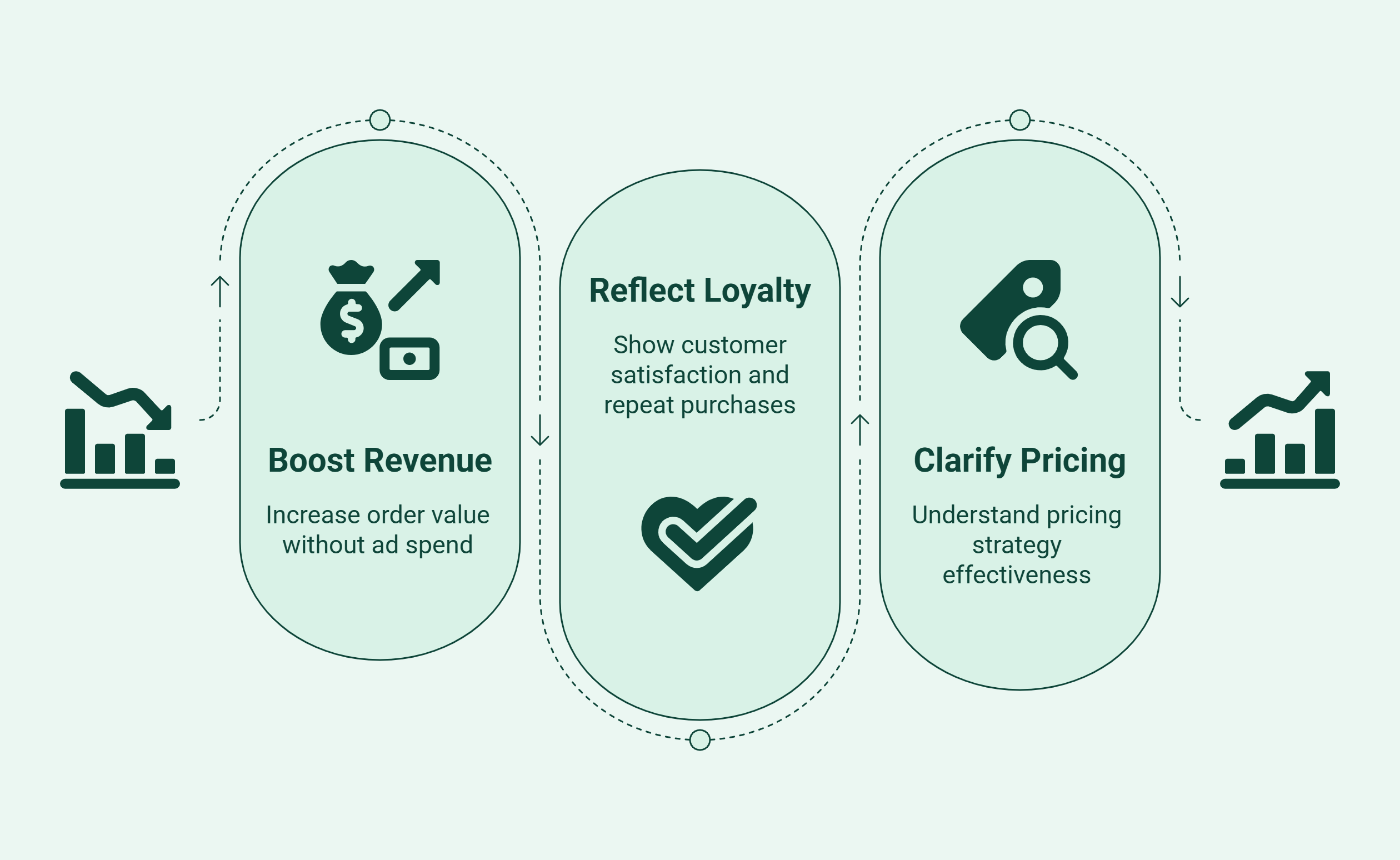
AOV shows how much revenue you generate from each order and can help identify whether existing customers are making higher-value purchases over time. A higher AOV means more revenue per transaction without spending more on ads, which directly improves profit margins, lowers your effective cost per acquisition, and stretches every marketing dollar further.
Driving more traffic is getting more expensive every year. Increasing AOV helps you generate more revenue from customers you already have, enabling you to grow sales without increasing your advertising budget.
Average order value is not just a revenue metric. It can also reflect customer loyalty when repeat buyers consistently spend more than first-time shoppers. Tracking AOV alongside repeat purchase rate gives a clearer picture of long-term customer value.
AOV reveals what encourages customers to spend more during each purchase. It helps you identify effective price points, promotions, bundles, and upsell opportunities before scaling your marketing efforts.
Conversion rate alone does not tell the full story. Revenue Per Visitor (AOV x Conversion Rate) is the number that shows you what each visitor is truly worth to your store.
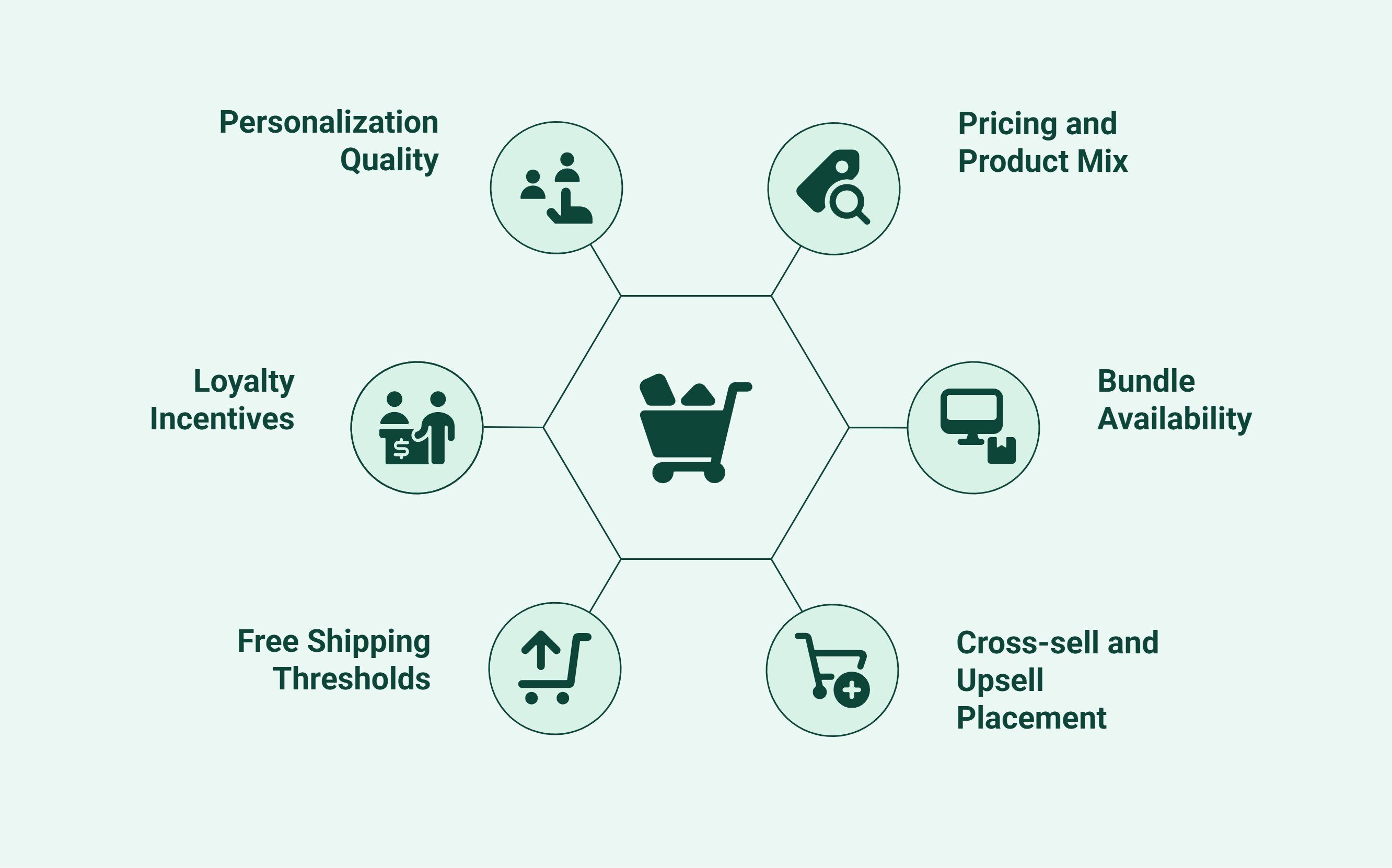
AOV is influenced by how you price products, present offers, and encourage a sense of urgency for customers to add more items to their cart. Factors such as pricing strategy, product mix, upsell placement, checkout experience, free shipping thresholds, and personalization all play a role. Several things influence how much a customer spends per order. Here are the six that carry the most weight:
If your catalog skews toward low-ticket items with no natural add-ons, AOV will stay low by default. A well-structured product mix with complementary items at different price points gives customers more reasons to spend more in a single order.
Bundles do not just increase AOV; they simplify the buying decision. But they only work if customers can actually see them. If your bundles are buried on a separate page, they are not doing their job. Tools like Kefi's Bundle Builder let you surface bundles directly on product and collection pages, right where buying decisions are made.
It is not just about having upsells. It is about where they show up. A cross-sell on the product page performs differently from one in the cart drawer. Different strategies for placement at the right moment in the buying journey make the difference between an ad and an ignore.
A large portion of US shoppers will add items to their cart just to qualify for free shipping. A threshold set just above your current AOV nudges customers to spend more without making them feel pushed.
Example: If your AOV is $75, setting your free shipping threshold at $85 gives most customers just enough incentive to add one more item.
When customers know they are close to unlocking a reward, they spend more to enhance their customer experience. Points programs, VIP tiers, and milestone rewards create a natural pull toward higher cart values, especially for repeat buyers.
Generic recommendations get ignored. Personalized ones, driven by purchase history and browsing behavior, perform significantly better. The more relevant the suggestion, the more likely a customer is to act on it.
The merchants seeing the biggest AOV gains are the ones combining multiple strategies. Better bundles, smarter upsells, loyalty incentives, and personalized recommendations work together across every stage of the buying journey to increase order value and drive stronger results.
Check our guide on How to Upsell on Shopify and Increase AOV in 2026 to discover proven upselling strategies that encourage customers to spend more at every stage of the buying journey.
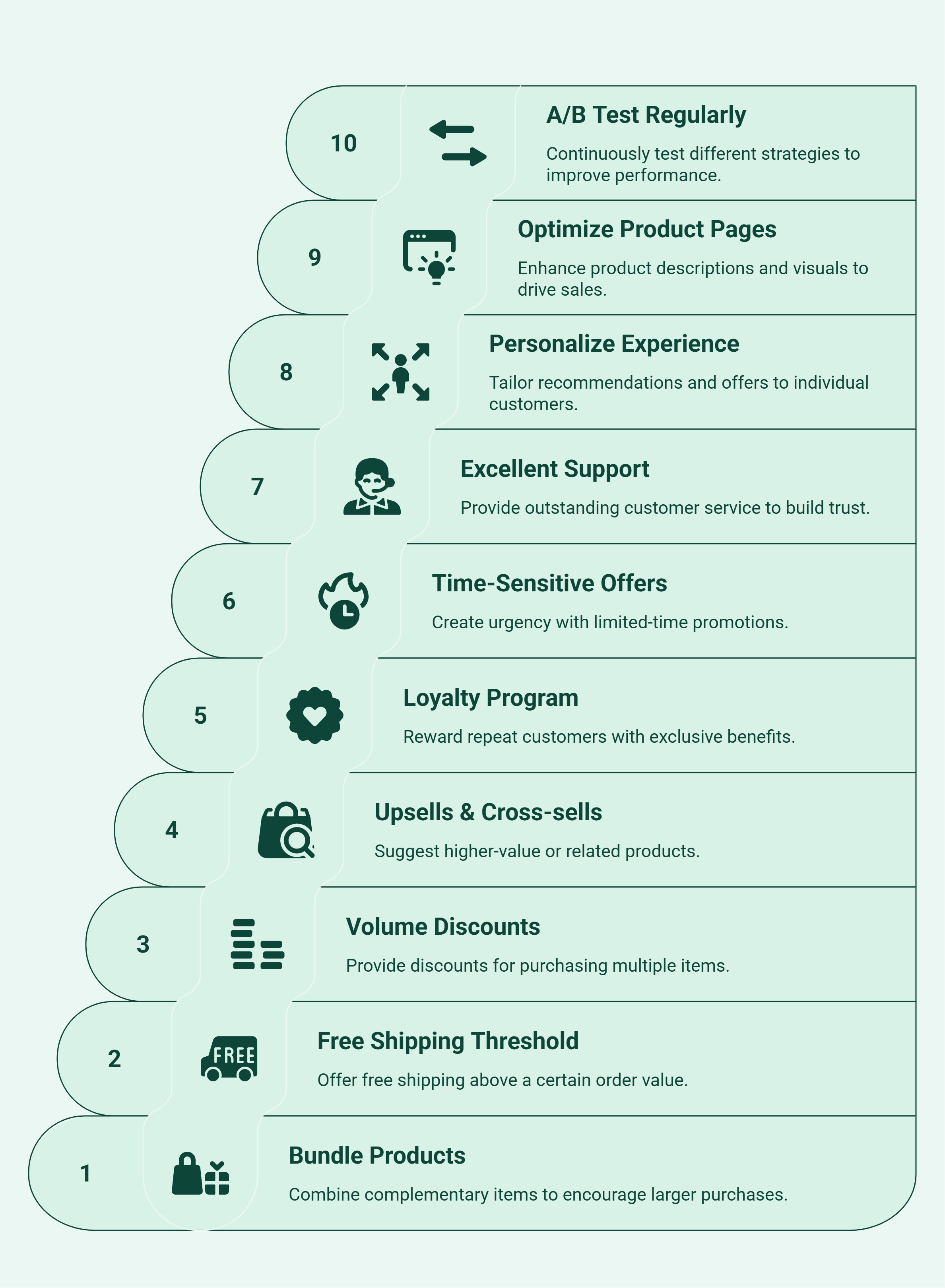
There is no single switch you flip to grow AOV. It is a combination of smart merchandising, well-placed incentives, and an effective way to create a shopping experience that makes spending feel more natural, not forced. Here are the best ways to improve the average order value in e-commerce.
Bundles increase order value by encouraging customers to buy related products together. When the pairing is obvious and the savings are visible, most shoppers will take it.
Here is what makes a bundle actually work:
Example: A supplement brand sells protein powder with a shaker bottle and a sample pack. The individual products cost $62, while the bundle costs $52. Customers see the value, buy more products, and increase AOV.
Relevant bundles reduce decision-making and increase the number of items purchased in a single order.
Free shipping thresholds work because customers will add items to a cart just to avoid paying for delivery. That behavior is completely predictable and, when set up correctly, highly profitable. Set your threshold 10 to 20% above your current AOV. If your store average is $75, aim for $85 to $90. High enough to nudge spend, low enough that most customers feel it is within reach.
If customers cannot see how close they are, the threshold does nothing. Visibility is everything here.
Buy more, save more is one of the oldest retail tactics because it works on both sides of the transaction. Customers feel rewarded for spending more, and you move more inventory per order.
A tiered pricing structure might look like this:
Example: A candle brand offers single candles at $18. At three candles, the price drops to $14 each. Customers planning to buy one often end up buying three, especially when the savings are shown clearly right on the product page. The brand did not discount anything aggressively. It just made the math visible.
A 2 percent discount for doubling your order does not motivate anyone. The savings have to feel meaningful relative to what the customer is spending.
Upselling means nudging someone toward a better or larger version of what they are already considering. Cross-selling means suggesting something that goes well with what is already in their cart.
The three placements that work best:
Most high-performing Shopify stores use AI-driven checkout upsells to automate this process. Instead of manually curating recommendations, AI analyzes purchase history and browsing behavior to surface the right product at the right moment, across every placement.
First, you give customers a reason to spend slightly more in the current session to hit a points milestone or unlock a reward. Second, returning customers often spend more than first-time buyers, so loyalty rewards can support both higher AOV and stronger retention.
To make a loyalty program actually drive AOV and not just retention:
When someone knows their purchase earns them credit toward a future discount, they become less price-sensitive at checkout.
A discount that expires in a set window or a bundle available "this week only" creates a reason to act now instead of later. This is especially effective for customers who are already on the cart page but hesitating.
What to keep in mind when using urgency tactics:
The right time-limited offer can push someone to complete the purchase and add one more item while they are at it.
A customer who cannot quickly find an answer about sizing, ingredients, or a shipping timeline will leave. A customer who gets an immediate, helpful response will often add more to their cart before checking out.
A few ways to make customer support work for revenue:
Reducing friction at the point of decision is one of the quietest AOV drivers there is. Fast, helpful support builds the confidence customers need to spend more.
Personalized recommendations convert better than generic ones. When customers see products based on their browsing or purchase history, the suggestions feel helpful rather than promotional, making them more likely to spend more. Use browsing and purchase history.
Here is how to make personalization work for AOV specifically:
When learning how to use personalization to improve average order value, the more relevant the recommendation, the more likely customers are to act on it.
A product page that loads slowly, has blurry images, or buries key information is quietly hurting your AOV every day. Customers who cannot easily see what they are buying will not add more to their cart.
Key things to get right:
The product page has to do the selling before checkout even begins. Small improvements across all of these compound quickly into a meaningful AOV lift.
Testing different threshold amounts, bundle structures, upsell placements, and loyalty incentives against each other is how you figure out what actually moves your specific audience during a specific period. Running assumptions instead of experiments is the most common reason AOV initiatives stall.
A simple A/B testing framework for AOV:
The stores that consistently grow AOV are the ones that treat it as an ongoing experiment, not a one-time setup.
Want to increase every order even further? Read our guide on How Can You Increase AOV With Product Add-ons on Shopify to learn how strategic add-ons can boost revenue at checkout.
Dynamic bundling tools help merchants create personalized product combinations, volume discounts, and upsell offers that encourage customers to spend more. The right tool depends on your store size, bundling strategy, and level of customization.
Kefi Commerce Kefi is a Shopify-native, Build for Shopify (BFS)-certified platform designed to increase revenue per order. Unlike single-feature apps, Kefi brings bundling, loyalty, upsells, and cart optimization together in one place, so you are not paying for four separate tools or dealing with integration issues.
Slide Cart
Loyalty and Rewards
Best for: Shopify merchants at any stage who want a single, no-code platform to increase AOV through bundles, upsells, loyalty, and cart optimization.
Shopify Bundles is a free native app built directly into the Shopify admin. It lets merchants create fixed product bundles and curated kits without installing a third-party app. Since it lives inside Shopify, there are no compatibility issues, no extra monthly cost, and no setup complexity.
Best for: New or early-stage Shopify merchants who need simple, native bundle creation and are not yet ready to invest in a dedicated AOV growth platform.
Rebuy is an AI-powered personalization platform that delivers smart product recommendations, cross-sells, and upsells across the full buying journey, from product pages through to post-purchase. It pulls from customer data, order history, and browsing behavior to surface relevant suggestions in real time.
Best for: High-volume Shopify stores with dedicated technical resources that want advanced, AI-driven personalization across the entire customer journey.
Frequently brought together replicates the Amazon-style "customers who bought this also bought" experience on Shopify product pages. It analyzes your store's order history to identify which products are commonly purchased together and surfaces those combinations as one-click bundle offers.
What it does well:
Best for: Shopify merchants who want a focused, low-maintenance product recommendation widget that mirrors the Amazon buying experience without a complex setup.
Bold Bundles is a dedicated bundling app with a strong focus on flexible discount structures. It supports fixed bundles, quantity breaks, and Mix-and-Match promotions, giving merchants more configuration options than most entry-level bundling tools.
What it does well:
Best for: Mid-size Shopify merchants who need flexible, rules-based bundle configurations and are comfortable managing separate tools for loyalty and cart optimization.
Here is a tighter comparison table with more focused core differentiators:

If you're running a Shopify store and want to increase AOV without relying on multiple apps, Kefi Commerce brings everything together in one platform. Create product bundles, loyalty rewards, a slide cart, and upsell offers that work seamlessly throughout the customer journey. With no coding, fewer integration issues, and no need to pay for several separate apps, Kefi Commerce offers a simple way to grow order value from start to finish.
Start your 14-day free trial with Kefi
Kefi helps merchants increase AOV without managing separate apps for bundles, loyalty, BOGO, free gifts, and volume discounts. Instead of relying on discounts alone, merchants can use targeted offers that make larger orders feel more valuable.
Kefi supports several AOV-focused promotions, including:
By combining promotions, rewards, and upselling opportunities in one platform, Kefi helps merchants maximize revenue from existing customers and build long-term customer loyalty.
Ready to turn more orders into higher-value orders? Explore Kefi Commerce to launch bundles, upsells, loyalty rewards, and promotions from one platform.
You do not need to implement every AOV tactic at once. Start with one opportunity that matches your store today, whether that is product bundles, free shipping thresholds, personalized recommendations, or free trial loyalty rewards.
Review your current AOV, identify where customers drop off, and test one change at a time. Measure the results, keep what works, and continue optimizing. Small improvements in order value can create meaningful revenue growth without increasing your advertising budget.
If you want to combine bundles, upsells, loyalty rewards, and promotional offers in one place, tools like Kefi Commerce can help you turn more existing customers into higher-value customers.
The stores that win in 2026 are not always the ones getting the most traffic. They are the ones making every order worth more.
Product bundling is one of the most effective features for increasing average order value because it encourages customers to purchase related products together and spend more in a single transaction.
You can increase transaction value by offering bundles, free shipping thresholds, upsells, loyalty rewards, and personalized recommendations that encourage customers to add more products to their carts.
Kefi Commerce is a strong option for AOV optimization because it combines bundles, loyalty programs, volume discounts, upsells, and promotions in one platform for Shopify merchants.
AI upselling uses customer behavior, purchase history, and browsing data to recommend relevant products. These recommendations help shoppers discover additional items and increase overall order value.
You can calculate the average order value by dividing the total revenue by the total orders. Shopify users can also find the Shopify average order value directly in the Reports section of their admin dashboard.
Yes. Average order value is an important e-commerce KPI because it measures how much customers spend per transaction and helps evaluate pricing, marketing, and revenue performance.
Average order value benchmarks vary by industry and product type. Compare your AOV with similar brands in your niche, and track your own growth over time for more meaningful insights.
.svg)
