
In a competitive market where acquisition costs are constantly rising, focusing on your existing customer base is no longer just a strategy—it's a necessity. A well-designed loyalty program is a powerful tool for fostering customer loyalty and driving sustainable growth. However, simply having a program isn't enough. To justify the investment and optimize performance, you must be able to prove its financial impact. This guide will walk you through measuring your loyalty program ROI, understanding the key metrics that influence customer behavior, and implementing strategies to maximize your returns.
Loyalty program ROI is a performance metric used to evaluate the efficiency and profitability of your loyalty initiatives. It measures the return you get on the money you invest in your program. To calculate it, you compare the incremental profit directly generated by the program to the total costs of the loyalty program. This calculation goes beyond surface-level engagement statistics to reveal the program's real financial contribution to your business.
Understanding this figure is critical for assessing the success of a loyalty program. It's not about tracking the total revenue from all members, as some of that business would have occurred anyway. Instead, the focus is on the additional revenue your program creates. By isolating this incremental value and weighing it against expenses like software fees, reward redemptions, and marketing, you can determine the true value of your efforts and make data-driven decisions for future growth.
Measuring loyalty program ROI is fundamental to ensuring your efforts contribute to long-term business growth. Without a clear understanding of profitability, your program is just an expense. A positive ROI demonstrates that your loyalty strategy is effectively driving desired customer behaviors and delivering tangible business value. Some examples of calculating loyalty program ROI in practice include comparing the average purchase frequency and total spending of loyalty members versus non-members. Businesses may also track the increase in customer retention rates after program implementation and subtract the costs of rewards and program management from the incremental revenue generated. These methods help provide a clear view of how loyalty initiatives impact the bottom line.
Let's explore the specific ways a loyalty program's ROI impacts your business.
A loyalty program plays a key role in encouraging customers to return and make repeat purchases. Offering rewards such as points, discounts, or exclusive deals creates a strong incentive for customers to choose your brand over competitors. Over time, this consistent engagement builds habitual buying behavior, turning occasional shoppers into regular customers and driving steady revenue growth. It also reduces the need to acquire new customers, which can be more expensive constantly. As repeat purchases increase, your revenue becomes more predictable and easier to scale.
Loyalty programs increase customer lifetime value by motivating customers to spend more and stay engaged longer. Through tiered rewards, bonus incentives, and personalized offers, customers are encouraged to increase both their purchase frequency and order value. This leads to stronger, more profitable relationships and maximizes the long-term revenue generated from each customer. Over time, even small increases in spending can significantly impact overall profitability. This makes loyalty programs a powerful tool for sustainable growth.
Beyond purchases, loyalty programs can turn satisfied customers into brand advocates. By rewarding actions like referrals, reviews, and social sharing, businesses can encourage customers to promote their brand organically. This not only builds trust through authentic word-of-mouth but also helps attract new customers at a lower acquisition cost. Advocacy-driven growth tends to bring in higher-quality customers who are more likely to convert. It also strengthens your brand reputation in a competitive market.
Loyalty programs generate valuable customer data that can guide smarter business decisions. By analyzing purchase behavior, engagement patterns, and reward preferences, businesses can refine their marketing strategies and optimize their loyalty offerings. This data-driven approach ensures that resources are invested effectively, leading to better customer experiences and improved ROI over time. It also helps identify what is working and what needs improvement within your program. As a result, you can continuously adapt and stay aligned with customer expectations.
Also Read: What are the Best Loyalty Apps for Shopify Growth?
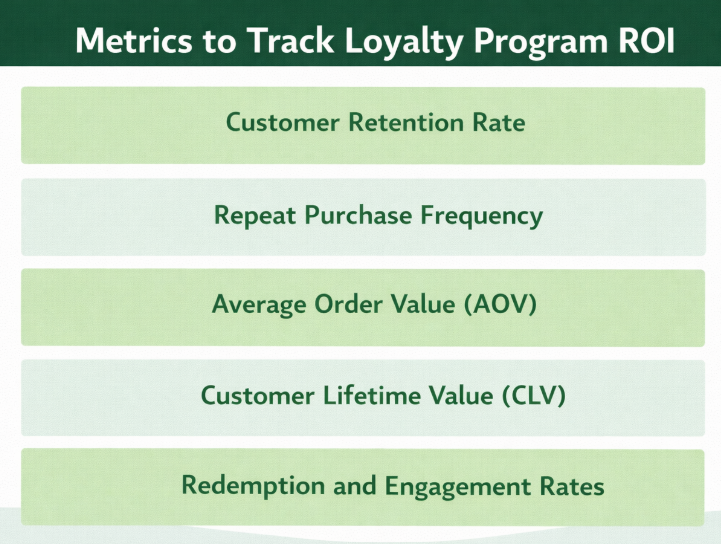
To accurately measure the ROI of your loyalty program, you need to move beyond vanity metrics and focus on the key metrics that truly reflect its impact on your bottom line. Tracking the right data is essential for understanding how your program influences the behavior of loyalty program members.
Here are the core KPIs you should be monitoring.
Customer retention rate (CRR) measures the percentage of customers your business keeps over a specific period, making it one of the clearest indicators of loyalty. A strong loyalty program should improve this metric by giving customers consistent reasons to return. When customers feel rewarded and valued, they are less likely to switch to competitors. Over time, a higher retention rate leads to more stable revenue and reduces dependency on new customer acquisition. This makes CRR a foundational metric for evaluating long-term program success.
Repeat purchase frequency tracks how often customers buy from your brand within a given timeframe. It directly reflects how well your loyalty program keeps your brand top of mind and encourages ongoing engagement. When customers are rewarded for returning, they naturally shorten the time between purchases. A higher frequency among loyalty members shows that your incentives are working effectively. This metric also helps you identify opportunities to further boost engagement through timely offers and reminders.
Average order value (AOV) measures how much customers spend per transaction and is a key driver of revenue growth. Loyalty programs often increase AOV by encouraging customers to spend more to unlock rewards or reach higher tiers. This behavior leads to larger cart sizes and more profitable transactions. Comparing AOV between members and non-members helps you clearly see the program’s financial impact. Even small increases in AOV can significantly improve overall profitability over time.
Customer lifetime value (CLV) represents the total revenue a customer generates throughout their relationship with your brand. Loyalty programs aim to increase CLV by boosting both purchase frequency and order value. When customers stay engaged for longer and spend more consistently, their overall value rises significantly. A higher CLV among members is a strong signal that your program is building meaningful, long-term relationships. This metric is crucial for understanding the true return on your loyalty investment.
Redemption and engagement rates indicate how actively customers participate in your loyalty program. A high redemption rate indicates that rewards are attractive and easy to use, while strong engagement shows ongoing member interest. On the other hand, low engagement can signal that the program needs better incentives or clearer communication. Tracking participation, active usage, and redemption patterns helps you understand what resonates with your audience. These insights allow you to refine and improve the overall program experience continuously.
Also Read: How to Build Expertise in Loyalty Segmentation?
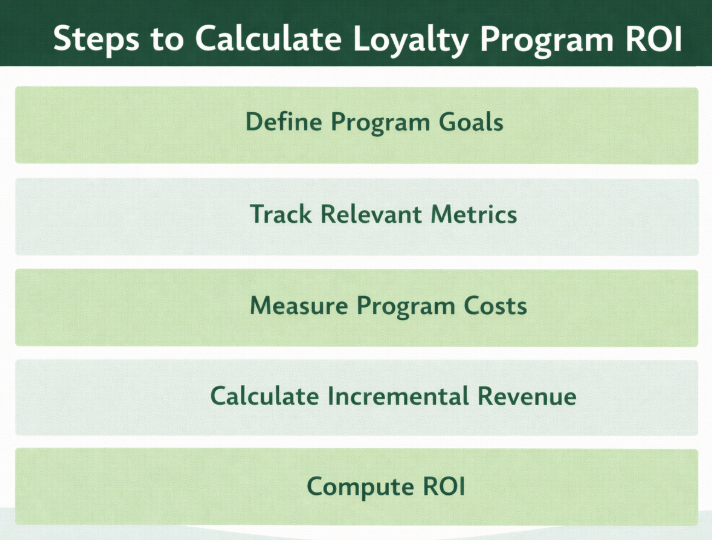
Calculating your loyalty program ROI doesn't have to be complicated. By following a proven method, you can arrive at a clear, defensible figure that demonstrates the program's value. The process involves quantifying the incremental profit generated by the program and comparing it to the total costs incurred.
The following steps outline a clear path to a successful ROI calculation for a loyalty program.
Before measuring ROI, it’s essential to define what success looks like for your loyalty program clearly. Setting specific goals such as increasing repeat purchases, improving retention, or boosting average order value helps align your program with overall business objectives. These goals serve as benchmarks for evaluating performance over time. Clear direction also makes it easier to design rewards and campaigns that drive desired behaviors. Without defined goals, it becomes difficult to measure real impact or justify investment.
Once your goals are in place, tracking the right metrics is crucial to understanding performance. Key indicators like retention rate, purchase frequency, AOV, and CLV provide insights into how your program influences customer behavior. Comparing these metrics between loyalty members and non-members helps isolate the program’s true impact. Consistent tracking ensures you have reliable data to base decisions on. This data-driven approach allows you to optimize and improve results continuously.
Accurately calculating ROI requires a complete understanding of all program-related costs. This includes direct expenses like rewards, discounts, and platform fees, as well as indirect costs such as marketing and team resources. Taking a comprehensive view ensures you don’t underestimate your investment. Clear cost tracking also helps in identifying areas where efficiency can be improved. Ultimately, knowing your total costs is essential for calculating true profitability.
Incremental revenue is the additional income generated specifically by your loyalty program. This is calculated by comparing the behavior of loyalty members with non-members to identify the uplift in spending and engagement. It helps separate organic revenue from program-driven revenue. Focusing on this difference gives you a more accurate picture of your program’s effectiveness. This step is critical because it directly links your loyalty efforts to financial outcomes.
After gathering all the necessary data, you can calculate ROI using the standard formula based on incremental profit and total costs. This final figure shows how much value your loyalty program is generating relative to your investment. A positive ROI confirms that your program is contributing to business growth and profitability. It also provides a clear, data-backed justification for scaling or improving your program. Regularly reviewing ROI ensures your strategy stays efficient and results-driven.
Also Read: Membership Rewards vs Other Loyalty Programs: Which Wins?
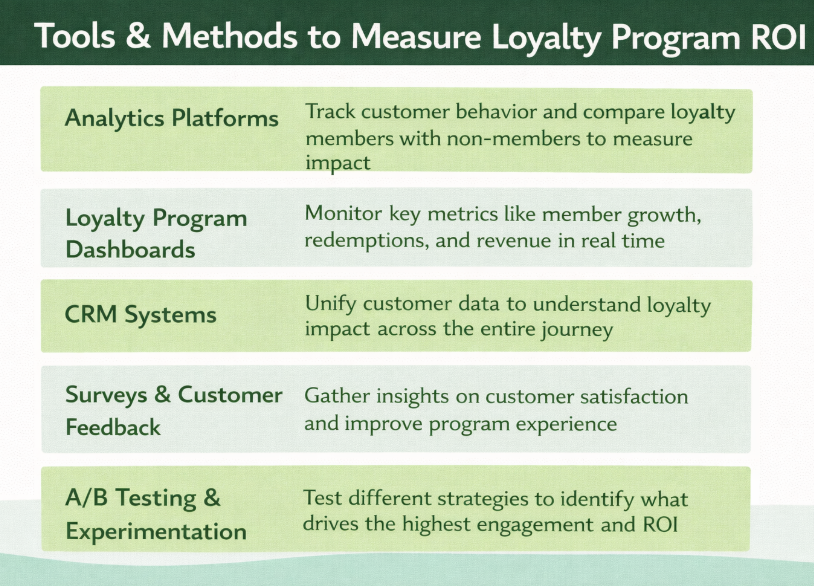
Measuring and tracking loyalty program ROI requires the right set of tools and methodologies. Relying on manual spreadsheets can be inefficient and error-prone. Modern loyalty software and analytics platforms provide the automation and clarity needed for accurate reporting.
Let's examine the most effective tools and methods available.
Analytics platforms like Google Analytics are powerful tools for tracking the broader impact of your loyalty program. By integrating your loyalty data, you can gain valuable insights into how members behave across your entire digital ecosystem.
These platforms allow you to create specific segments for your loyalty members. You can then compare their behavior, such as time on site, pages per visit, and conversion rates, to that of non-members. This provides a holistic view of engagement that goes beyond simple transaction data.
By tracking key metrics within these platforms, you can identify trends and patterns in your loyalty data that might not be apparent from your ecommerce platform alone. This deeper analysis helps you understand the full customer journey and make more strategic decisions to optimize your program.
Most modern loyalty software comes equipped with built-in loyalty program dashboards that provide a real-time overview of performance without the need to manually handle raw data. These dashboards bring all essential KPIs into one place, including member growth, redemption rates, points issued, and loyalty-attributed revenue, making it easier to track progress and identify trends quickly.
By regularly monitoring these insights, you can understand shifts in customer behavior, such as increases in average order value or spikes in redemptions after campaigns. Tools like Kefi Loyalty Program offer intuitive dashboards that simplify this process, helping you stay on top of performance and make faster, data-driven decisions for ongoing optimization.
Integrating your loyalty program with your Customer Relationship Management (CRM) system provides a unified view of every customer. CRM systems consolidate all touchpoints, from purchases and support tickets to loyalty program activity, into a single customer profile.
This integration allows you to see how your loyalty program impacts broader customer relationships. You can track the entire journey of your loyalty members to understand how their engagement with the program correlates with their overall satisfaction and long-term value to your business.
By leveraging the data in your CRM, you can create highly targeted marketing campaigns for specific segments of your loyalty members. For example, you can send a special offer to high-value members who haven't purchased in a while, strengthening customer engagement and driving repeat sales.
Quantitative data tells you what is happening, but qualitative customer feedback tells you why. Surveys and other feedback mechanisms are invaluable for understanding the customer experience and gauging customer satisfaction with your loyalty program.
Directly asking your loyalty program members about their experience can uncover insights that data alone cannot provide. You can learn what rewards they find most valuable, what parts of the program are confusing, and what changes they would like to see.
Consider using these methods to gather feedback:
This feedback is crucial for making improvements that enhance the customer experience and increase program engagement.
To truly optimize your loyalty program, you need to embrace experimentation. A/B testing allows you to test different elements of your program design on small segments of your audience to see what drives the best results before rolling out changes to everyone.
This data-driven approach takes the guesswork out of optimization. You can test various aspects of your program to understand their impact on customer behavior and ROI. This continuous improvement cycle ensures your program remains effective and engaging.
Some elements you can A/B test include:
Through consistent A/B testing, you can refine your program based on real data, maximizing its impact and profitability.
Also Read: How Lifetime Technologies went from a Single Additive to System Kits.

While measuring loyalty program ROI is crucial, it’s not without its challenges. Common hurdles like data silos and attribution gaps can make it difficult to get a clear picture of your program's true impact. These issues can obscure the real return on your loyalty program investment.
Let's explore these challenges in more detail.
One of the biggest challenges in measuring loyalty program ROI is accurately attributing customer actions to the program. Customers often interact with multiple channels before making a purchase, making it hard to pinpoint what truly influenced their decision. This issue is further complicated when data is scattered across different systems, such as ecommerce platforms, POS systems, and marketing tools. Without a unified view, tracking the complete customer journey becomes difficult. Integrating systems and centralizing data is essential to improve accuracy and close these attribution gaps.
Loyalty programs often deliver benefits that are not directly measurable, such as improved brand perception, customer satisfaction, and advocacy. While these factors significantly impact long-term growth, assigning them a clear monetary value can be challenging. Similarly, identifying true incremental sales requires distinguishing between organic purchases and those influenced by the program. Using control groups and comparing behavior between members and non-members can help estimate this impact. Even though difficult to quantify, these benefits should still be considered to complete the ROI picture.
Accurate ROI measurement depends on reliable data collection and proper tracking of customer activity. However, issues like incomplete data, duplicate profiles, or customers not being logged in during purchases can lead to gaps in tracking. These inconsistencies can distort key metrics and affect decision-making. Ensuring seamless member identification and maintaining unified customer profiles can help address these challenges. Regular data audits also play a crucial role in keeping your analysis accurate and trustworthy.
Measuring ROI accurately requires accounting for all costs associated with the loyalty program, which can be more complex than it seems. While direct costs like rewards and platform fees are easy to track, indirect costs such as team effort, marketing spend, and operational resources are often overlooked. Ignoring these can lead to an inflated perception of ROI. Properly tracking both direct and indirect expenses provides a more realistic understanding of your investment. This ensures better budgeting and more informed decision-making over time.
Also Read: How Squaties Scaled Order Volume via Performance Bundling.

Once you have a system for measuring loyalty program ROI, the next step is to optimize it. Maximizing your return involves refining your loyalty strategy to drive deeper customer engagement and encourage higher-value behaviors. A successful rewards program is one that continually evolves.
The following strategies provide a clear roadmap for boosting the profitability and effectiveness of your program.
Personalization is one of the most effective ways to maximize loyalty program ROI. By using customer data to tailor offers, rewards, and communications, you can create experiences that feel relevant and meaningful to each member. This makes customers feel valued and increases their likelihood of engaging with your program. Personalized incentives often lead to higher conversion rates and increased spending. Over time, this deeper engagement strengthens relationships and drives long-term profitability. It also helps reduce churn by keeping customers consistently interested in your brand. As personalization improves, so does the overall customer experience.
The structure of your rewards program plays a critical role in its success. Offering the right mix of rewards, from discounts to exclusive experiences, keeps members motivated and engaged. A well-designed program encourages customers to spend more and progress through different tiers. Regularly updating and refining your rewards ensures the program stays fresh and appealing. This continuous optimization helps maintain excitement and improve overall program performance. It also allows you to adapt to changing customer preferences over time. A flexible program design ensures long-term sustainability and relevance.
Referral incentives are a powerful way to turn loyal customers into brand advocates. By rewarding customers for referring friends or sharing your brand, you can drive new customer acquisition at a lower cost. Double-sided rewards, where both the referrer and new customer benefit, tend to be especially effective. This approach builds trust and encourages more participation. As advocacy grows, it expands your reach and contributes to higher ROI. It also brings in higher-quality customers who are more likely to engage and convert. Over time, this creates a strong network effect for your brand.
Data and analytics provide valuable insights into how your loyalty program is performing. By analyzing customer behavior, reward preferences, and engagement patterns, you can identify what works best and where improvements are needed. This allows you to make informed decisions rather than relying on assumptions. Continuous data-driven optimization helps you allocate resources more effectively. In the long run, this ensures your program remains efficient, relevant, and profitable. It also enables you to quickly identify trends and respond to changes in customer behavior. This ongoing refinement is key to maximizing long-term ROI.
Also Read: How Metalbird drove consistent growth across 8 stores.
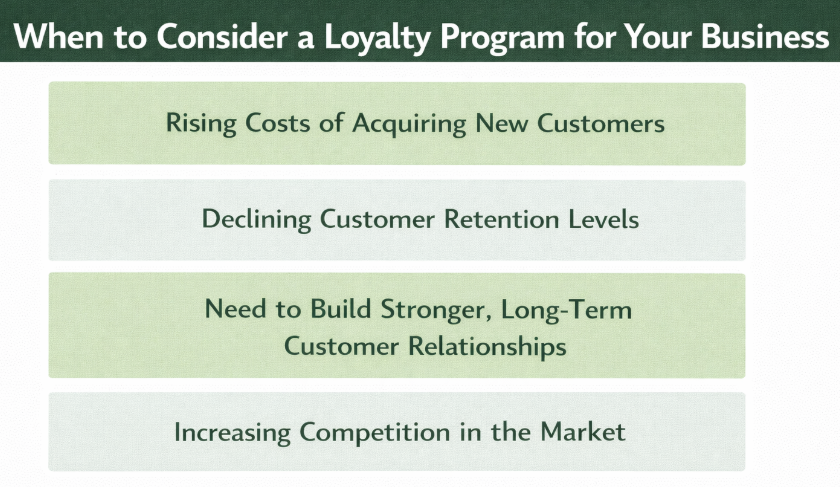
Deciding when to launch a rewards program is a strategic choice that depends on your specific business situation. It is not just about attracting new customers; it is about nurturing the ones you already have to drive sustainable business growth. If your business is facing certain challenges, a loyalty program might be the right solution. The goal is to shift focus toward building long-term relationships with repeat customers. The following sections will explore these specific scenarios in more detail.
When the cost of acquiring new customers continues to increase, it becomes difficult to sustain growth through acquisition alone. Relying heavily on paid marketing without strong repeat purchases can drain your budget quickly. This is when shifting focus to customer retention becomes important. A loyalty program helps you maximize value from existing customers by encouraging repeat purchases and building a more stable and cost-effective revenue stream.
If you notice that customers are not returning after their first purchase, it is a clear sign of declining retention. Frequent customer losses can impact long-term growth and reduce overall profitability. A loyalty program can help address this by giving customers a reason to come back through rewards and incentives. It also shows that you value their continued support, helping rebuild trust and improve long-term engagement.
When your business relies mainly on one-time transactions, it becomes harder to build lasting customer relationships. Building strong relationships requires more than just selling products; it involves creating meaningful interactions and experiences. A loyalty program helps strengthen these relationships by offering personalized rewards, exclusive perks, and a sense of belonging. This deeper connection encourages customers to stay loyal even when alternatives are available.
In a highly competitive market, standing out can be challenging when many businesses offer similar products or pricing. A loyalty program gives you an advantage by adding extra value beyond the purchase itself. Customers are more likely to choose a brand that rewards them for their loyalty with points, perks, or exclusive offers. This differentiation helps you retain customers, reduce price sensitivity, and stay competitive in the long run.
Also Read: How a Premier Portuguese Winery Cultivated a +16.80% AOV Lift.
To increase ROI, leveraging the Kefi Loyalty Program, VIP Tier effectively can make a significant difference. By enhancing VIP tier benefits with exclusive rewards and personalized experiences, you create stronger incentives for customers to engage and spend more. This not only improves retention but also encourages higher-value purchases over time.
With the Kefi Loyalty Program, VIP Tier, you can also use built-in analytics to identify high-value customers and tailor rewards that keep them coming back. Introducing milestone-based perks and early access to offers further motivates repeat purchases and deeper engagement. Clearly showcasing VIP benefits across your store helps customers understand the value of upgrading, driving more participation in higher tiers.
Additionally, experimenting with different reward structures within the Kefi Loyalty Program, VIP Tier can help you discover what resonates most with your audience. Tactics like bonus point campaigns or limited-time VIP perks create urgency and boost conversions. Regularly reviewing performance data ensures your program stays optimized, helping you consistently improve ROI and build a more predictable, long-term
Book a Demo to see how Kefi Loyalty Program, VIP Tier works.
In conclusion, maximizing your loyalty program ROI is essential for sustaining long-term business growth. By understanding the key metrics and challenges associated with measuring ROI, you can implement strategic actions to enhance customer retention, drive repeat purchases, and ultimately build brand advocacy. Emphasizing personalization, optimizing your rewards structure, and leveraging data analytics will not only improve engagement but also yield measurable results that positively impact your bottom line. As you work towards these goals, remember to continuously assess and adapt your approach based on customer feedback and behavior. For a deeper dive into enhancing your loyalty initiatives, consider exploring our Kefi Loyalty Program, which offers tailored solutions designed to amplify your success.
While initial engagement can be seen within weeks, a meaningful, positive ROI from a loyalty program typically takes six to twelve months to materialize. The full impact of a loyalty program on customer behavior and net profit requires time to collect enough data to measure long-term changes in retention and lifetime value from your loyalty program investment.
The biggest mistake is failing to isolate incremental revenue. Many businesses look at total member revenue, which inflates the loyalty program ROI. This is often caused by data silos and attribution gaps, which prevent an accurate assessment of the loyalty effort. Focusing on the uplift in key metrics against a control group is essential.
Common challenges in measuring loyalty program ROI include data silos, attribution gaps, and the accurate accounting of all program costs. Overcome them by integrating your systems to unify customer data, using control groups to isolate program impact, and working with finance to track all direct and indirect expenses.
B2B loyalty program ROI measurements focus on long-term partnerships and customer lifetime value, while B2C programs emphasize immediate purchases and engagement metrics. B2B calculations often involve complex contracts and negotiations, whereas B2C relies on straightforward transaction data for assessment.
To maximize ROI from your loyalty program, focus on data analytics to understand customer behavior, enhance engagement with personalized offers, and leverage tiered rewards to incentivize repeat purchases. Regularly review performance metrics to refine strategies and optimize member satisfaction for better returns.
Advanced analytics uses techniques such as predictive modeling, cohort analysis, and customer segmentation to evaluate the impact of loyalty programs on revenue and retention. It goes beyond basic metrics to uncover deeper insights into customer behavior and long-term value.
To calculate ROI, subtract the total cost of the loyalty program from the revenue generated through it, then divide by the total cost. This helps determine whether your program is delivering profitable returns or needs optimization.
Advanced analytics helps identify which program elements drive the most value, such as rewards, tiers, or campaigns. This allows businesses to make data-backed decisions, optimize spending, and improve customer engagement strategies.
Key sources include CRM data, transaction history, customer lifetime value metrics, and loyalty platform analytics. Combining these sources provides a complete view of how the program influences revenue and retention.
Start by tracking program costs, such as rewards and software, then measure incremental revenue from repeat purchases and higher order values. Finally, compare gains against costs to evaluate the program's overall performance.
.svg)
