
Are you struggling to decide between offering a discount and running a promotion? Many business owners grapple with this choice, uncertain which path best aligns with their marketing goals. While they might seem similar, discounts and promotions serve distinct purposes and have different impacts on customer loyalty and the perceived value of your products. Understanding these differences is crucial for developing a pricing strategy that not only drives sales but also supports your long-term business goals and strengthens your brand.
A discount is a direct price reduction on a product or service. This popular tactic provides immediate value to customers, motivating them to make a purchase sooner rather than later. The core of a discount strategy involves simple price reductions, such as a percentage discount (e.g., 20% off) or a fixed amount off (e.g., $10 off). This approach is highly effective for moving inventory, boosting short-term revenue, and attracting shoppers who are primarily motivated by price.
Discounts can be a permanent part of your pricing strategy or used periodically for events like clearance sales. Common types of discounts used by retailers include percentage-based markdowns, fixed-amount reductions, and special offers like "buy one, get one free" (BOGO). When used thoughtfully, discounts can increase brand awareness and attract new customers without significantly damaging your brand's long-term value.
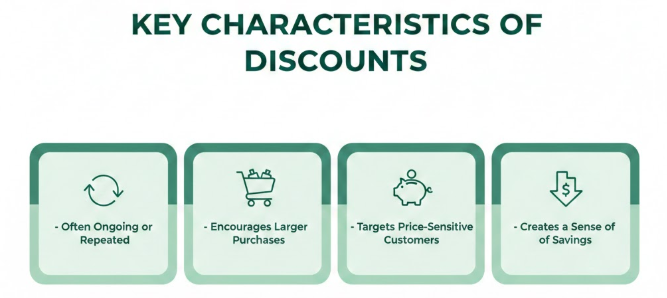
Discounts are defined by a few core traits that distinguish them from other types of deals. They are primarily focused on reducing the final price a customer pays, making them a simple and easily understood incentive. Let's explore the specific characteristics that make discounts a unique tool in your marketing arsenal.
A defining feature of many discount strategies is their recurring nature. Businesses may consistently offer deals such as 10% off for first-time buyers or special discounts for students. This repetition helps customers associate the brand with savings and value. However, frequent discounts should be managed carefully to avoid reducing the perceived value of products.
Many discount structures are specifically designed to incentivize customers to buy more in a single transaction. This is a powerful way to boost sales and increase each customer's average order value (AOV). Consider volume-based discounts, where the price per item decreases as the quantity purchased increases. A customer who intended to buy one item might be persuaded to buy three to unlock a better price, directly increasing your revenue from that sale.
Similarly, offering a discount for reaching a certain cart value, like "$20 off orders over $100," encourages shoppers to add more items to their cart. This strategy makes customers feel they are getting a better deal while helping you efficiently move more products and increase your bulk purchase numbers.
Discounts are exceptionally effective at attracting price-sensitive customers. These are shoppers who prioritize cost over other factors, such as brand name or premium features. For them, a lower price provides clear and immediate value. When you offer a discount, you send a direct signal to this demographic that your product is now within their budget or offers a better deal than competitors. This is a great way to capture a segment of the market that you might otherwise miss.
This approach is particularly useful for acquiring new customers. A compelling introductory discount can be the nudge someone needs to try your brand for the first time. By appealing directly to their desire for savings, you can convert hesitant shoppers into first-time buyers.
At their core, discounts work by creating a powerful psychological effect: the sense of savings. When customers see a price reduction, they feel like they are making a smart financial decision, almost as if they are gaining extra cash. This feeling isn't just about the final price; it's about the perceived gain. A simple price reduction from $50 to $40 feels like a $10 win for the shopper. This positive emotion can be a strong motivator for completing a purchase, especially for items they were already considering.
Simple price reductions are easy for customers to understand and appreciate. There are no complex rules or conditions. The straightforward nature of the price reduction reinforces this sense of savings, making the purchase feel both rewarding and justifiable.
Also Read: How to Master Shopify Multiple Discount Codes for Savings?
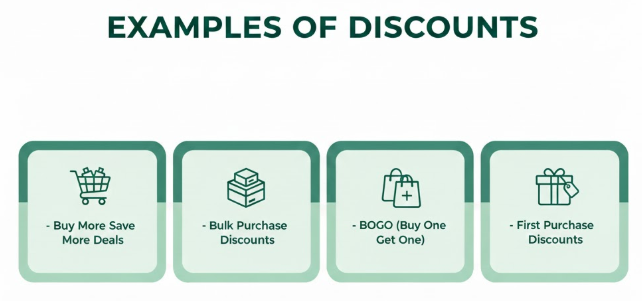
Discounts come in various forms, each designed to achieve a specific business objective. Beyond a simple percentage discount, there are structured deals that encourage specific buying behaviors, such as purchasing in larger quantities or trying a new brand. Let’s look at some of the most popular discount formats you can implement in your own business.
"Buy More, Save More" is a tiered discount strategy that directly rewards customers for purchasing in larger volumes. This popular tactic is among the most common types of discounts used by retailers because it effectively increases average order value (AOV).
The structure is simple: the more a customer buys, the greater the discount they receive. This incentivizes shoppers to add more items to their cart to unlock higher savings, a great way to introduce them to new products they might not have considered otherwise.
This approach can be structured in various ways to suit your goals:
Bulk discounts are designed to encourage customers to purchase a large quantity of a single item. This is different from "Buy More, Save More" deals, which often apply to different products across a store. Bulk discounts are valuable tools for moving a high volume of a specific product.
This strategy is particularly effective for consumable goods or products that customers use regularly. By offering a lower price per unit for a larger package, you incentivize shoppers to stock up, which increases your average order value and secures future sales.
Common examples of bulk discounts include:
Buy One, Get One (BOGO) is a highly popular form of sales promotion that feels like an incredible deal to customers. In a BOGO offer, a customer gets a second item for free or at a reduced price (like 50% off) after purchasing the first item at full price.
This tactic is excellent for a few reasons. It can rapidly clear out excess inventory, introduce new customers to your products, and increase the perceived value of a purchase. Shoppers are often more attracted to getting something for "free" than they are to a simple percentage discount of equivalent value.
BOGO deals can be structured in several ways:
A first-purchase discount is a special offer extended exclusively to new customers to incentivize their initial purchase. This is a classic tactic for converting visitors into buyers and is a great example of discount pricing aimed at customer acquisition.
The goal is to lower the barrier to entry for someone who may be hesitant to try your brand. By offering a discount on their first order, you give them a compelling reason to complete the purchase, which helps build brand awareness and expand your customer base.
Examples of first purchase discounts include:
Also Read: Mica: Painting Stories on Nursery Walls through Mix & Match Magic.
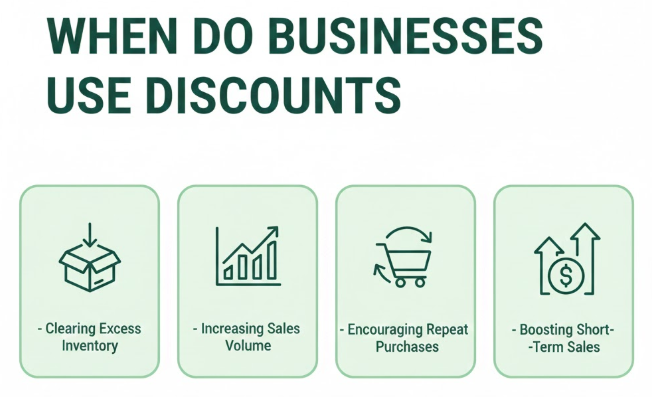
Businesses deploy discounts strategically to achieve specific goals that go beyond simply making a sale. While often used interchangeably with other sales promotion strategies, discounts are typically chosen for their direct and immediate impact on sales volume and inventory levels. Let's examine the primary scenarios where a discount becomes the most effective tool for the job.
One of the most common and practical uses for discounts is to clear out excess inventory. Holding onto old or seasonal stock costs money in storage and ties up capital that could be used to purchase new, in-demand products. A well-timed sales promotion focused on discounting this surplus stock can quickly turn those items into cash. Whether it's end-of-season apparel or products nearing their expiration date, a price reduction motivates customers to buy items that might otherwise go unsold.
While these sales may come with lower profit margins, they are often crucial for your bottom line. Clearing excess inventory frees up valuable warehouse space and improves cash flow, allowing you to invest in the next wave of products and keep your business moving forward.
When the primary objective is to increase sales volume quickly, discounts are an incredibly effective tool. Simple price reductions can provide the push needed to convert more browsers into buyers, leading to a significant lift in total units sold. This strategy is particularly useful for meeting sales targets or generating revenue during slower periods. A straightforward "20% off" or "$10 off" offer is easy for customers to understand and act on, making it a reliable way to boost sales.
While the profit per item is lower, the increase in total volume can lead to higher overall revenue. This approach is about playing the numbers game—selling more products at a slightly lower margin to achieve a higher total income.
Discounts can be valuable tools for fostering customer loyalty and encouraging repeat purchases. By offering exclusive discounts to existing customers, you show them that you appreciate their business and give them a reason to come back. These types of discounts are often part of a loyalty program or sent via email to a specific customer segment. For example, offering a special discount on a customer's birthday or after they've made a certain number of purchases makes them feel valued and recognized.
While the ultimate goal is to have customers who buy without needing an incentive, strategic discounts can help build the purchasing habit. They serve as a bridge to true brand loyalty, reinforcing a positive relationship until the customer's preference for your brand is firmly established. This aligns with business goals focused on lifetime customer value.
Sometimes, a business simply needs to boost sales in the short-term. This could be to meet a quarterly goal, generate immediate cash flow, or capitalize on a period of high consumer traffic. In these situations, a discount strategy is a go-to solution. An aggressive, time-limited discount can create a flurry of purchasing activity. This is because the offer provides a clear and immediate incentive to buy now rather than later. Shoppers who were on the fence are more likely to make a purchase when faced with a compelling, temporary price drop.
The focus here is on immediate results. While this approach may not build long-term loyalty on its own, it is highly effective for achieving a quick, measurable lift in revenue. It's a tactical move designed for a specific, short-term outcome.
Also Read: How Calitron Boosted Revenue and AOV with Smart Bundling.
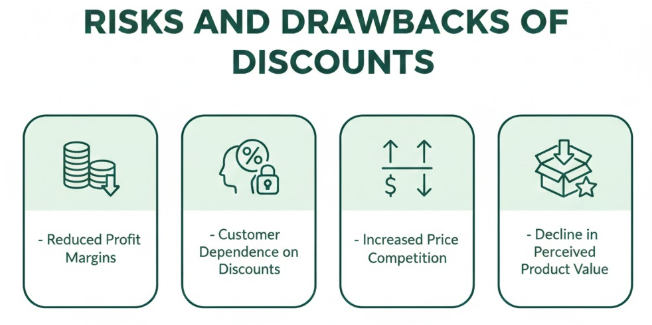
While discounts are effective, they are not without risks. Over-relying on price reductions can negatively impact your brand perception and train customers to devalue your products. Let's explore some of the key risks involved.
The most direct and obvious drawback of offering discounts is reduced profit margins. Every price reduction cuts directly into the profit you make on each sale. While the goal is often to make up for this with higher sales volume, that isn't always guaranteed. If a discount strategy is not carefully planned, it can lead to selling more but earning less. This is particularly dangerous for businesses with already thin margins. A 20% discount might seem manageable, but its impact on the bottom line can be significant.
It is essential to calculate the break-even point for any discount. You need to know exactly how much more you need to sell to justify the price reduction. Without this analysis, you risk sacrificing profitability for the sake of sales volume.
A significant risk of frequent discounting is creating a dependence on discounts among your customer base. When sales become a regular occurrence, shoppers learn to wait for them. Why buy a product at full price today if they know it will be 30% off next week? This behavior erodes true customer loyalty, replacing it with loyalty to the deal itself. These customers are not attached to your brand; they are attached to your prices. If a competitor offers a better discount, they will likely switch without a second thought.
To avoid this, your sales promotion plan should be strategic and varied. Use discounts sparingly and mix them with other value-adds that build a deeper connection with your brand, ensuring customers return for more than just a lower price.
When you rely heavily on discounts, you enter into a dangerous game of price competition. Your competitors will likely notice your strategy and may respond with their own discounts, triggering a "race to the bottom" where everyone continuously lowers prices to win customers. This cycle is damaging for all businesses involved. It squeezes profit margins across the board and shifts the focus from product quality and brand value to price alone. This phenomenon is common in various industries, from retail to software.
Instead of fighting solely on price, a better long-term strategy is to differentiate your brand in other ways. A well-executed sales promotion that highlights unique features, superior customer service, or added value can be more sustainable than simply being the cheapest option available.
Constant discounts can seriously harm your brand image and lower the perceived product value. Price is often used as an indicator of quality. If a product is always on sale, customers may begin to wonder whether it was ever worth the original price. This is especially true for premium or luxury brands, where a high price point is part of the appeal. A discount-heavy pricing strategy can cheapen the brand and alienate customers who are willing to pay for quality and exclusivity.
Protecting your perceived product value is crucial for long-term success. Your pricing should reflect the quality, craftsmanship, and innovation that go into your products. Use discounts as a strategic tool, not a crutch that undermines the very value you've worked to build.
Also Read: How The Chosen Cultivated a Community through Curated Merchandise Kits.
Promotions are a broader marketing strategy designed to stimulate interest and drive sales through special, often time-limited, campaigns. Unlike a simple discount that just reduces a price, promotions are events. They can include a variety of incentives, such as free gifts, contests, exclusive access, or bundled deals, and are typically built around a specific theme or goal. The main difference between discounts and promotions is that promotions are campaign-driven and create a sense of occasion, while discounts are often a more straightforward, ongoing price reduction.
Effective sales promotions are designed to grab attention, create urgency, and achieve specific marketing objectives beyond just moving products. They might be used to launch a new product, celebrate a holiday, or boost engagement during a slow period. Think of promotions as a planned narrative to excite your audience, rather than just a markdown on a price tag.
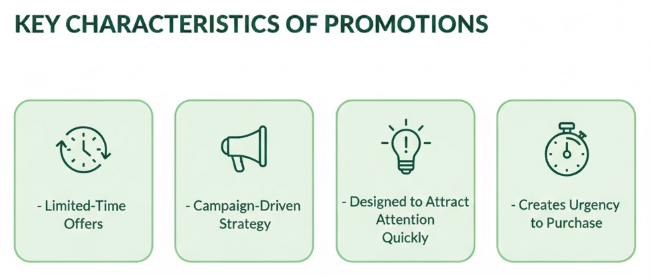
Promotions are distinguished from simple discounts by their strategic and event-based nature. The characteristics of promotions center on timing, narrative, and perceived exclusivity. We will now explore these defining traits in more detail.
A core characteristic of most promotions is that they are a limited-time offer. This scarcity is a powerful psychological trigger. By setting a clear end date for the special offer, you create a sense of urgency that encourages customers to act now rather than later.
This "fear of missing out" (FOMO) is a key driver of a promotion's success. Phrases like "This weekend only!" or "Sale ends at midnight" prompt immediate action from shoppers who might otherwise hesitate or forget about the purchase.
The temporary nature of the offer also makes it feel more special. It's not an everyday price; it's a unique opportunity. This exclusivity enhances the perceived value of the deal and makes the act of purchasing feel more exciting and rewarding.
Promotions are inherently a campaign-driven activity. They are not random markdowns; they are part of a larger, coordinated marketing effort with a specific theme and goal. This could be a holiday campaign, a new product launch, or a back-to-school sale. This campaign-based approach allows you to build a narrative around the promotion. You can use storytelling, themed visuals, and targeted messaging across multiple channels to generate excitement and anticipation. This makes the promotion an event that customers can look forward to.
Effective sales promotion strategies require careful planning and execution. From defining the target audience to choosing the right channels, every element of the campaign should work together to achieve the desired outcome. This is where comprehensive sales promotion solutions become invaluable for managing the complexity.
Promotions are crafted to be attention-grabbing. They use bold messaging, exciting offers, and a sense of eventfulness to cut through the noise and quickly capture consumers' interest. The goal is to make an immediate impact. Whether it's a flash sale with a ticking countdown timer or a "gift with purchase" offer, promotions are designed to be compelling. This ability to attract attention is crucial for boosting brand awareness and drawing new customers to your store.
Unlike a standard discount that might blend in, a promotion is meant to stand out. It provides immediate value in a way that feels exciting and new, which can be far more effective at generating buzz and driving traffic than a simple price cut.
The creation of urgency is perhaps the most powerful effect of a promotion. Both discounts and promotions affect consumer buying behavior, but promotions excel at compelling immediate action. By framing an offer as temporary or limited, you tap into the psychological principle that people value things more when they are scarce.
A countdown timer, a "limited stock" warning, or a "24-hour sale" message signals to the customer that they must act now or risk missing out. This urgency helps overcome purchase hesitation and reduces cart abandonment, as shoppers are motivated to complete their transaction before the opportunity disappears.
This isn't about devaluing your products; it's about framing their value within a specific timeframe. A well-executed sales promotion makes customers feel smart for capitalizing on a fleeting opportunity, reinforcing the positive feeling associated with their purchase.
Also Read: How Puur Scaled Average Order Value via Intelligent Accessory Pairing.
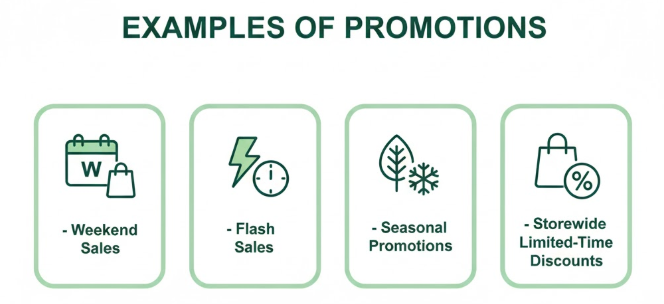
Promotions encompass a wide range of creative and strategic types of deals designed to generate excitement and drive specific actions. Unlike standard discounts, these are events with a clear beginning and end, often tied to a particular theme or time of year. Here are a few classic examples of promotions in action.
Weekend sales are a classic example of promotional pricing. This type of promotion concentrates a sales event into a short, high-traffic period—the weekend. By limiting the offer to just two or three days, you create a powerful sense of urgency. This strategy is effective for achieving short-term marketing goals, such as clearing specific inventory or boosting sales to meet a monthly target. Customers know they have a limited window to act, which encourages them to visit your store (online or physical) and make a purchase.
Common structures for weekend sales include:
A flash sale is an extreme form of a limited-time offer, often lasting only a few hours. This type of sales promotion is designed to create a massive surge of excitement and traffic in a very short period. The deep discounts and extremely short duration of a flash sale trigger a strong sense of urgency and FOMO (fear of missing out). This can be a highly effective way to clear out slow-moving stock, attract a flood of new email subscribers, and generate significant buzz on social media.
Key elements of a successful flash sale are:
Seasonal promotions are tied to specific times of the year, holidays, or events. These campaigns leverage the existing consumer mindset and increased purchasing intent associated with these periods. This is a strategic way to align your business goals with consumer behavior. From a Black Friday holiday campaign to a "Back to School" sale, seasonal promotions feel natural and expected by customers. They provide a perfect opportunity to theme your marketing efforts and create relevant, timely offers that resonate with your audience.
Examples of seasonal promotions include:
A storewide limited-time discount is a powerful type of promotion that applies a percentage discount to nearly everything in your store for a specific period. This creates a simple, compelling message that is easy for customers to understand and act upon. Unlike targeted discounts on specific items, a storewide promotion encourages customers to browse your entire catalog, potentially leading them to discover new products they might not have otherwise considered.
However, this type of promotion should be used sparingly. If used too often, it can damage your brand image and train customers to wait for these sales.
Also Read: How Minimal Home Redefined Interior Elegance through Strategic Upselling.
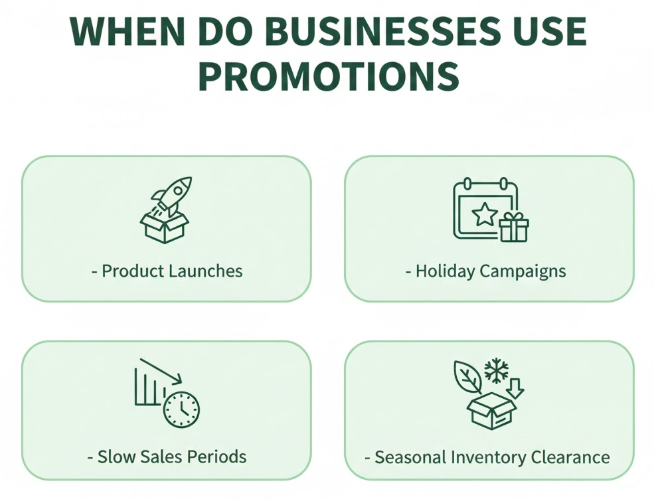
Businesses turn to promotions when they have specific goals that go beyond a simple sales lift. Promotions are the tool of choice for creating buzz, launching products, and capitalizing on consumer behavior during key moments. Let's look at the key scenarios where a planned promotion is the ideal strategic choice.
A product launch is a critical moment for any business, and promotions are essential for making it a success. The primary goal during a launch is to generate awareness and attract attention quickly, and a special introductory promotion is the perfect way to do it. An offer like a limited-time introductory price, a free gift with the new product, or a bundle deal can create the excitement needed to drive those crucial first sales.
The marketing goals for a launch are clear: get the product into customers' hands and start building a sales history. A well-designed launch promotion provides a compelling reason for customers to be early adopters, overcoming the hesitation that often comes with trying something new.
Holidays are prime time for retail, and a well-executed holiday campaign is crucial for capitalizing on the surge in consumer spending. During periods like Black Friday, Christmas, or Valentine's Day, customers are actively looking for deals and gift ideas. Effective sales promotions during these times can significantly boost revenue and brand awareness. Promotions can be themed around the holiday, offering special bundles, gift guides, or deals that make shopping easier and more appealing for customers.
A holiday campaign is more than just a sale; it's an opportunity to connect with customers on an emotional level and become part of their holiday traditions. By creating timely and relevant offers, you can capture a larger share of the holiday market.
Every business experiences a slow sales period. These lulls in activity can drain resources and morale. A timely promotion is a proactive way to combat this dip and boost sales when you need it most. During these times, a promotion can reignite customer interest and drive traffic to your store. A flash sale, a special offer for loyalty members, or a "mid-season" sale can create a reason for customers to shop when they otherwise wouldn't.
This is a strategic adjustment to your pricing strategy, designed to stimulate demand during off-peak times. Instead of passively waiting for sales to pick back up, a well-planned promotion can help you generate revenue and maintain momentum throughout the year.
While simple discounts can be used to clear excess inventory, a promotional event is often more effective for large-scale seasonal clearance. An "End-of-Season Sale" or "Summer Blowout" promotion turns the clearance process into an exciting event. This approach is one of the most successful sales promotion strategies for moving a large volume of seasonal stock quickly. By framing it as a limited-time event, you create urgency and attract bargain hunters who are eager to find great deals.
This helps you avoid the costs of storing out-of-season items and frees up cash and space for new inventory. A clearance promotion is a strategic way to manage the product lifecycle and maintain a fresh and relevant product offering for your customers.
Also Read: How SportsStop Dominated the Diamond and Field with High-Velocity Bundling.
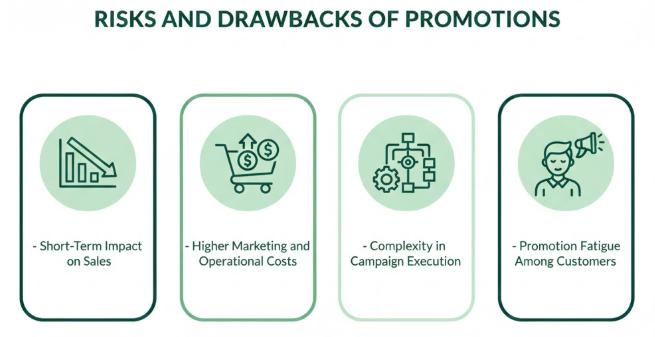
Despite their benefits, promotions carry their own set of risks. Poorly planned campaigns can lead to high operational costs and logistical headaches. If promotions are run too frequently, customers can experience "promotion fatigue," which can diminish the impact of your offers. Let's examine some of the key risks in more detail.
A primary drawback of promotions is that their impact can be overwhelmingly focused on short-term sales. While they are excellent at creating a temporary spike in revenue, they don't always translate into long-term customer loyalty or sustained growth. Customers who are attracted by a deep, one-time promotional offer may not return to purchase at full price. Their loyalty is to the deal itself, not to your brand.
Therefore, if your business goals are centered on building a loyal customer base, relying solely on promotions can be counterproductive. They should be used as part of a broader strategy that also focuses on product quality, customer service, and building lasting relationships.
Running a successful promotion involves more than just marking down a price. There are significant marketing and operational costs associated with planning, launching, and managing a campaign. This can include advertising spend, graphic design, email marketing efforts, and social media management. A complex promotion might also require a dedicated team of experts to manage the logistics and customer service inquiries.
These costs need to be factored into your marketing goals and budget. A promotion might look successful on the surface due to high sales, but if the associated costs are too high, it may not be profitable in the end.
The effectiveness of a promotion hinges on a smooth campaign execution, which can be surprisingly complex. A successful sales promotion plan has many moving parts, from setting up the offer correctly on your website to coordinating marketing messages across different channels. Any execution mistakes, such as a broken coupon code or unclear terms and conditions, can lead to customer frustration and damage brand reputation.
To manage this complexity, it is crucial to leverage technology. Modern ecommerce platforms and specialized apps can automate many aspects of a promotion, from scheduling start and end times to applying discounts correctly at checkout. This helps ensure a seamless experience for both you and your customers.
When a brand runs promotions too frequently, customers can develop "promotion fatigue." The constant barrage of "limited-time offers" and "once-in-a-lifetime deals" starts to lose its meaning and impact. The sense of urgency and exclusivity is diminished. This can lead to a decline in engagement, as customers begin to ignore your marketing messages.
To maintain the effectiveness of your promotions, they should be strategic and spaced out. This preserves their specialness and ensures that when you do run a promotion, it captures your customers' attention and drives the desired action, helping to build rather than erode customer loyalty.
Also Read: How Squaties Scaled Order Volume via Performance Bundling.
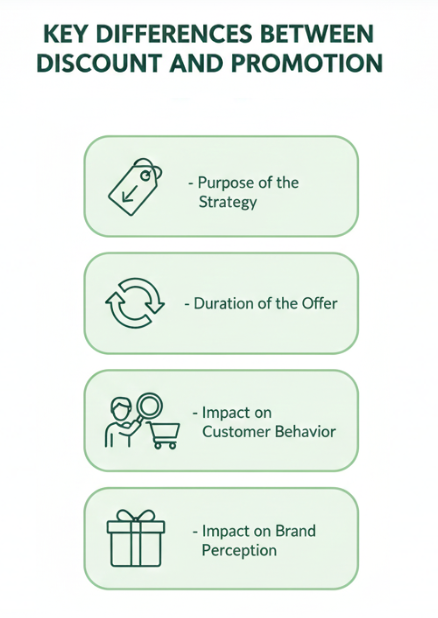
The main difference between a discount and a promotion lies in their scope and purpose. A discount is a straightforward price reduction, often part of an ongoing discount strategy to attract price-sensitive buyers. Understanding these nuances allows you to choose the right tool for your objective, whether it's clearing inventory or launching a new product.
The fundamental difference between discounts and promotions begins with their purpose. A discount strategy is typically tactical, with the specific goal of driving immediate sales or clearing inventory. It's a direct lever to pull when you need to increase sales volume or convert a price-sensitive customer.
Promotions, on the other hand, serve broader, more strategic business goals. A promotion might be designed to build brand awareness, launch a new product line, drive traffic during a key season, or reward loyal customers. The price incentive is just one part of a larger campaign.
Your choice between the two should be guided by your specific goals. If your objective is simply to sell more of a certain item quickly, a discount may suffice. If you want to create an event, generate buzz, and build a narrative around your brand, a promotion is a more appropriate tool for your pricing strategy.
The offer's duration is another key differentiator. Discounts, particularly things like volume discounts or first-time buyer offers, can be ongoing. They can become a permanent or semi-permanent part of your pricing structure, available to customers indefinitely.
Promotions are, by definition, short-term. Their power comes from their temporary nature. The offer duration is a critical component of the strategy, creating the urgency that drives customers to act. A promotion has a clear start and end date, whether it's a 24-hour flash sale or a week-long holiday event.
This difference in offer duration shapes customer expectations. With ongoing offers, customers learn that the value is always there. With short-term promotions, they learn that they must act quickly to take advantage of the opportunity, which drives a different kind of purchasing behavior.
Discounts and promotions influence customer behavior in distinct ways. Discounts appeal to the rational side of a shopper, providing clear, immediate value. They attract customers who are methodical in their search for the best price and can foster customer loyalty among those who consistently seek value.
Promotions, however, tap into the emotional side of purchasing. The urgency and excitement of a limited-time event trigger impulsive behavior. This is how discounts and promotions affect consumer buying behavior differently: one encourages calculated savings, while the other prompts spontaneous action.
A customer might wait patiently for a product to go on discount, but a flash promotion can make them buy a product they weren't even considering a moment before. Understanding this distinction is key to predicting how your customers will respond and choosing the strategy that best aligns with your desired outcome.
The way you use discounts and promotions has a profound impact on your brand perception. One of the main drawbacks of overusing discounts is that it can devalue your products and cheapen your brand image. If items are constantly on sale, customers may perceive the full price as artificial and the product quality as lower.
Promotions, when used strategically, can actually enhance your brand image. A well-executed, exciting promotion can make your brand feel dynamic and generous. Because they are temporary events, they don't permanently alter the perceived value of your products, unlike constant discounts.
The benefits of both are clear: increased sales and customer acquisition. However, the risk to your brand is a critical consideration. A thoughtful balance is key. Use promotions to create excitement, and use discounts sparingly to achieve specific tactical goals, all while protecting the long-term value of your brand.
Also Read: How Lifetime Technologies went from a Single Additive to System Kits.
Instead of choosing between discounts and promotions, the most successful sales promotion strategies often combine them. This hybrid approach allows you to leverage the strengths of both, creating a powerful and flexible sales promotion plan. For example, you can create a promotion (a limited-time event) that features a special discount (a price reduction). A "Weekend Flash Sale" offering "30% off all winter coats" is a perfect example of this synergy. You get the urgency of the promotion combined with the clear value of the discount.
This layered approach can be highly effective in boosting sales. Are discounts or promotions more effective for increasing sales? The answer is often "both, together." You could run a holiday promotion with a tiered discount structure, such as "Buy 2, Get 15% off; Buy 3, Get 25% off." This encourages larger purchases within the urgent timeframe of the promotional event. By blending the two, you can target different customer motivations simultaneously and achieve more complex business goals.
Also Read: How Metalbird drove consistent growth across 8 stores.
Shopify stores can leverage the Kefi Product Bundle Builder to create tailored bundles that include discounts and promotions. This strategy enhances perceived value, encourages larger purchases, and fosters customer loyalty through unique offers that resonate with shoppers' preferences.
With Kefi, merchants can easily create bundle deals, mix and match product offers, and offer volume discounts without complex setup. The app allows businesses to design customizable bundles that encourage customers to add more products to their cart. Shopify stores can also run limited-time promotional bundles, helping create urgency while increasing average order value. By combining flexible discount rules with bundle promotions, Kefi enables merchants to run more effective sales strategies and drive higher conversions.
Book a Demo to see how Kefi Product Bundle Builder works.
Understanding the dynamics between discounts and promotions is crucial for any business aiming to cultivate customer loyalty. While discounts often target price-sensitive consumers and drive immediate sales, promotions create excitement and urgency that can attract new customers and enhance brand visibility. By recognizing when and how to implement each strategy, businesses can navigate the fine line between boosting short-term sales and maintaining long-term profitability. Ultimately, a well-balanced approach that leverages both discounts and promotions can lead to sustainable growth and a loyal customer base. To explore how you can effectively combine these strategies in your own business, consider booking a free consultation with our experts today.
Discounts focus on lowering the price of the product to encourage purchases, while promotions use broader marketing tactics, such as bundles, free gifts, or limited-time campaigns. Businesses often combine both approaches to attract customers and increase conversions.
A discount promo combines a price reduction with a promotional campaign to attract attention and drive quick purchases. Ecommerce stores often use tools like Kefi to create bundle deals or limited-time offers that increase average order value.
Using both discounts and promotions allows businesses to balance pricing strategies and marketing campaigns. Platforms like Kefi help merchants create structured offers such as product bundles, tiered deals, and promotional campaigns to increase sales.
A discount is a direct price reduction offered to customers, while a promotion is a broader marketing strategy designed to encourage purchases. Promotions can include discounts, but they may also involve bundles, loyalty rewards, or limited-time offers.
Enterprise-level promotions and discounts help large retailers manage complex campaigns, seasonal offers, and bulk purchase incentives. Advanced promotion tools like Kefi allow businesses to create scalable bundle offers and automated promotions.
A discount can be part of a promotion, but the two are not identical. Promotions are broader marketing campaigns that may include discounts, bundles, or special incentives to encourage purchases.
Promotions and discounts create a sense of urgency and perceived value for shoppers. This motivates customers to complete purchases more quickly and sometimes to add more items to their cart.
A promotional discount combines a price reduction with a marketing campaign, usually for a limited time. This strategy helps attract attention, create urgency, and drive more conversions during special events or seasonal sales.
Promo pricing temporarily reduces product prices to attract customers and encourage faster purchase decisions. Ecommerce stores can also pair promo pricing with bundle offers using tools like Kefi to increase both conversions and average order value.
.svg)
