
If you're running an e-commerce store, you've probably faced this situation before. A customer adds one item to their cart, checks out, and leaves. Meanwhile, you're spending more on ads, email campaigns, and customer acquisition, making every order feel more expensive to win.
That's why many brands look for ways to encourage larger purchases without constantly running sitewide sales. One of the most effective approaches is offering a volume discount. When customers see that buying more unlocks better value, they're often willing to add extra items to their order. It feels like a win for them, and it can help you generate more revenue from the same customer.
Of course, volume discounts only work when they're structured properly. Discounts that are too aggressive can hurt profitability, while confusing pricing tiers can discourage customers from buying more in the first place.
In this guide, we'll break down how volume discounts work, explore the most common pricing models, look at real ecommerce examples, and show you how to create profitable volume discount campaigns for your Shopify store.
A volume discount is a pricing strategy that rewards customers for purchasing larger quantities by reducing the price per unit. The more units a customer buys, the lower the effective cost of each item. This approach is commonly used by e-commerce brands, wholesalers, retailers, and SaaS businesses to encourage larger orders.
Volume discounts can take several forms, including tiered pricing, buy more, save more offers, quantity breaks, and customer-specific pricing. Rather than lowering prices for everyone, businesses offer additional savings only when customers reach specific purchase thresholds. This helps create value for customers while giving merchants more control over pricing and profitability.
Volume discounts work because they create a clear exchange of value. Customers receive a better deal when they buy more, while businesses increase revenue from each transaction. Unlike blanket discounts, volume-based pricing encourages customers to change their buying behavior rather than simply paying less.
Customers naturally compare the value they receive at different purchase levels. When additional savings become available after adding one or two more units, buying more often feels like the smarter financial decision.
Volume discounts work particularly well for products customers already expect to repurchase, such as supplements, skincare, coffee, pet products, and household essentials. Customers buy larger quantities upfront to save money and avoid reordering sooner.
Brands can use volume discounts to accelerate the sale of seasonal products, excess inventory, or slow-moving stock. Larger orders reduce inventory holding costs while improving warehouse efficiency and cash flow.
When customers consistently receive value from larger purchases, they are more likely to return. This is especially true for replenishable products where quantity-based savings can become part of the customer's regular purchasing habit.
Acquiring new customers is often expensive. Volume discounts help merchants generate more revenue from existing visitors by encouraging higher-value transactions, making them one of the most efficient ways to grow sales without increasing marketing spend.
The most successful volume discount campaigns are built around customer buying behaviour. When the offer feels relevant and the savings are easy to understand, businesses can increase order value, improve inventory efficiency, and create a stronger customer experience simultaneously.
Not all volume discounts serve the same purpose. Some are designed to increase average order value, while others help clear inventory, improve retention, or encourage larger purchases. Choosing the right volume pricing model depends on your business goals, product type, customer behavior, and profit margins.
Tiered volume pricing increases discounts as customers purchase more units. For example, customers may receive 10% off when buying three items and 20% off when buying five.
Best for: Increasing average order value (AOV)
This model motivates customers to reach the next discount tier, making it one of the most effective strategies for consumables, beauty products, supplements, and household essentials.
Buy more, save more pricing offers progressively larger savings as customers add more items to their cart. The discount structure is easy to understand and clearly communicates the value of purchasing additional quantities.
Best for: Encouraging larger purchases
Many Shopify brands use this model because it increases cart value while maintaining a straightforward shopping experience.
Fixed quantity discounts reward customers for reaching a specific purchase threshold. For example, buying four products may unlock a fixed $20 discount.
Best for: Clearing inventory
This approach helps move slow-selling products, seasonal inventory, or excess stock while keeping promotions simple and easy to understand.
Category-based volume discounts apply when customers purchase multiple products from the same collection or category. For example, a skincare brand may offer savings when customers buy any three products from its cleanser or moisturiser range.
Best for: Cross-selling and product discovery
This model encourages customers to explore related products while increasing basket size and exposure to a broader product range.
Customer segment pricing offers quantity-based discounts to specific groups such as wholesale buyers, VIP customers, loyalty members, or subscribers.
Best for: Customer retention and wholesale growth
By offering personalized pricing to selected customer groups, businesses can strengthen loyalty while protecting margins across the wider customer base.
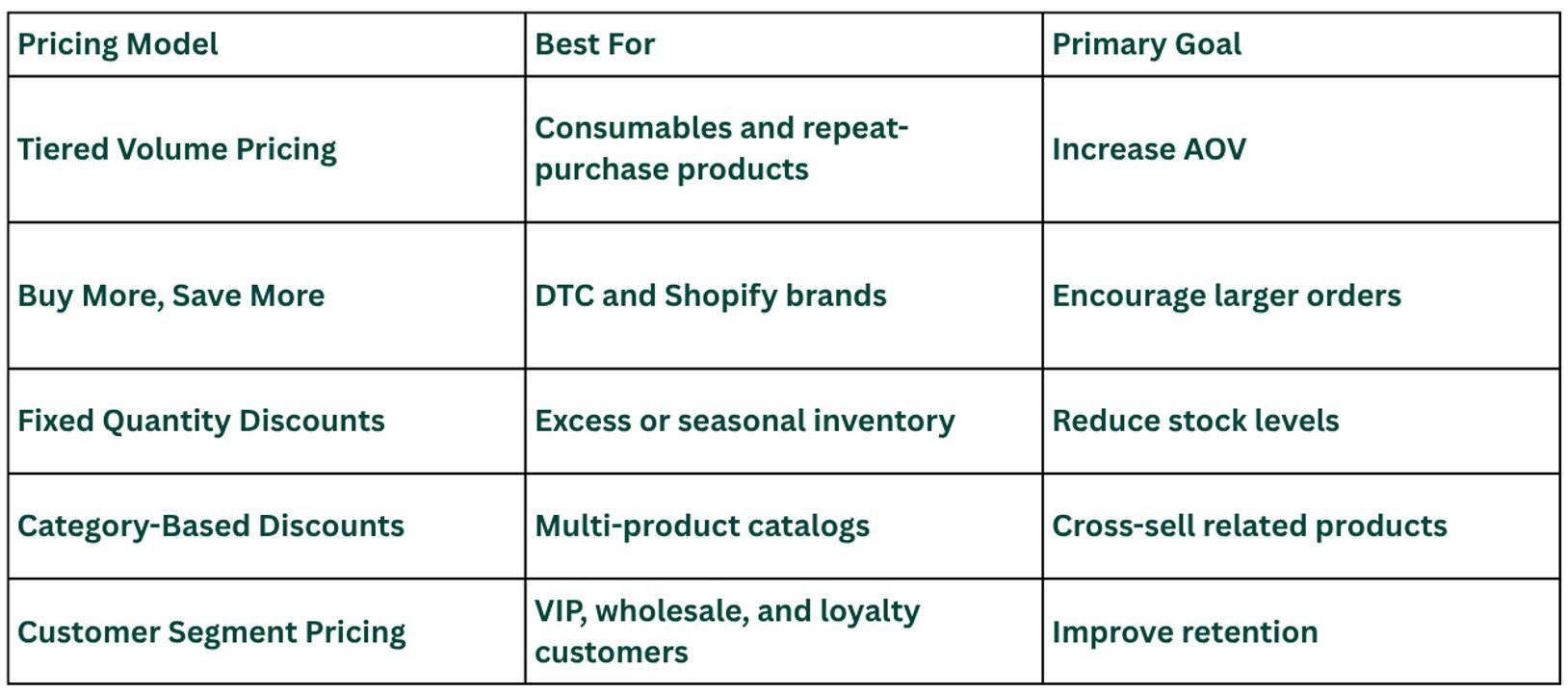
The most effective volume discount strategy starts with a clear objective. Whether your goal is increasing average order value, improving retention, moving inventory, or encouraging larger purchases, choosing the right pricing model will have a far greater impact than simply offering bigger discounts.
A volume discount pricing formula determines how much customers save when they purchase larger quantities. The goal is not simply to lower prices but to increase order value while preserving profitability. Small adjustments in discount structure can significantly impact revenue and margins.
A simple volume discount pricing formula calculates the discounted selling price based on quantity thresholds.
Formula:
Discounted Price = Original Price × (1 − Discount Percentage)
For example, if a product costs $50 and the volume discount is 15%, the discounted price becomes $42.50 per unit. Merchants can apply different discount percentages at different quantity levels to encourage larger purchases.
Consider a product priced at $100 per unit with the following discount structure:
If a customer purchases six units, the discounted price becomes $90 per unit.
Calculation:
This pricing approach rewards larger purchases while maintaining a clear discount structure.
Before launching any volume discount, calculate how much profit remains after the discount is applied.
Example:
If a product sells for $100 and has a 50% gross margin, the cost of goods sold is $50. Offering a 30% volume discount reduces the selling price to $70, leaving $20 in contribution margin.
A margin safety check helps ensure that increased sales volume does not come at the expense of profitability.
The best discounts encourage customers to spend more without reducing profits unnecessarily. A small discount that drives a significant increase in quantity purchased often performs better than a large discount that erodes margins.
Testing different discount tiers can help identify the balance between customer motivation and business profitability.
Many businesses make avoidable pricing mistakes when creating discount structures, including:
Avoiding these mistakes can help merchants build sustainable discount programs that support growth.
An effective volume discount pricing formula combines accurate calculations with profit protection. The strongest offers motivate customers to buy more while preserving contribution margin, creating a pricing strategy that supports both short-term revenue gains and long-term business growth.
Not every customer needs a volume discount. These offers deliver the strongest results when buying behavior is already predictable and recurring. Businesses that target frequent purchasers can increase order value, improve retention, and generate more revenue without constantly acquiring new customers.
Volume discounts for frequent users work best when customers purchase the same product regularly. Items such as supplements, skincare products, pet supplies, and household essentials naturally lend themselves to larger orders because buyers know they will need replacements in the future.
Products that require regular replenishment are ideal for quantity-based discounts. Customers can save money by purchasing multiple units upfront, while merchants benefit from higher order values, reduced reorder frequency, and more predictable revenue from recurring purchasing patterns.
Business customers often purchase products in larger quantities than individual consumers. Offering volume discounts to B2B and wholesale buyers can encourage bigger orders, strengthen account relationships, improve customer retention, and create a competitive advantage in price-sensitive markets.
Loyalty members have already demonstrated trust in your brand, making them strong candidates for exclusive volume discounts. Rewarding repeat customers with quantity-based savings can increase engagement, encourage larger purchases, and reinforce the value of remaining active in your program.
Want customers to keep coming back? Discover how Kefi Commerce helps you build loyalty programs that reward repeat purchases and increase lifetime value.
VIP customers typically contribute a disproportionate share of revenue. Offering personalized volume discounts to these high-value shoppers can strengthen loyalty, increase customer lifetime value, and encourage larger purchases without extending the same discounts to the entire customer base.
The best volume discounts for frequent users are offered when customers already have a reason to buy repeatedly. Aligning discounts with established purchasing behavior helps increase revenue, protect margins, and strengthen long-term customer relationships through value-driven incentives.
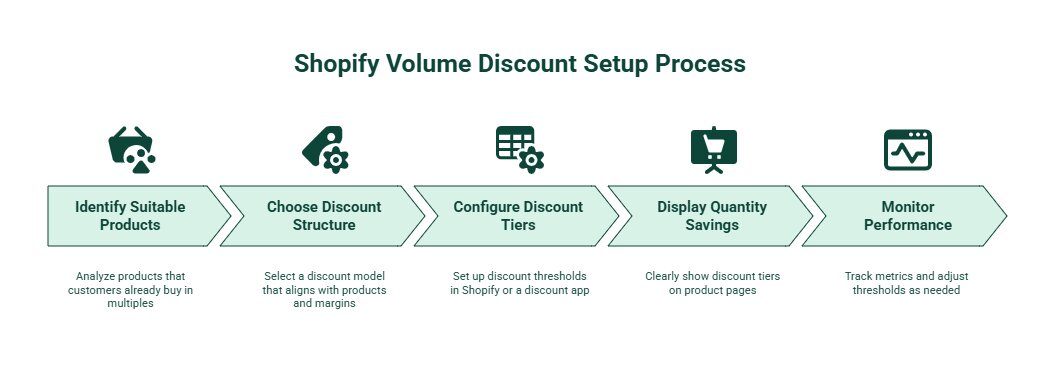
Successful Shopify volume discounts depend as much on implementation as pricing. Even a well-designed offer can underperform if discount tiers are confusing or difficult to find. Clear setup, visibility, and ongoing optimization are what turn discounts into measurable revenue drivers.
Start by analyzing products that customers already purchase in multiple quantities. Consumables, replenishment products, low-cost accessories, and frequently reordered items often perform best. Reviewing order history can reveal natural purchasing patterns that make volume discounts feel valuable rather than forced.
Select a discount model that aligns with your products and margins. Common options include percentage discounts, fixed dollar discounts, and buy more, save more offers. The right structure should encourage larger purchases while protecting profitability and maintaining pricing consistency.
Set up discount thresholds that motivate customers to increase purchase quantities. While Shopify provides basic discount capabilities, many merchants use dedicated apps to create advanced tiered pricing, automate offers, and manage multiple volume discount campaigns efficiently.
Customers should immediately understand how much they can save. Display discount tiers directly on product pages, collection pages, or near the add-to-cart button. Clear messaging reduces friction, improves offer visibility, and increases the likelihood of larger purchases.
Track metrics such as average order value, conversion rate, units per order, and profit margin. If customers rarely reach a discount tier, consider adjusting thresholds. Regular optimization helps ensure volume discounts continue supporting both revenue growth and profitability.
Effective Shopify volume discounts combine customer insights, strategic pricing, and clear communication. Merchants that continuously test and refine discount thresholds are more likely to increase order value, improve conversion rates, and achieve sustainable ecommerce growth.
Email marketing gives merchants a direct way to explain volume discounts and highlight potential savings. Unlike on-site promotions that rely on discovery, emails can proactively encourage larger purchases, making them particularly effective for repeat customers and quantity-based offers.
Email marketing becomes more effective when volume discounts are matched to customer behavior and purchase timing. Targeted campaigns help shoppers recognize value faster, increasing engagement, order sizes, and repeat purchases without relying solely on broad promotional discounts.
Curious about the cost of running volume discount campaigns? Explore Kefi Commerce pricing and find the right plan for your Shopify store.
Volume discounts and bundle discounts can both increase revenue, but they influence customer behavior differently. Volume discounts encourage shoppers to buy more of the same product, while bundles increase order value by combining related products into a single purchase incentive.
The primary difference lies in what customers are encouraged to buy. Volume discounts reward higher quantities of the same product through tiered savings, while bundles combine multiple products at a discounted price. Volume offers focus on quantity growth, whereas bundles focus on product mix expansion.
Volume discounts typically perform better for consumables, replenishment products, and items customers purchase repeatedly. When shoppers already know what they want, offering lower prices for larger quantities can increase average order value without requiring additional product discovery or cross-selling efforts.
Product bundles work best when products naturally complement one another. They can introduce customers to additional items, increase perceived value, and boost cross-selling opportunities. Bundles are particularly effective for beauty, wellness, electronics, and gift-oriented product categories.
Many successful e-commerce brands use both approaches together. For example, a brand may offer a bundle of related products while also providing a volume discount when customers purchase multiple bundles. This strategy can maximise order value while giving customers more ways to save.
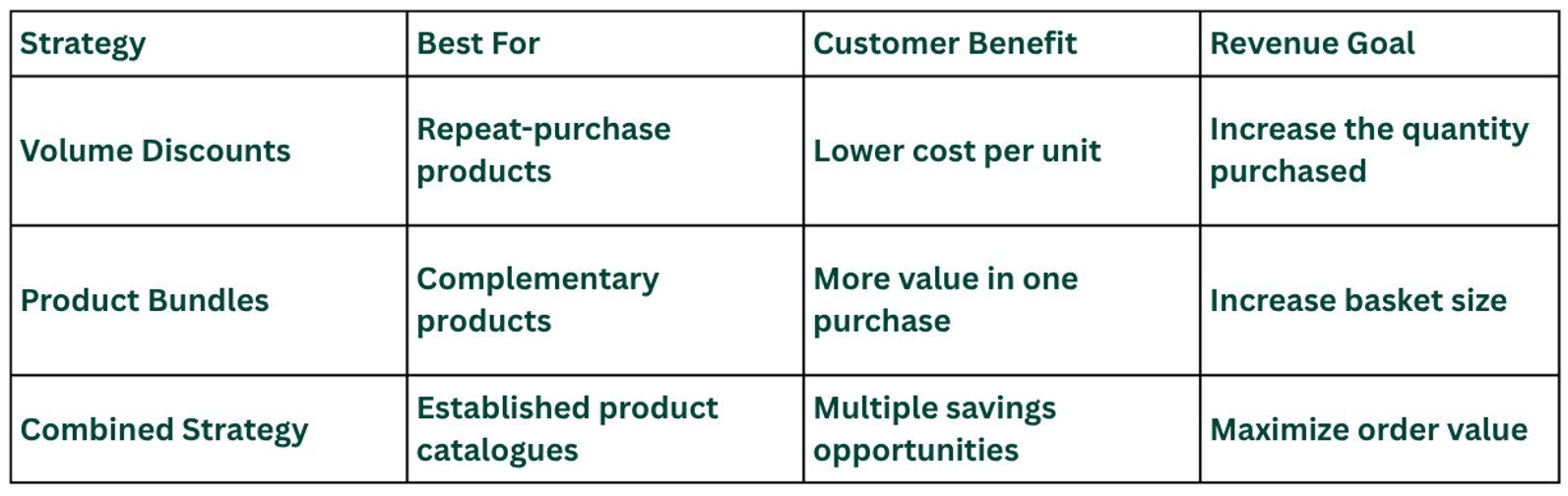
The highest-revenue strategy often depends on customer buying behavior rather than the discount itself. Brands that align volume discounts and bundles with purchasing intent can increase order value, improve conversion rates, and generate stronger long-term profitability.
Want to increase AOV with product bundles? See how Kefi Commerce helps Shopify stores create high-converting bundle offers.
Zalunas, a wellness and personal care brand, implemented Kefi Commerce's Buy More Save More offers across nine best-selling products. Customers received larger discounts as they purchased more units, encouraging stock-up purchases on products they used regularly.
Results:
This example shows that effective volume discounts do not require deep markdowns. When aligned with customer buying habits, they can increase order value while supporting long-term revenue growth.
Want to launch volume discounts without relying on multiple apps? Book a demo with Kefi Commerce to create Buy More Save More campaigns, quantity breaks, bundles, and other high-converting promotions from one platform.
The best volume pricing options for businesses in 2026 depend on business model, customer behavior, and profit margins. As acquisition costs continue to rise, more companies are using volume pricing to increase customer value, improve retention, and generate sustainable revenue growth.
Small ecommerce businesses often benefit from simple buy more, save more offers. Easy-to-understand discount tiers can increase average order value without adding complexity. This approach allows merchants to test volume pricing strategies while maintaining control over margins and customer expectations.
As Shopify brands grow, tiered volume pricing becomes more effective. Multiple discount levels encourage larger purchases while providing flexibility across product categories. Combined with personalization and performance tracking, this model can support both revenue growth and customer retention goals.
Subscription businesses can use volume pricing to encourage longer commitments and larger upfront purchases. Discounts on multi-month plans or bundled subscriptions can improve customer lifetime value, reduce churn, and create more predictable recurring revenue without significantly increasing acquisition costs.
Wholesale and B2B brands typically rely on customer segment volume pricing and quantity-based discounts. These pricing structures reward larger orders, strengthen business relationships, and help secure long-term contracts while supporting competitive pricing in high-volume purchasing environments.
Businesses with large product catalogs often benefit from category-based volume discounts. Encouraging customers to purchase multiple items within the same collection can increase basket size, improve product discovery, and support cross-selling initiatives without requiring deep discounts across the entire store.
The most effective volume pricing options for businesses are those aligned with customer purchasing patterns and profitability goals. In 2026, successful brands will focus less on discounting broadly and more on using strategic pricing to drive measurable growth.
Volume discounts work best when they are tied to clear business objectives, customer purchasing behavior, and healthy profit margins. Whether your goal is increasing average order value, improving retention, accelerating inventory movement, or driving larger repeat purchases, the right pricing structure can deliver measurable results.
Focus on testing different volume pricing models, monitoring performance, and refining offers over time. A data-driven volume discount strategy is far more effective than relying on broad, one-size-fits-all promotions.
To define volume discount, it is a type of discount where customers receive a reduced price when purchasing large quantities of a product. The discount is usually based on the total quantity or number of units purchased, helping businesses boost sales, improve cash flow management, and benefit from economies of scale.
There is little difference between a volume discount and a bulk discount. Both reward bulk buying by offering a price reduction when customers place large orders. The main goal is to encourage bulk purchases, increase sales volume, and lower the total cost per unit for customers.
Start by determining the full price, profit margins, and unit economics of your product. Then create a volume pricing structure with quantity thresholds and a tiered discount structure. A good volume pricing method should encourage larger orders without causing profit loss or reducing long-term profitability.
Common mistakes include offering discounts that create lower margins, setting unclear pricing tiers, ignoring market research, and failing to conduct proper data analysis. Businesses should also avoid threshold volume discounting levels that reduce profitability or negatively affect the perceived price of their product.
Use clear discount tiers, understand your cost structures, and align discounts with customer buying behavior. The most effective types of volume discounts encourage larger quantities while protecting profitability. Regular performance reviews help businesses adapt their package pricing and pricing strategies for long-term growth.
Yes. Zalunas provides a strong bulk discount example through its Buy More, Save More offers. Customers purchasing larger quantities receive a different price based on the quantity of a product ordered. This approach creates a good deal for customers while helping the business boost sales, expand market share, and support product development in new markets.
Volume-based pricing lowers the per-unit cost as usage or purchase volume increases. Platforms like Salesforce and Stripe use pricing tiers to reward larger commitments. Similarly, Shopify merchants can use tools like Kefi Commerce to offer quantity-based discounts that encourage larger purchases and higher order values.
.svg)
