.jpg)
Acquiring a new customer is only half the battle. According to research by Bain & Company, increasing customer retention by just 5% can boost profits by 95%. If customers never return after their first purchase, you're forced to keep investing in acquisition just to maintain the same level of sales.
That's where the repeat purchase rate becomes a metric worth paying attention to. It shows how effectively your store turns first-time buyers into returning customers, helping you understand whether your products, customer experience, and retention efforts are creating long-term revenue instead of one-time transactions.
In this guide, you'll learn how to calculate repeat purchase rate, evaluate whether your performance is on track, uncover why customers aren't coming back, and apply practical strategies that encourage more repeat purchases and stronger customer loyalty.
Repeat purchase rate measures the percentage of customers who make more than one purchase from your store during a specific period. For Shopify merchants, it's one of the clearest indicators of whether customer acquisition efforts are turning into long-term revenue instead of one-time sales. The more customers who return, the stronger your customer loyalty, retention, and long-term growth potential.
For e-commerce businesses, the repeat purchase rate shows whether growth comes from loyal customers or constant customer acquisition. A high repeat purchase rate usually means customers see enough value in your products and shopping experience to return without needing to be acquired again.
For Shopify merchants, this metric helps answer a practical question: Are first-time buyers becoming long-term customers? Tracking repeat purchases alongside customer behavior makes it easier to identify whether your retention strategy is working or whether customers are dropping off after their first order.
Looking at repeat purchase rate in isolation isn't enough. Merchants should evaluate it alongside factors such as purchase frequency, product type, and customer buying cycles to understand whether their performance reflects healthy customer loyalty or opportunities to improve retention.
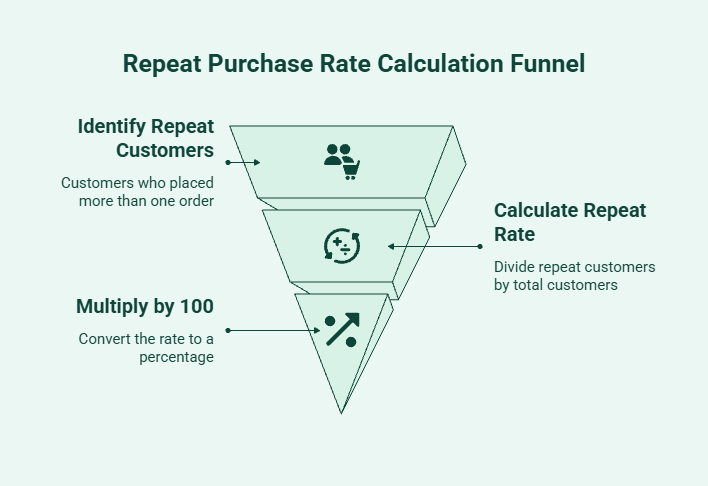
To calculate the repeat purchase rate, divide the number of customers who made more than one purchase by the total number of unique customers during the same period, then multiply the result by 100. Tracking this percentage consistently helps Shopify merchants measure whether more first-time buyers are returning over time.
The calculation only requires two numbers from the same reporting period:
Formula:
Repeat Purchase Rate = (Repeat Customers ÷ Total Customers) × 100
Although the formula is simple, consistency matters. Use the same reporting period, whether monthly, quarterly, or annually, so you can compare performance accurately and identify meaningful retention trends.
Small improvements can have a significant business impact. For example, increasing your repeat purchase rate from 20% to 25% may seem modest, but across thousands of customers it can generate more repeat orders, improve customer lifetime value, and reduce reliance on paid acquisition to drive revenue.
Imagine your Shopify store had 5,000 unique customers during the last quarter. If 1,250 of them placed another order before the quarter ended, your calculation would look like this:
(1,250 ÷ 5,000) × 100 = 25%
A 25% repeat purchase rate means one out of every four customers returned to make another purchase during that period. By calculating this metric consistently, you can evaluate whether changes to your retention strategy are encouraging more customers to buy again.
Your repeat purchase rate is most useful when you evaluate it within the context of your own business rather than relying on a single industry benchmark. Here's what to look for:
Rather than chasing a specific percentage, focus on whether your repeat purchase rate is improving over time. Consistent growth usually signals that your retention strategies are strengthening customer loyalty and creating more sustainable revenue.
There isn't a universal repeat purchase rate that every Shopify store should aim for. What's considered "good" depends on your product category, buying cycle, and business model. Instead of comparing your store with every e-commerce brand, measure your performance against similar businesses and, more importantly, your own historical trends.
If you're searching for the average repeat purchase rate on Shopify, it's worth noting that Shopify doesn't publish an official benchmark. That's because repeat purchase rates vary significantly by industry and buying cycle, making category-specific comparisons far more meaningful than a platform-wide average.
Customer buying behavior varies across industries, so compare your repeat purchase rate with businesses that have similar purchase cycles rather than relying on a single e-commerce average.
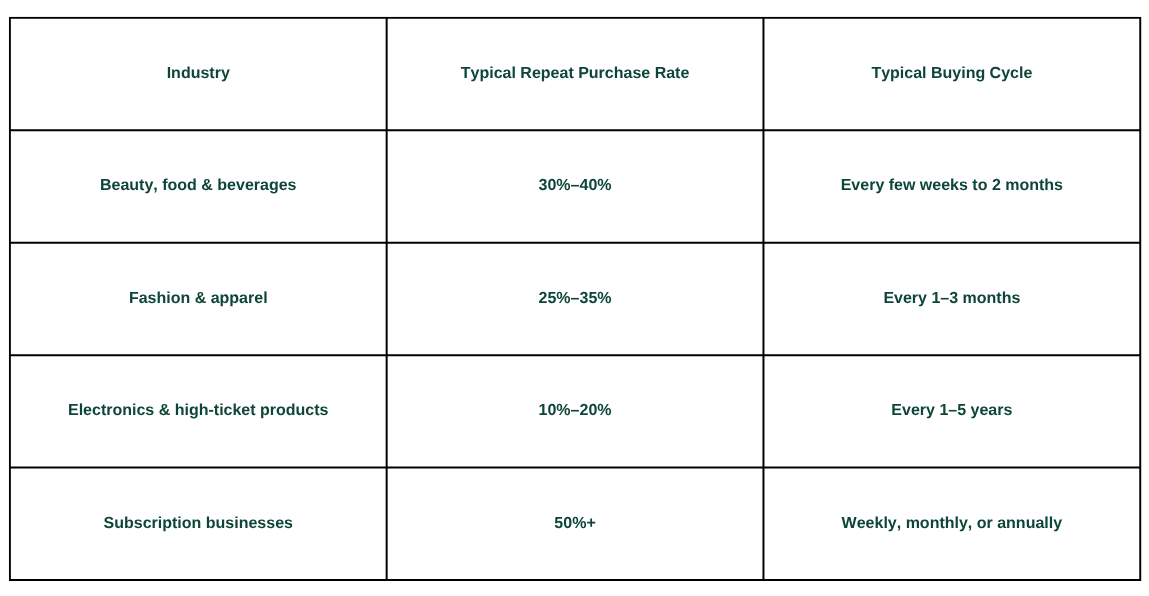
These benchmarks provide useful context rather than fixed targets. A skincare brand naturally sees customers reorder more frequently than a furniture retailer because the products are consumed at different rates. Evaluating your repeat purchase rate against businesses with similar buying cycles leads to more realistic expectations and better retention decisions.
Your repeat purchase rate is influenced by far more than the quality of your products. It reflects how well your business gives customers a reason to come back after their first purchase.
The biggest factors include:
The goal isn't to chase an industry benchmark. The most meaningful sign of success is seeing your repeat purchase rate improve over time as your customer retention strategy becomes more effective.
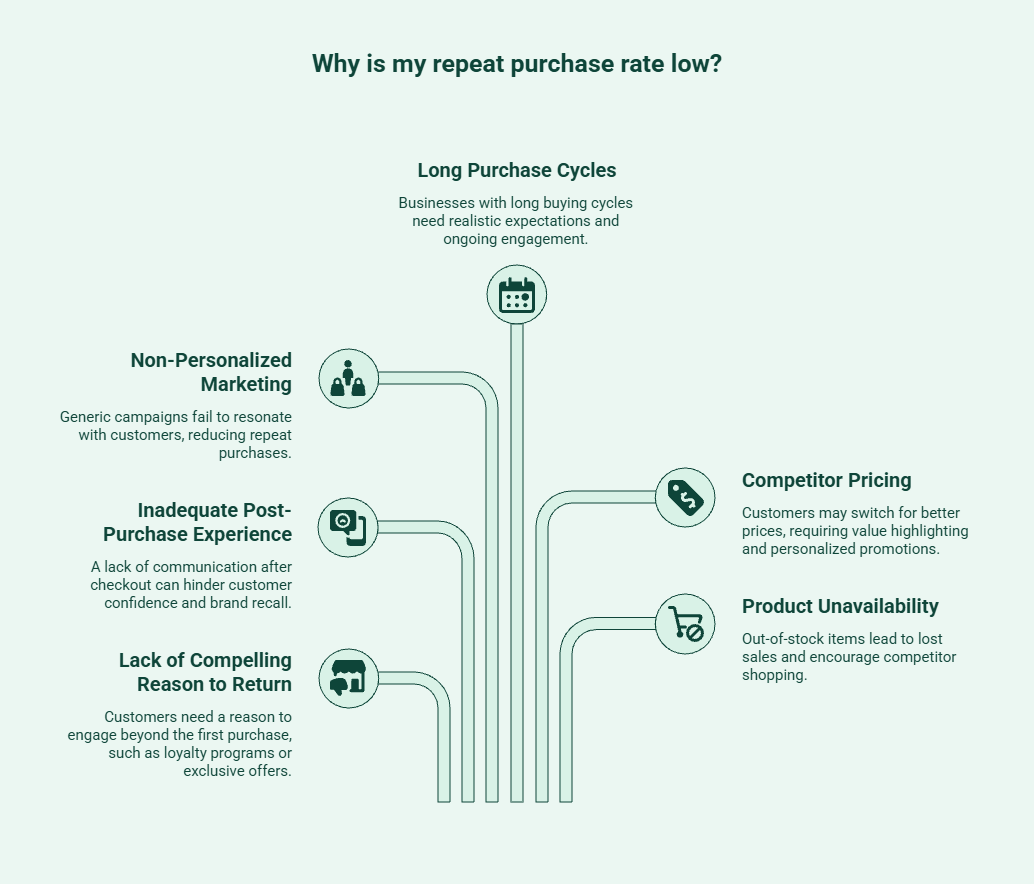
A low repeat purchase rate doesn't always point to a single problem. It usually signals friction somewhere between a customer's first purchase and their decision to buy again, impacting the overall customer experience. Identifying where that friction occurs helps you improve retention without relying on constant discounts or acquiring more new customers.
A successful initial purchase doesn't automatically lead to a second one. Once customers receive their order, they need another reason to engage with your brand before they start comparing alternatives or simply forget about you.
Common reasons customers don't return include:
The easier you make the decision to return, the less likely customers are to shop with competitors the next time they need a similar product.
For many brands, the customer journey ends the moment an order is placed. When there's little communication after checkout, customers have fewer opportunities to build confidence in your brand or remember you when they're ready to buy again.
An effective post-purchase experience should include:
Consistent post-purchase engagement keeps your brand top of mind and strengthens the relationship beyond the initial transaction.
Sending the same campaign to every customer rarely encourages repeat purchases. Buyers expect recommendations, offers, and reminders that reflect what they've already purchased, where they are in their buying journey, and their engagement on social media.
Personalization becomes more effective when you use:
Relevant communication feels helpful instead of promotional, making customers more likely to return when they're ready to buy again.
A lower repeat purchase rate isn't always a sign that your retention strategy is failing. Businesses selling furniture, electronics, or luxury goods naturally have longer buying cycles than stores selling coffee, skincare, or pet supplies, especially when considering retail purchases.
Instead of comparing your store with every ecommerce business:
Understanding your customers' buying cycle helps you set realistic expectations and focus on the retention opportunities you can actually influence.
Even satisfied customers may not return if they find a similar product at a lower price elsewhere. In highly competitive categories, aggressive discounting, free shipping, or better bundle offers from competitors can quickly influence buying decisions.
To reduce price-driven churn:
Customers are more likely to stay loyal when they feel they're receiving better overall value, not just the lowest price.
Customers can't make a second purchase if the products they want are consistently out of stock. Inventory shortages not only lead to lost sales but also encourage shoppers to try competing brands, especially for products they buy regularly.
To minimize missed repeat purchases:
Maintaining product availability helps capture repeat purchases before customers look elsewhere.
Once you know what's preventing customers from coming back, you can focus on retention strategies that address those gaps instead of relying on constant discounts or acquiring more new customers.
Customers rarely return because of a single promotion or email. They come back when every stage of the customer journey gives them another reason to buy again, including social proof from testimonials and reviews. The most effective retention strategies work together to reduce purchase friction, reward loyalty, and keep your brand relevant long after the first order.
A customer's first purchase shouldn't be the end of the relationship. Without a clear reason to come back, even satisfied shoppers may explore competitors or simply forget about your brand.
Loyalty programs help solve this by rewarding continued engagement instead of one-time transactions, ultimately transforming occasional customers into dedicated brand advocates. Rather than relying on constant discounts, they encourage customers to keep purchasing by making every order feel more valuable.
Effective loyalty programs can include:
A well-designed loyalty program gives customers an ongoing reason to choose your store, increasing repeat purchases while strengthening long-term customer relationships.
Customers are far more likely to return when they don't have to start their shopping journey from scratch. The easier it is to discover relevant products, the less effort it takes to place another order.
Instead of sending the same promotion to every customer, use purchase history to create a more personalized experience.
For example:
A skincare brand might recommend a moisturizer a few weeks after a customer purchases a cleanser, while a coffee retailer can remind customers to reorder before they run out.
For Shopify merchants, managing personalized recommendations, replenishment reminders, and targeted promotions across different customer segments can quickly become complex. Platforms like Kefi Commerce help simplify these retention efforts by enabling merchants to create personalized shopping experiences based on customer behavior, making it easier to encourage repeat purchases at scale.
Relevant recommendations reduce decision-making effort, making repeat purchases feel convenient instead of promotional.
Discounting alone rarely builds customer loyalty. Instead, focus on promotions that increase perceived value while encouraging customers to purchase again.
Strategies such as Product bundles, Buy One, Get One (BOGO) offers, and volume discounts work because they align with how customers naturally shop.
These promotions can help merchants:
The most effective promotions solve a shopping need rather than simply lowering prices.
When customers feel they're getting more value instead of just a lower price, they're more likely to return without waiting for the next sale.
Many brands invest heavily in winning the first sale but lose momentum after checkout. Yet the period immediately after a purchase is often when long-term customer relationships are built.
Every interaction should reassure customers they made the right decision and provide a natural path back to your store.
An effective post-purchase strategy may include:
The timing matters just as much as the message. Reaching customers when they're most likely to need another purchase makes your communication feel helpful rather than intrusive.
Consistent post-purchase engagement keeps your brand top of mind and creates more opportunities for repeat purchases over time.
The strongest retention strategies evolve with your customers. Every repeat purchase, abandoned reorder, product review, and support conversation reveals what's encouraging customers to return or what's preventing them from making another purchase. Instead of collecting customer data without a clear plan, use those insights to make targeted improvements.
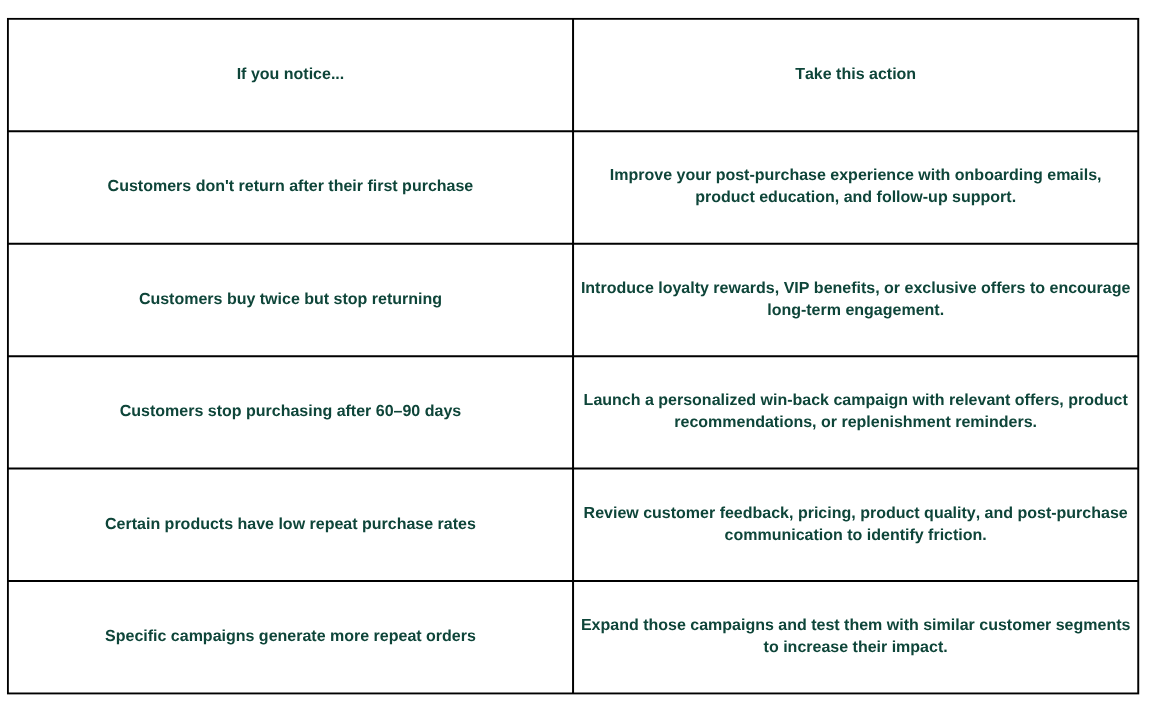
As your customer base grows, managing these retention strategies across multiple tools can become difficult. Kefi Commerce helps Shopify merchants turn customer insights into action by making it easier to launch personalized promotions, loyalty programs, bundles, BOGO offers, and targeted retention campaigns from a single platform.
The most successful Shopify merchants don't just track customer behavior; they act on it. Small, data-driven improvements made consistently can strengthen customer loyalty, increase repeat purchases, and drive sustainable long-term growth.
Increasing repeat purchase rate rarely comes down to a single tactic. Shopify merchants often combine loyalty programs, personalized promotions, product bundles, and post-purchase marketing campaigns to encourage customers to buy again. As those strategies grow, managing them across multiple apps can become time-consuming and difficult to optimize.
With Kefi Commerce, merchants can bring these retention strategies together in one platform, making it easier to create personalized shopping experiences that encourage repeat purchases while increasing customer lifetime value.
Kefi Commerce helps merchants:
The most successful Shopify stores don't rely on a single retention tactic; they build a connected customer experience that gives shoppers a reason to return after every purchase. If you're looking to simplify that process, explore how Kefi Commerce can help you build stronger customer loyalty, increase repeat purchases, and drive sustainable long-term growth.
Winning a customer's first order is only the beginning. Sustainable e-commerce growth comes from giving shoppers a reason to return, whether through personalized experiences, loyalty rewards, relevant promotions, or thoughtful post-purchase engagement. The more consistently you turn first-time buyers into repeat customers, the less your business depends on constantly acquiring new ones and the more you can benefit from repeat business.
Start by measuring your repeat purchase rate, identifying where customers are dropping off, and focusing on the retention strategies that will have the biggest impact on your ecommerce store business. If you're looking for a simpler way to bring loyalty programs, personalized promotions, bundles, BOGO offers, and retention campaigns together, Kefi Commerce helps Shopify merchants build stronger customer relationships that drive more repeat purchases and long-term revenue growth.
Track your repeat purchase rate monthly or quarterly, depending on your sales volume and purchase cycle. By implementing a subscription model, consistent tracking helps you identify retention trends, measure the impact of new strategies, and respond quickly if repeat purchases begin to decline.
Offer customers a reason to return through loyalty programs, personalized recommendations, bundles, BOGO or volume discounts, and timely post-purchase communication, all backed by exceptional customer service. Combining these strategies creates a more rewarding shopping experience and encourages customers to make another purchase.
Customers often don't make a second purchase when they lack a reason to return, receive irrelevant follow-up marketing, have a poor post-purchase experience, or buy products with naturally longer purchase cycles. Identifying the cause helps you choose the right retention marketing strategies.
Repeat purchase rate measures the percentage of customers who buy from your store more than once, while customer retention rate measures how many customers continue their relationship with your brand over a specific period, which is essential for sustainable growth, whether or not they make another purchase during that time.
Yes. For example, increasing your repeat purchase rate from 15% to 25% means more satisfied customers buy again without increasing acquisition spend, boosting revenue, improving customer lifetime value, and creating more predictable long-term growth.
.svg)
