
Activewear shoppers rarely build their entire wardrobe around one brand. They may buy leggings from one retailer, running shoes from another, and training accessories wherever they find the best fit, performance, or style. With so many alternatives available, even a positive first purchase does not guarantee they will choose the same brand next time.
That buying behavior creates a distinct retention challenge for activewear brands. According to McKinsey, 51% of active consumers say fitness is a core part of their identity. This gives activewear brands an opportunity to build loyalty around lifestyle, identity, and community, creating meaningful reasons for customers to stay engaged with the brand even when they are not actively shopping.
This guide explores what makes the best loyalty programs for activewear brands successful, how to choose the right loyalty model for your business, and which loyalty strategies for sports gear brands can strengthen retention and long-term growth without relying on constant discounts.
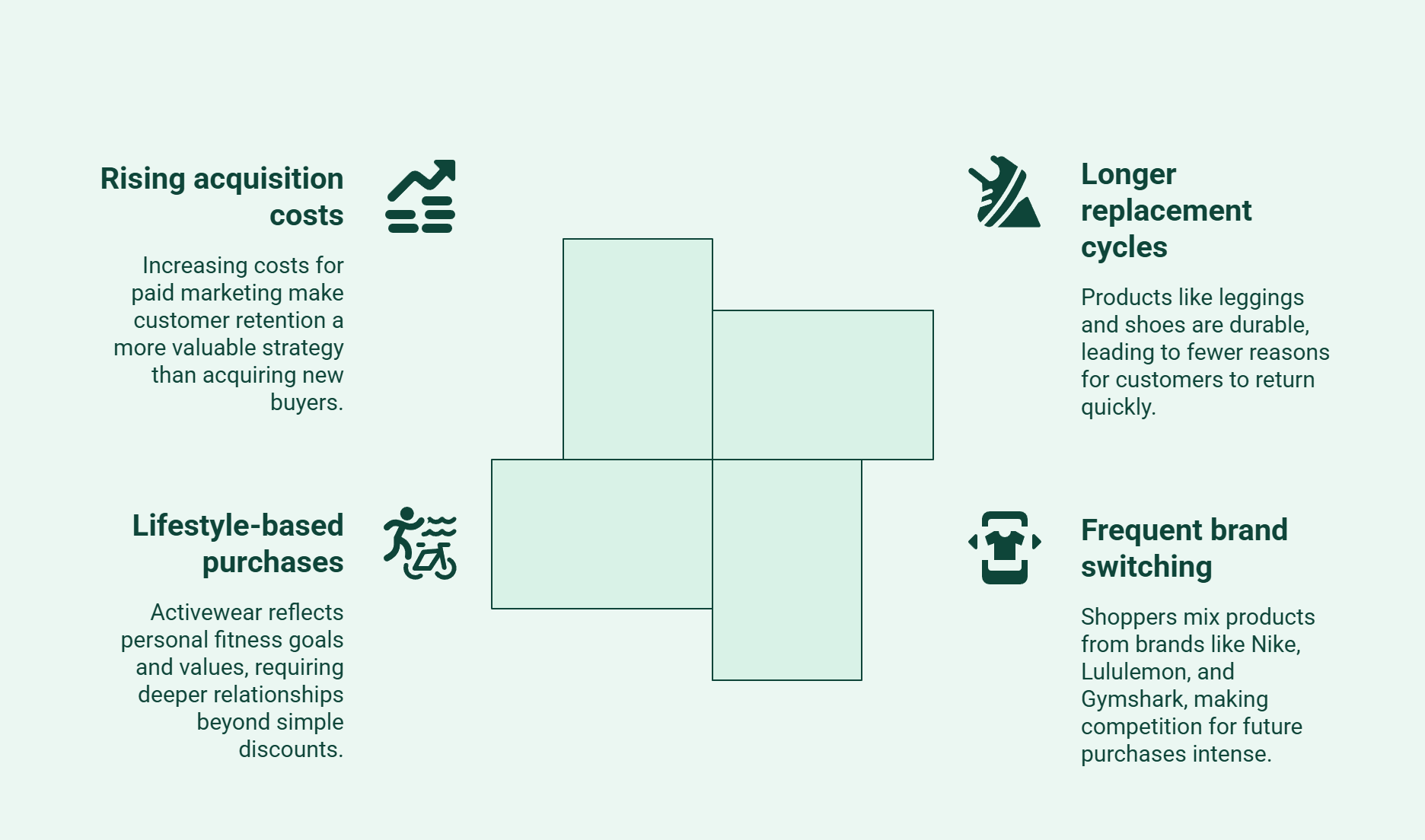
Not every ecommerce category faces the same retention challenges. Activewear brands operate in a market where purchases are less frequent, competition is intense, and customers have plenty of alternatives. These factors make loyalty a critical part of long-term growth rather than just another retention tactic.
Leggings, shoes, training apparel, and outerwear are built for durability and often last for several months with regular use. Unlike cosmetics, supplements, or other frequently replenished products, customers have fewer reasons to return quickly, making consistent engagement between purchases much more important.
Many shoppers do not rely on a single activewear brand for every purchase. They often mix products from brands like Nike, Lululemon, Gymshark, and others based on style, performance, or new product launches. This makes it easier for competitors to win future purchases unless customers have a compelling reason to stay loyal.
Activewear is closely tied to personal fitness goals, daily routines, and self-expression. Customers are often looking for brands that reflect their values, performance expectations, and sense of community. Loyalty programs that reward participation and offer exclusive experiences create stronger, longer-lasting relationships than discounts alone.
As customer acquisition costs continue to increase, replacing one-time buyers through paid marketing becomes more expensive. Since activewear purchases happen less frequently, improving customer retention and encouraging repeat purchases often delivers a stronger return on investment than continuously focusing on new customer acquisition.
For activewear brands, loyalty works best when it reflects how customers actually shop and what keeps them engaged between purchases. The goal is to give customers meaningful reasons to choose your brand again.
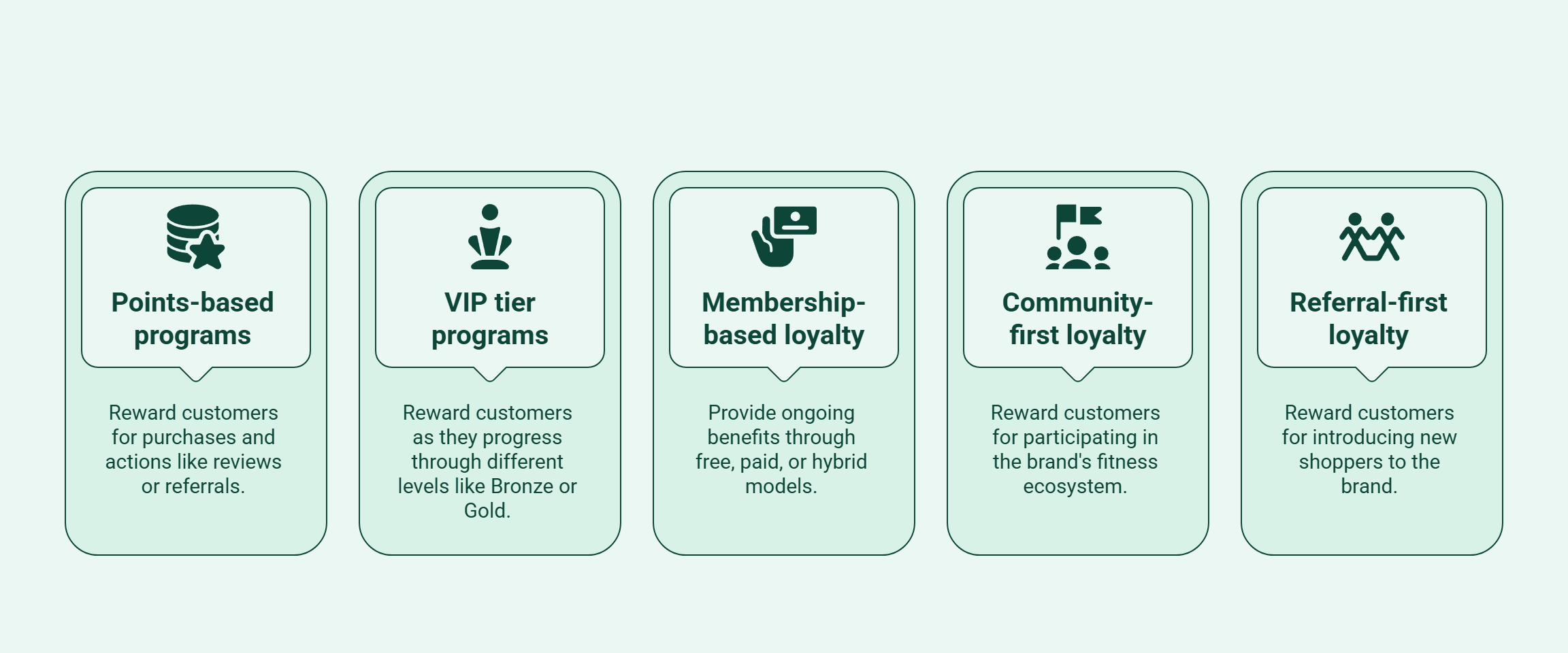
There is no single loyalty model that works for every activewear business. The right approach depends on your product range, customer behavior, average order value, and brand positioning. Before launching a program, identify the loyalty structure that best supports your long-term retention goals.
Points-based programs reward customers for purchases and other valuable actions, such as writing reviews or referring friends. Customers accumulate points over time and redeem them for rewards, making this one of the simplest loyalty models to understand.
Best for
Pros
Cons
Ideal customer
Customers who make multiple purchases throughout the year and appreciate earning rewards over time.
Points-based loyalty programs work best when the earning and redemption structure is simple, rewards feel attainable, and customers have enough purchase opportunities to benefit from participating over time.
VIP programs reward customers as they progress through different levels, typically Bronze, Silver, Gold, and Elite. Each tier unlocks additional benefits, creating a sense of achievement and encouraging customers to spend more to reach the next level.
Best for
Pros
Cons
Ideal customer
Highly engaged shoppers who regularly purchase new collections and value exclusive perks.
VIP tiers are often more effective when customers make fewer but higher-value purchases. Exclusive benefits such as early access, limited-edition launches, complimentary shipping, or priority support create stronger motivation than simply earning additional points.
Membership programs provide ongoing benefits through free, paid, or hybrid models. Rather than rewarding individual purchases, they focus on delivering continuous value that encourages customers to remain connected with the brand.
Best for
Pros
Cons
Ideal customer
Customers who actively follow the brand, shop throughout the year, and value exclusive access over occasional discounts.
Premium activewear brands increasingly adopt memberships because benefits like early product releases, exclusive collections, member-only events, and personalized services create stronger perceived value than recurring discounts.
Community-first programs reward customers for participating in the brand's fitness ecosystem rather than focusing only on purchases. Rewards can be tied to running clubs, fitness challenges, in-person events, user-generated content, educational content, or ambassador participation.
Best for
Pros
Cons
Ideal customer
Customers who enjoy sharing their fitness journey and participating in brand communities beyond shopping.
Community-first loyalty works best when your goal is to build lasting relationships rather than simply increase transactions. By rewarding participation, shared experiences, and customer contributions, activewear brands can create a loyal community that stays engaged with the brand even between purchase cycles.
Referral-first programs reward customers for introducing new shoppers to the brand. Since fitness activities are often social, referrals naturally fit activewear buying behavior across gym communities, Pilates studios, CrossFit boxes, running clubs, and training groups.
Best for
Pros
Cons
Ideal customer
Loyal customers who regularly recommend products to friends, teammates, or workout partners.
Referral-first loyalty is highly effective for activewear brands because it turns satisfied customers into brand advocates. It helps drive trusted customer acquisition while rewarding the people who already support your brand.
The best loyalty programs for activewear brands align with both customer behavior and business goals. While points and VIP tiers remain effective for many brands, memberships, community engagement, and referrals often create deeper customer relationships that extend well beyond individual purchases.
Ready to build a smarter loyalty strategy? Book a demo with Kefi Commerce and see how personalized retention campaigns can help turn more shoppers into repeat customers.
The best loyalty programs are built around customer expectations rather than a single rewards model. Some brands focus on exclusive access, while others prioritize community, personalization, or tiered benefits. These examples show how different approaches can strengthen customer retention and encourage repeat purchases.
Squaties uses a personalized retention strategy that delivers relevant offers based on customer behavior instead of relying on blanket promotions. By tailoring incentives to different customer segments, the brand creates more relevant shopping experiences while encouraging repeat purchases and long-term customer relationships.
This approach demonstrates how personalization can make loyalty more relevant and effective without relying on frequent sitewide discounts.
Nike Membership is a strong example of a loyalty program that goes beyond purchase-based rewards. Instead of relying only on points or discounts, Nike combines exclusive products, digital fitness content, personalized services, and member-only experiences to maintain an ongoing relationship with customers.
Nike builds loyalty by combining convenience, exclusivity, personalization, and digital fitness content. This keeps members engaged with the brand both when they shop and when they use Nike’s fitness services.
adidas adiClub uses a points-based and tiered loyalty structure to encourage customers to remain engaged over time. Members can progress through different levels and unlock increasingly valuable benefits, making the program suitable for customers who purchase regularly and participate in adidas-related activities.
adiClub encourages repeat engagement through points, tier progression, and exclusive benefits. As members move to higher levels, they gain additional incentives to continue purchasing and interacting with adidas.
lululemon Membership reflects the brand’s premium, lifestyle-oriented positioning. Rather than focusing primarily on conventional points or discounts, the program uses practical services, early access, community experiences, and wellness-related partner benefits to add value for members.
lululemon strengthens loyalty through premium services, exclusive access, and community experiences. Benefits such as hemming, product access, events, and partner perks support the brand’s wider lifestyle positioning.
The North Face XPLR Pass extends loyalty beyond shopping by connecting rewards with outdoor participation and exploration. This makes the program closely aligned with the interests and lifestyle of its target customers.
XPLR Pass builds stronger customer connections by rewarding outdoor participation and product engagement. Its focus on exploration, exclusive experiences, and field testing makes the program feel closely connected to The North Face community.
Although these brands use different loyalty strategies, they all focus on delivering ongoing value rather than simply rewarding transactions. The most effective programs create meaningful customer experiences that strengthen retention, increase repeat purchases, and build lasting brand loyalty.
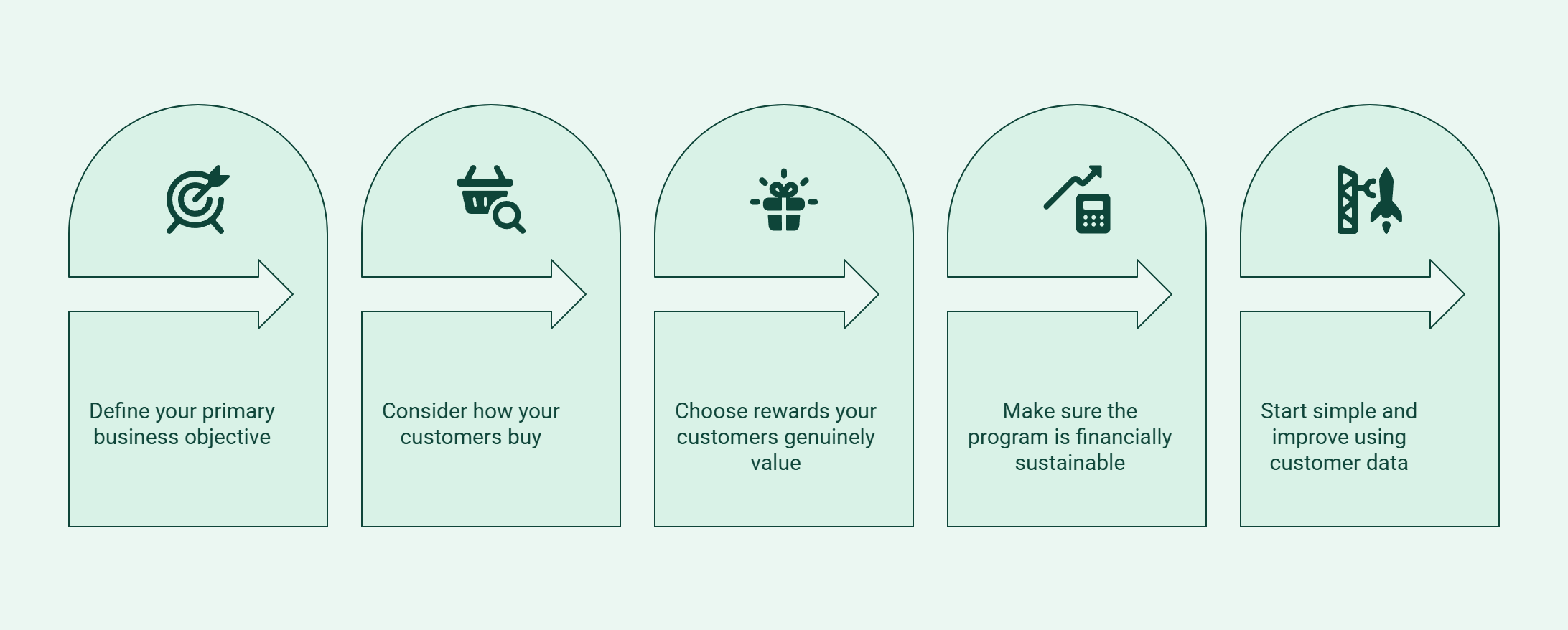
The best loyalty model depends on your business goals, customer behavior, and the value you want to deliver. Rather than following what other brands are doing, evaluate your own business needs first. These steps will help you choose a loyalty strategy that supports sustainable growth.
Start by identifying what you want your loyalty program to achieve. Your goal may be increasing repeat purchases, improving average order value, reducing customer acquisition costs, generating referrals, or building stronger customer engagement. Your objective should guide every decision that follows.
Look at your average purchase frequency, order value, and product mix. Customers who regularly buy accessories or training essentials behave differently from those purchasing premium outerwear or running shoes. Understanding these buying patterns helps you choose a loyalty model that fits your sales cycle.
Not every customer is motivated by discounts. Depending on your audience, early product access, exclusive collections, member-only experiences, free shipping, or personalized rewards may create greater long-term engagement. Select benefits that reflect your brand positioning rather than competing on price alone.
Every reward has a cost. Before launching, calculate whether the expected increase in customer lifetime value and repeat purchases can support the incentives you plan to offer. A profitable loyalty program should strengthen margins over time, not reduce them.
Launch with a clear structure that customers can easily understand, then monitor participation, reward redemption, repeat purchases, and overall performance. Customer feedback and purchasing data will help you refine the program as your business grows.
Choosing the right loyalty model gives you the strategic foundation for your program. Once you've defined what the program should achieve, how customers should engage, and which rewards make sense, the next step is choosing the technology capable of delivering that strategy effectively.
Want to give customers more value without relying on another broad discount? Build personalized product bundles with Kefi Commerce and create offers around complementary activewear products your customers are more likely to buy together.
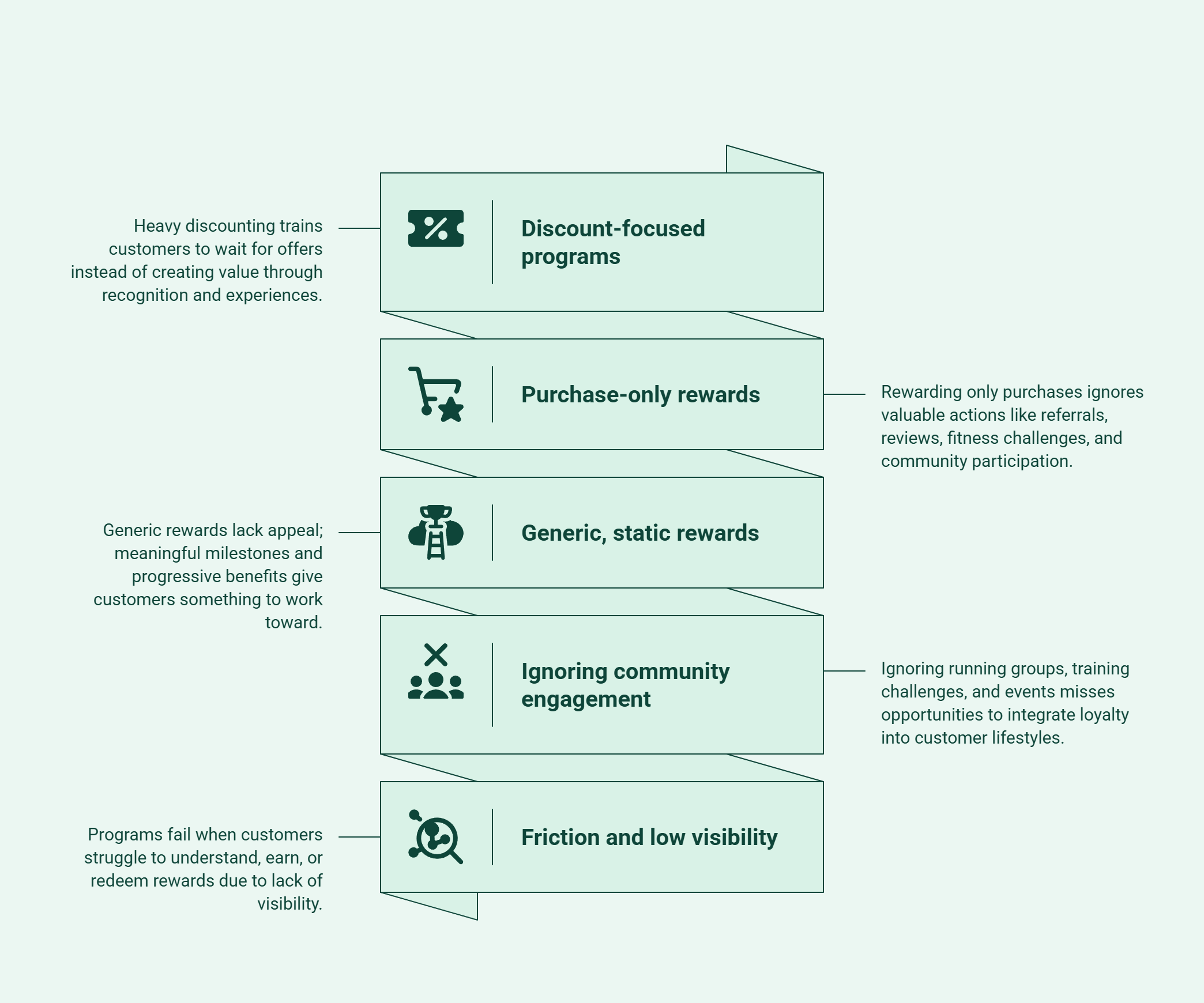
Launching a loyalty program doesn't guarantee higher retention or repeat purchases. Many programs underperform because they focus on short-term incentives rather than creating reasons for customers to stay engaged. Here are five common mistakes activewear brands should avoid.
Heavy discounting may generate short-term sales, but it can train customers to wait for the next offer. A strong loyalty program should create value through recognition, access, experiences, and relevant benefits rather than competing primarily on price.
Activewear often has longer buying cycles, so purchase-only rewards leave significant gaps in engagement. Brands can maintain momentum by recognizing valuable actions such as referrals, product reviews, fitness challenges, user-generated content, and community participation.
Generic rewards can quickly lose their appeal, especially when every customer receives the same benefits. Adding meaningful milestones, exclusive perks, or progressive benefits gives customers something to work toward while making continued participation more rewarding.
Fitness naturally creates opportunities for participation beyond shopping. Running groups, training challenges, sporting events, and online communities can deepen customer relationships. Brands that ignore these touchpoints miss an opportunity to make loyalty part of their customers' lifestyles.
Even valuable rewards will underperform if customers struggle to understand, earn, or redeem them. The program should be simple and consistently visible across customer accounts, emails, product pages, and post-purchase communications so members know both how and when to participate.
Successful loyalty programs remove friction while creating value customers genuinely want to return for. For activewear brands, that means designing the program around ongoing engagement rather than simply rewarding the next transaction.
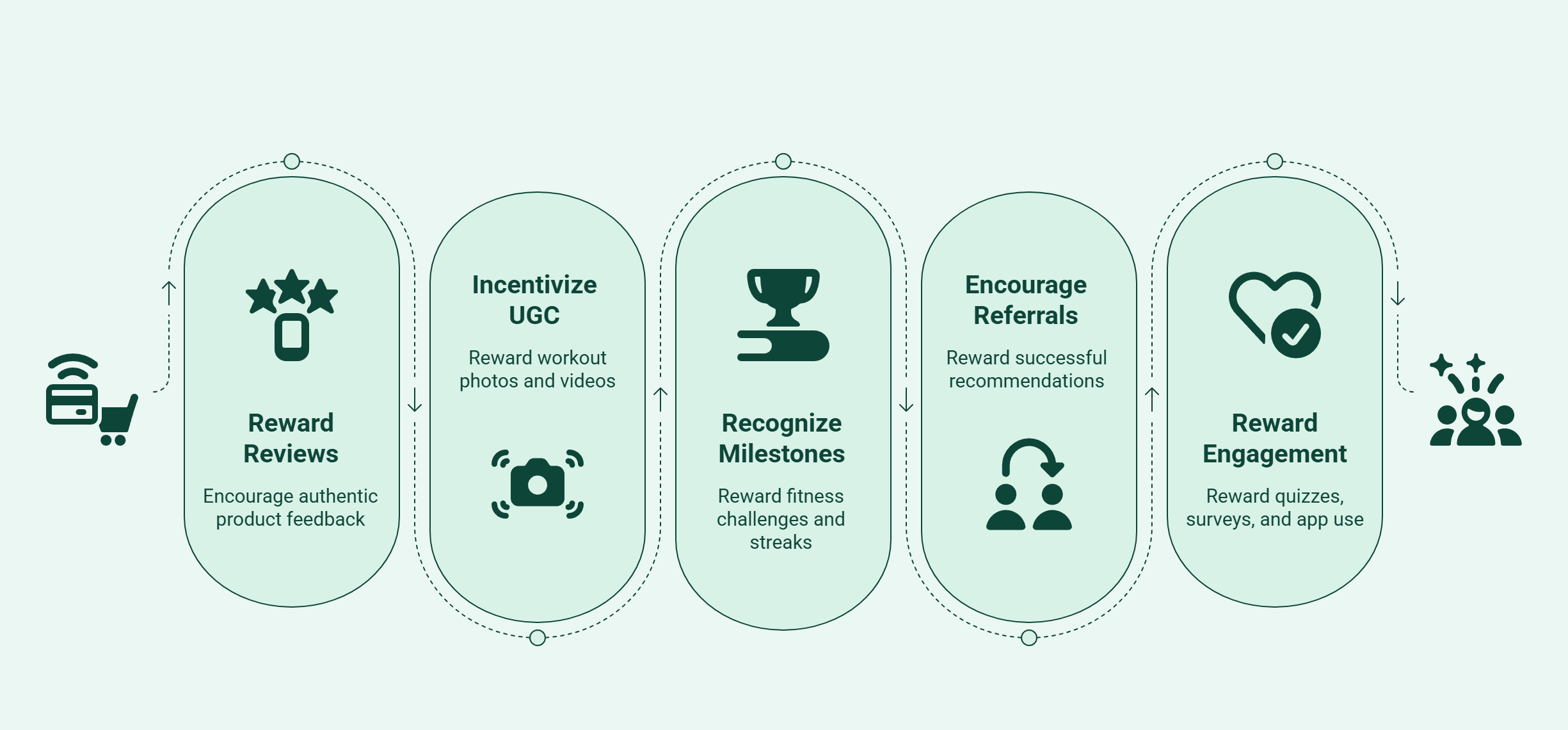
The strongest loyalty programs do more than reward spending. They encourage behaviors that deepen customer relationships, strengthen brand engagement, and contribute to long-term business growth. By rewarding meaningful actions throughout the customer journey, activewear brands can keep customers engaged even when they are not actively shopping.
Verified reviews help future shoppers make informed buying decisions while providing valuable customer feedback. Offering loyalty points for detailed, authentic reviews encourages more user-generated content without relying solely on post-purchase emails.
Customers who share photos or videos of themselves using your products create authentic social proof that traditional advertising cannot replicate. Rewarding approved user-generated content encourages community participation while expanding your brand's organic reach.
Customers often stay engaged with fitness goals long after making a purchase. Rewarding completed running challenges, workout streaks, or personal milestones gives them a reason to interact with your brand between buying cycles while reinforcing healthy habits.
Recommendations often happen naturally among gym partners, running groups, sports teams, and workout classes. Rewarding successful referrals helps activewear brands acquire new customers through trusted personal recommendations rather than relying entirely on paid advertising.
Meaningful engagement extends beyond transactions. Actions such as completing product quizzes, celebrating birthdays, participating in surveys, using a fitness app, or engaging with educational content can all strengthen customer relationships while providing valuable first-party data for future personalization.
Rewarding behaviors beyond purchases transforms a loyalty program from a simple rewards system into an ongoing engagement strategy. By recognizing actions that build trust, strengthen community, and encourage brand participation, activewear brands can create deeper customer relationships while supporting long-term retention.
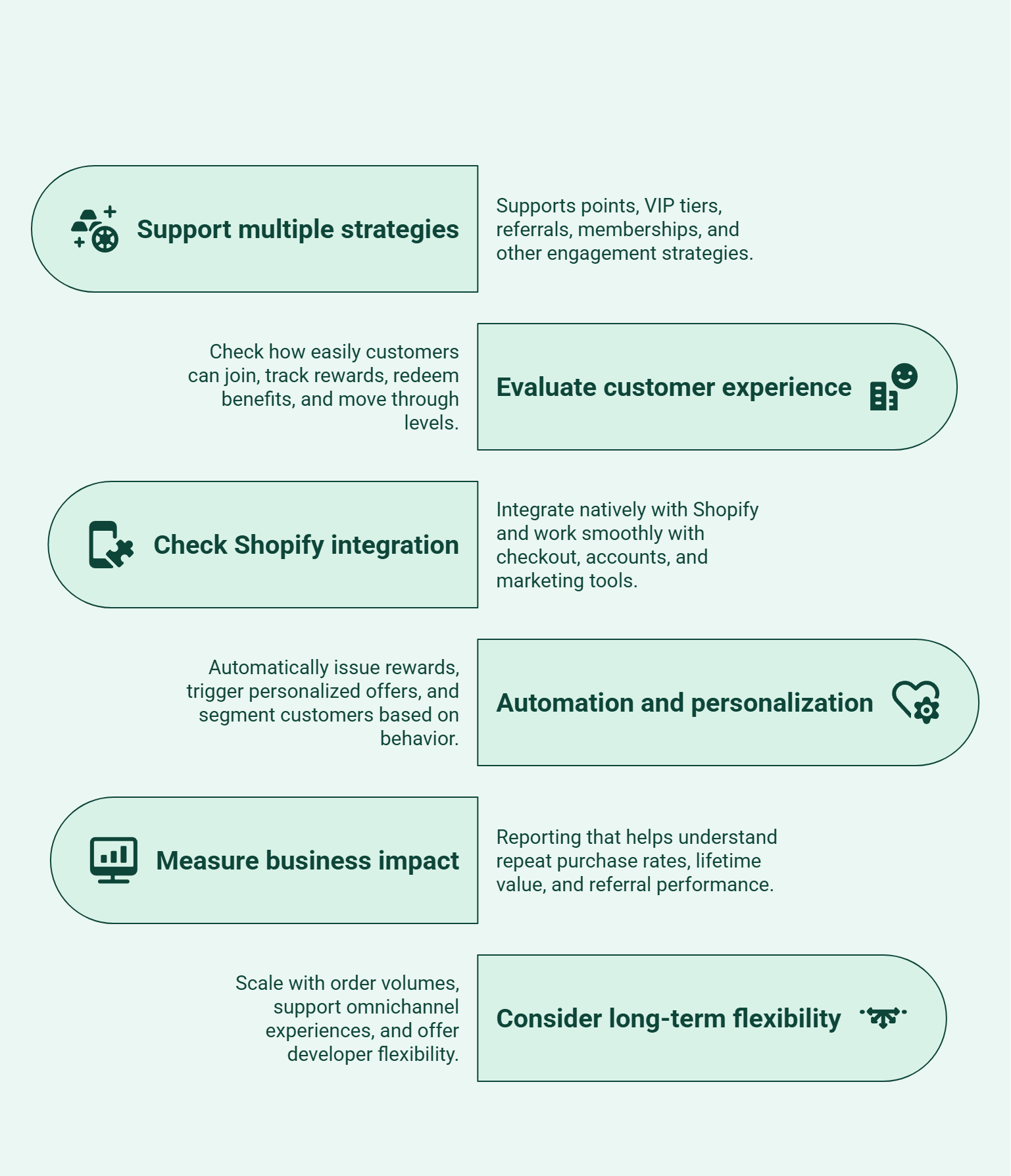
Choosing the right loyalty platform is about finding a solution that supports your retention strategy both today and as your business grows. Rather than comparing feature lists, evaluate how well each platform can help you deliver a seamless customer experience, automate key processes, and adapt to changing business needs.
Your retention strategy may evolve as your brand grows. Instead of selecting a platform limited to one reward type, look for one that supports points, VIP tiers, referrals, memberships, and other engagement strategies without requiring multiple apps.
A loyalty program should feel like a natural extension of your brand. Check how easily customers can join, track their rewards, redeem benefits, and move through different loyalty levels. A simple and intuitive experience encourages higher participation and repeat engagement.
Your loyalty platform should integrate natively with Shopify and work smoothly with your checkout, customer accounts, marketing tools, and other Shopify apps. Strong integrations reduce manual work, improve data accuracy, and create a more consistent shopping experience.
As your customer base grows, manually managing rewards becomes inefficient. Choose a platform that can automatically issue rewards, trigger personalized offers, segment customers based on their behavior, and communicate with members at the right time.
A loyalty platform should provide more than basic enrollment numbers. Look for reporting that helps you understand repeat purchase rates, customer lifetime value, reward redemption, referral performance, and which campaigns contribute most to retention.
Your business needs today may not be the same a year from now. Select a platform that can scale with increasing order volumes, support omnichannel experiences, and offer developer flexibility if you need custom functionality or advanced integrations in the future.
The best loyalty platform is one that supports your business goals without limiting future growth. By evaluating customer experience, integrations, automation, reporting, and scalability, you can choose a solution that delivers lasting value instead of simply adding another app to your Shopify store.
Looking for a plan that matches your retention needs? Explore Kefi Commerce plans and pricing to find the right fit for your Shopify store.
Once you've defined your loyalty strategy, the next decision is whether to build the technology in-house or use an established platform. For most Shopify activewear brands, the choice comes down to customization, resources, cost, and speed to market.
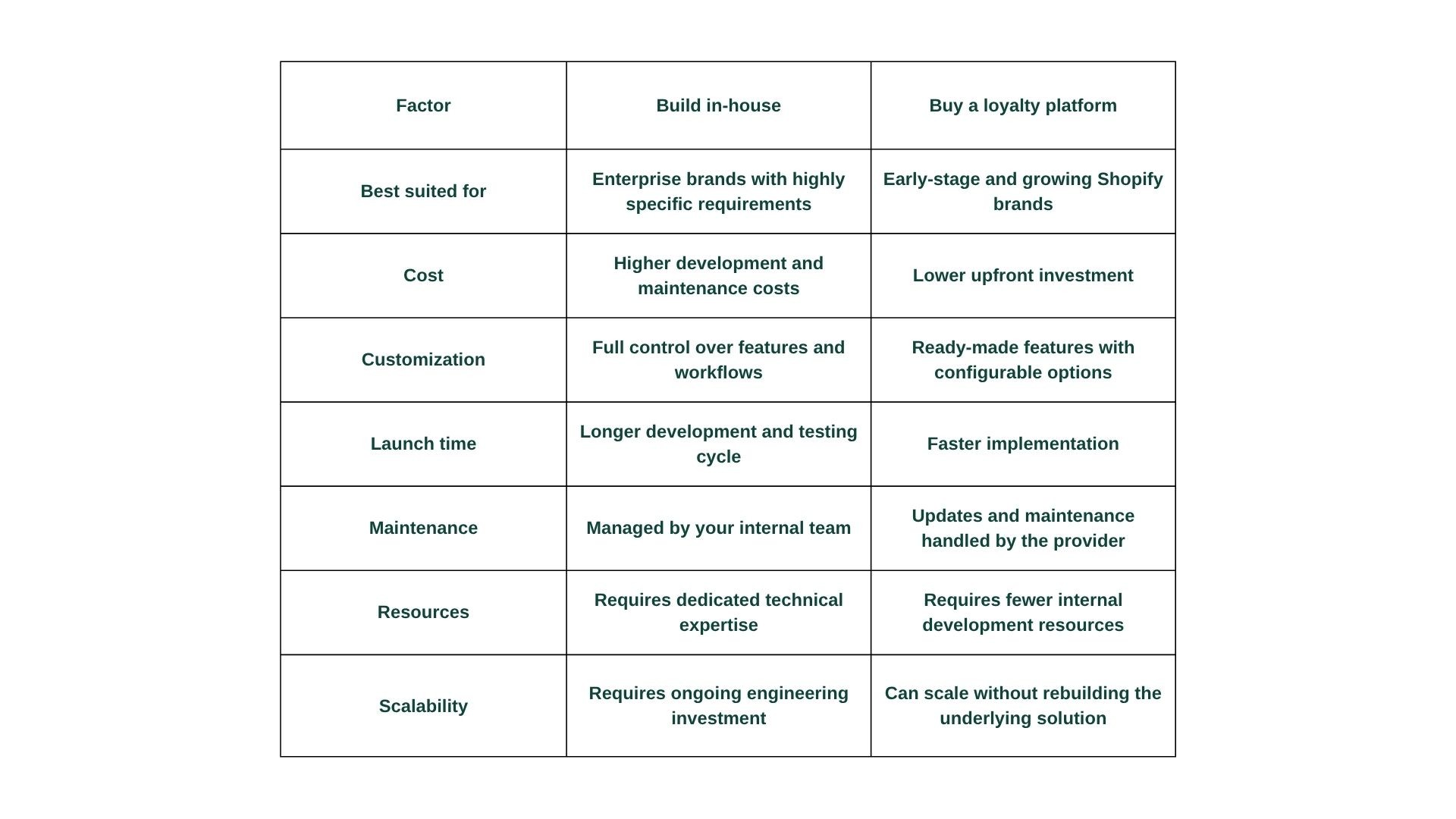
For most Shopify activewear brands, buying a loyalty platform offers a faster and more resource-efficient route to launch. Building in-house becomes worthwhile when you have dedicated engineering resources and requirements that existing platforms cannot adequately support.
Building a loyalty program is only part of the equation. To deliver lasting results, activewear brands need a solution that helps them create personalized customer experiences, encourage repeat purchases, and manage multiple retention strategies without adding operational complexity.
Kefi Commerce helps Shopify activewear brands bring these strategies together in one platform. From personalized promotions and targeted offers to bundles, volume discounts, and customer segmentation, brands can create more relevant shopping experiences that strengthen customer relationships and increase long-term customer value.
Ready to build a loyalty program that goes beyond one-size-fits-all rewards? Book a demo with Kefi Commerce to see how you can create personalized retention strategies that increase repeat purchases, improve customer lifetime value, and support sustainable growth for your Shopify store.
Building customer loyalty isn't about offering the biggest rewards. It's about creating consistent value throughout the customer journey. Whether through personalized experiences, exclusive benefits, community engagement, or thoughtful reward structures, successful activewear brands focus on giving customers meaningful reasons to stay connected long after their first purchase.
The strongest loyalty programs continue to evolve alongside customer expectations, making continuous optimization just as important as the initial launch. Brands that treat loyalty as a long-term growth strategy instead of a short-term marketing tactic will be better positioned to increase customer lifetime value and achieve sustainable growth.
Yes. Team sports apparel brands often use referral programs, sporting events, community events, exclusive offers, and bonus points to encourage repeat purchases while strengthening team participation and customer engagement.
The best loyalty programs for activewear brands emphasize experiential rewards, priority access, exclusive events, and a sense of belonging, while general clothing rewards programs typically focus on discounts and purchase-based incentives.
You can find comparisons in ecommerce publications, Shopify blogs, and industry resources that review the best loyalty programs for activewear brands, including benefits like free hemming, access pass, and personalized shopping experience.
Nike, adidas, Lululemon, and The North Face are frequently recognized for offering some of the best loyalty programs for activewear brands, with benefits such as first dibs, special offers, mobile apps, and birthday celebrations.
A successful loyalty program reflects your brand's core values, enhances the online shopping experience, and rewards meaningful customer engagement with benefits that encourage customers to return for their next time purchase.
.svg)
