.jpg)

A customer who places one large order isn't always your most valuable customer. In fact, increasing customer retention by just 5% can increase profits by 25% to 95%. That's why the shoppers who come back again and again often generate far more long-term revenue than one-time buyers, yet many Shopify merchants still focus more on acquiring new customers than maximising the value of the ones they already have.
Without knowing your customer lifetime value, it's difficult to tell whether your marketing budget is bringing in profitable customers or simply driving one-time sales. You might celebrate rising revenue while overlooking a bigger problem: customers aren't returning often enough to sustain growth. That's why successful Shopify brands track customer lifetime value alongside metrics like average order value and repeat purchase rate to make smarter growth decisions.
Looking beyond individual transactions changes how you evaluate marketing, retention, and customer experience. Once you understand how customer lifetime value is calculated and tracked, you can make more informed decisions about where to invest your budget, which customers deserve the most attention, and what drives sustainable growth for your Shopify store.
Shopify customer lifetime value (CLV) is the estimated total revenue a customer generates over the course of their relationship with your store, not just from a single purchase. Instead of measuring individual transactions, CLV shows the long-term value each customer brings through repeat purchases over their average lifespan.
For Shopify merchants, CLV provides a clearer picture of business performance than revenue alone. A store with fewer repeat customers may generate strong short-term sales, but one with higher customer lifetime value is often more profitable because existing customers continue to return at lower acquisition costs.
Customer lifetime value is typically measured using four key factors:
While average order value measures the value of one transaction, customer lifetime value measures the total value of the customer relationship. A high AOV doesn't necessarily mean a customer is highly valuable if they never return. CLV combines spending, buying frequency, and customer lifespan to show which customers contribute the most to long-term revenue.
Calculating Shopify customer lifetime value (CLV) starts with three numbers: your average order value, purchase frequency, and average customer lifespan. Together, these metrics estimate the revenue the average customer generates over their relationship with your store.
The standard Shopify customer lifetime value formula is:
Customer lifetime value = Average order value × Purchase frequency × Customer lifespan
To calculate each metric:
Imagine a coffee subscription store where customers spend an average of $60 per order, place 4 orders each year, and stay active for 3 years.
Using the Shopify customer lifetime value formula:
Customer lifetime value = $60 × 4 × 3 = $720
Now compare that figure with your customer acquisition cost (CAC). If it costs $120 to acquire a new customer and that customer generates $720 over their lifetime, your acquisition investment is far easier to justify because each customer delivers significantly more revenue than it costs to acquire them.
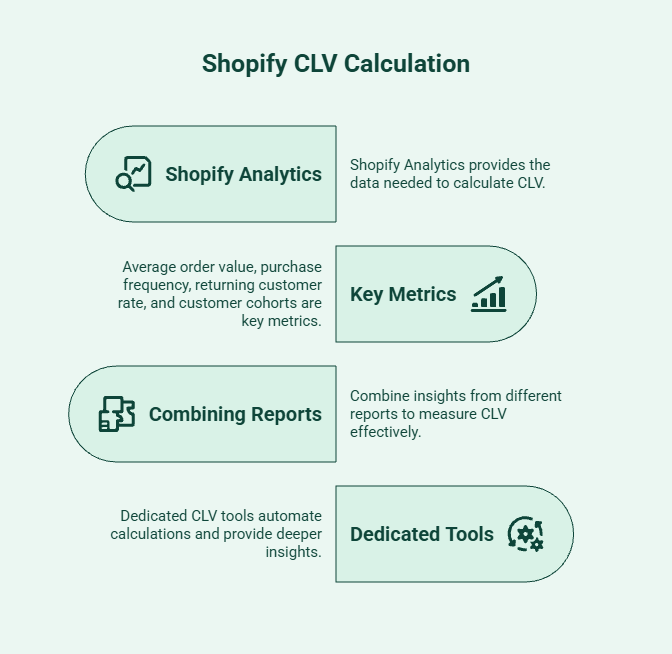
Unlike metrics such as sales or average order value, Shopify doesn't display customer lifetime value as a built-in metric. Instead, it gives you the customer and sales data needed to calculate CLV yourself. Once you know which reports to use, finding customer lifetime value becomes much more straightforward.
No. Shopify doesn't provide a dedicated customer lifetime value (CLV) report. Instead, Shopify Analytics gives you the customer and sales data needed to calculate and monitor CLV manually. Combining these reports helps you understand which customers generate the most long-term value.
The key metrics you'll need include:
Using a consistent reporting period across these metrics helps you calculate customer lifetime value more accurately and identify meaningful trends.
Shopify Analytics is where you'll find the data behind your CLV calculations. Rather than searching for a dedicated "Customer Lifetime Value" report, focus on the metrics that determine how much customers are worth over time.
The most important metrics include:
Using the same reporting period across these metrics helps ensure your CLV calculations reflect actual customer behaviour rather than seasonal fluctuations.
No single report tells the full story, so it's worth combining insights from different reports instead of relying on one dashboard.
For example:
Looking at these reports together helps answer a more valuable business question: Are your customers becoming more valuable after their first purchase, or are they buying once and disappearing?
Shopify Analytics provides the data needed to calculate customer lifetime value, but managing multiple reports becomes more difficult as your store grows. If you're exporting spreadsheets, comparing customer segments manually, or tracking CLV across different campaigns, dedicated tools can save time and provide deeper insights.
Dedicated customer lifetime value tools help merchants:
As your customer base expands, dedicated tools make it easier to measure customer lifetime value consistently and turn customer data into actionable growth strategies.
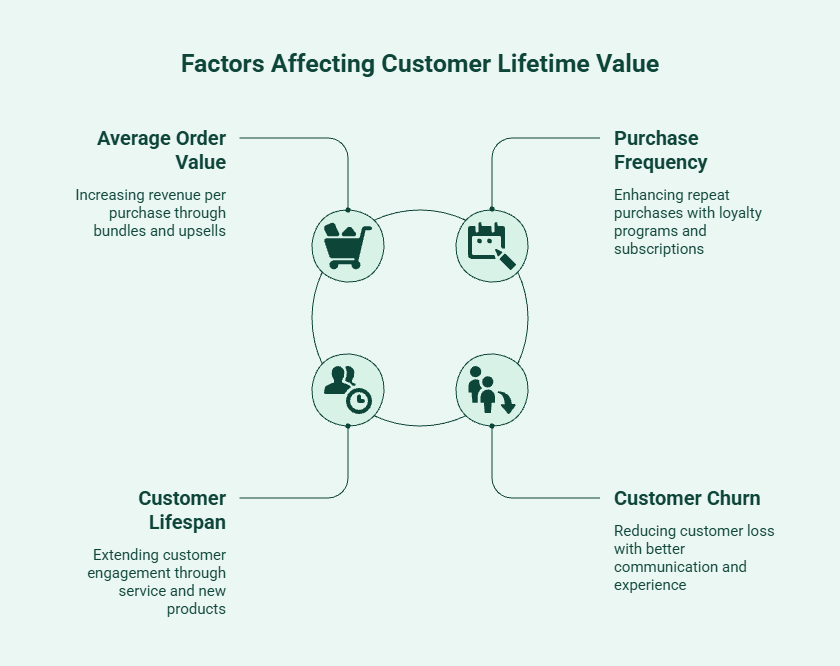
Customer lifetime value depends on how customers buy, how often they return, and how long they stay with your business. Improving any one of these factors can increase CLV, but the strongest long-term growth comes when they work together.
A higher average order value (AOV) increases revenue per purchase, but it doesn't automatically make a customer more valuable. A shopper who places multiple smaller orders can contribute more lifetime revenue than someone who makes one expensive purchase.
Focus on increasing AOV through:
Customer lifetime value grows every time a customer returns to buy again. Even a small increase in repeat purchases can have a bigger long-term impact than acquiring more first-time customers because you're generating additional revenue without paying another acquisition cost.
Ways to improve purchase frequency include:
Subscriptions are particularly effective for businesses selling consumables such as beauty products, supplements, pet supplies, or coffee. By encouraging customers to reorder automatically, subscription models increase purchase frequency, extend customer lifespan, and create more predictable recurring revenue.
Customer lifespan measures how long people continue buying from your store. The longer customers stay engaged, the more opportunities you have to generate revenue through future purchases instead of constantly replacing lost customers.
Merchants often extend customer lifespan by:
Customer churn shortens the relationship between your business and your customers. When shoppers stop returning after one or two purchases, lifetime value declines regardless of how much they spent initially.
Common reasons for high churn include:
Understanding how these factors influence customer lifetime value makes it easier to identify where improvements will have the greatest impact. The next step is choosing the right Shopify tools to measure these metrics consistently and turn them into actionable growth opportunities.
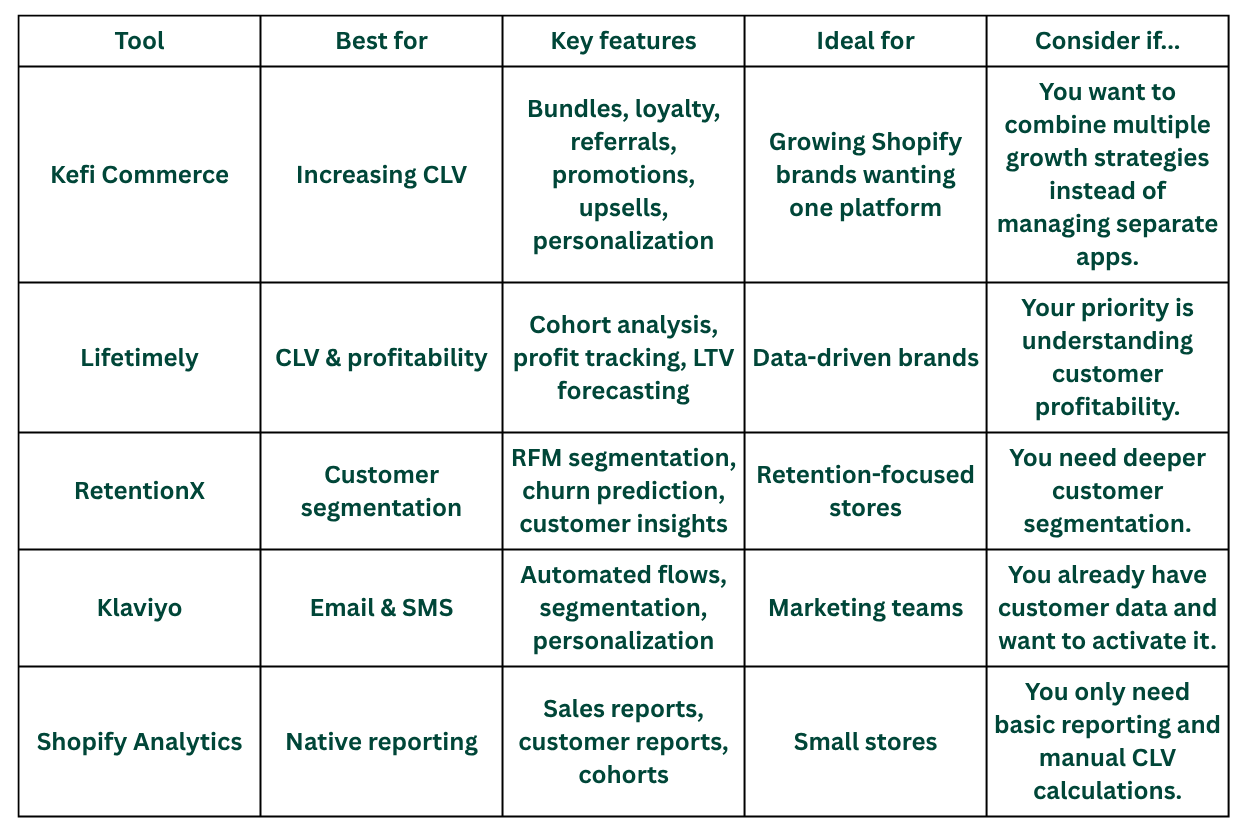
The best Shopify customer lifetime value tool depends on what you're trying to achieve. Some platforms focus on measuring CLV, while others help you use those insights to improve retention, personalise marketing, and increase repeat purchases.
Many Shopify merchants use separate apps for promotions, bundles, loyalty programs, referrals, and personalised offers. While each tool solves a specific problem, managing multiple apps often leads to higher costs, disconnected customer experiences, and more time spent switching between platforms.
Kefi Commerce brings these growth strategies together in one platform, helping merchants increase customer lifetime value by encouraging repeat purchases, growing average order value, and improving customer retention without adding unnecessary operational complexity.
With Kefi Commerce, merchants can:
Instead of relying on multiple disconnected apps, merchants can manage their customer growth strategies from a single platform, making it easier to test campaigns, optimise performance, and build stronger long-term customer relationships.
Ready to turn customer lifetime value into measurable growth? Explore how Kefi Commerce helps Shopify merchants increase repeat purchases, improve customer retention, and launch revenue-driving campaigns from one platform.
Lifetimely is best suited for merchants who want a deeper understanding of customer lifetime value and profitability. It combines CLV reporting with cohort analysis, making it easier to see which customer groups generate the highest long-term returns.
Best suited for:
RetentionX focuses on customer segmentation. Instead of treating every customer the same, it groups shoppers based on buying behaviour, purchase history, and customer value, helping merchants create more targeted retention strategies.
Best suited for:
Klaviyo helps merchants act on customer lifetime value insights through personalised email and SMS marketing. By segmenting customers based on their behaviour and value, businesses can send campaigns that encourage repeat purchases instead of relying on generic promotions.
Best suited for:
For merchants just starting to track customer lifetime value, Shopify Analytics provides the reports needed to calculate CLV without installing additional apps. While it doesn't generate CLV automatically, it gives you access to customer, order, and revenue data that forms the basis of every calculation.
Best suited for:
Choosing the right tool depends on whether you simply want to measure customer lifetime value or actively improve it. Once you have the right data, the next step is using it to increase repeat purchases, strengthen customer loyalty, and grow long-term revenue.
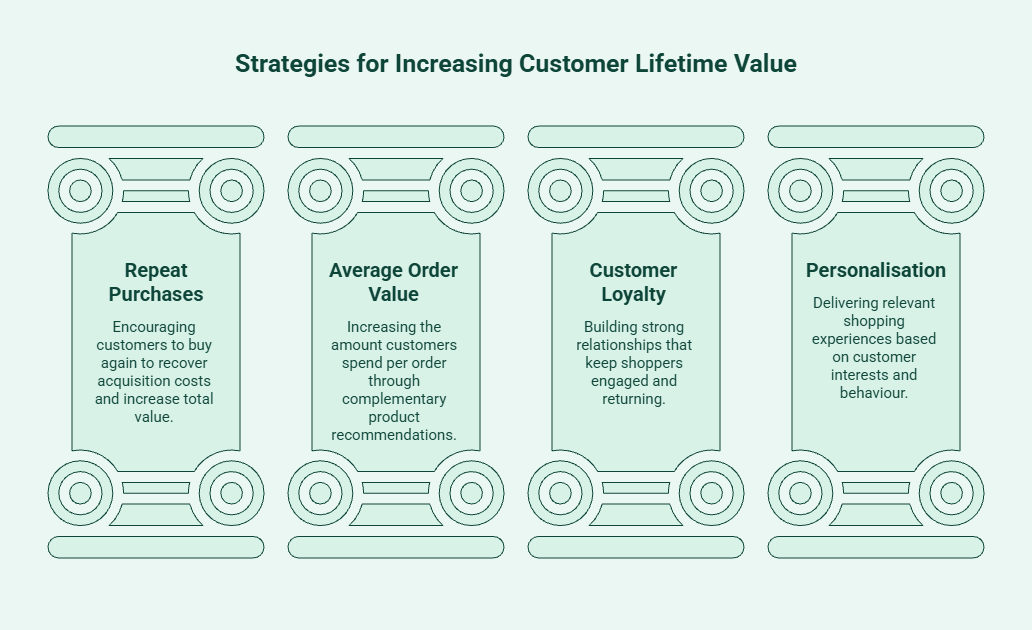
Increasing customer lifetime value isn't about relying on a single tactic. Merchants see the biggest improvements when they encourage customers to buy again, increase the value of each order, and build stronger relationships that keep shoppers engaged over time.
Acquiring a customer is often the most expensive part of the buying journey. Every repeat purchase helps recover that acquisition cost while increasing the total value each customer generates.
Focus on strategies that encourage customers to come back:
Increasing the amount customers spend per order can lift customer lifetime value without increasing traffic. The key is recommending products that genuinely complement what customers are already buying.
Effective ways to increase average order value include:
Customers are more likely to stay with brands that consistently deliver value beyond the first purchase. Loyalty isn't built through discounts alone; it's created through rewarding experiences and consistent engagement.
Strengthen customer loyalty by:
Customers respond better to offers that reflect their interests and buying behaviour. Instead of sending the same promotion to everyone, use customer data to deliver more relevant shopping experiences.
Start by:
Improving customer lifetime value is an ongoing process rather than a one-time project. The most successful Shopify merchants review customer behaviour regularly, test different retention strategies, and refine their approach based on what drives customer return.
Customer lifetime value helps Shopify merchants look beyond individual sales and measure the long-term value of every customer relationship. By consistently tracking CLV, you can make smarter decisions about retention, marketing efforts, and customer experience while building more sustainable revenue.
Kefi Commerce helps you put those insights into action. From loyalty programs and personalised promotions to bundles, upsells, and referral campaigns, it brings your growth strategies together in one platform, making it easier to increase customer lifetime value and drive long-term growth.
Kefi Commerce, Lifetimely, RetentionX, and Shopify Analytics help automate customer lifetime value calculations. The right choice depends on whether you need basic reporting, customer segmentation, profitability insights, or tools that help increase customer lifetime value.
Yes. Shopify reports and third-party tools like Lifetimely and RetentionX let you analyse customer lifetime value by segments such as first-time buyers, repeat customers, purchase history, or purchase patterns and spending patterns, helping you identify your most valuable customer groups.
Use Shopify CLV data to identify your highest-value customers, personalise marketing campaigns, improve customer retention, increase repeat purchases, and allocate your marketing budget more effectively. These insights help you focus on strategies that deliver sustainable, long-term revenue growth.
Shopify doesn't provide customer lifetime value as a ready-made metric, so merchants often need to combine multiple reports or use third-party tools. Tracking customer lifespan, purchase frequency, and customer segments consistently can also become challenging as a store grows.
Use Shopify data to identify your highest-value customers, monitor repeat purchase behaviour, and spot opportunities to increase average order value. Then, create personalized offers, loyalty programs, and retention campaigns that encourage customers to provide valuable customer feedback, buy more often, and stay engaged with your brand.
Review customer lifetime value regularly using a consistent reporting period, segment customers by buying behaviour, and compare CLV alongside metrics like average order value, purchase frequency, and retention rate. This helps you identify trends and make more informed growth decisions.
Yes. Shopify merchants can use free customer lifetime value calculators or spreadsheet templates to estimate CLV. Many third-party tools also offer built-in calculators that automatically use your store's customer and sales data.
Shopify doesn't provide a dedicated customer lifetime value report, but its native analytics offer the customer and sales data needed to calculate CLV using reports such as sales, customer cohorts, and returning customer metrics.
.svg)
