.png)
Getting customers to place their first order is already expensive. Getting them to buy more without hurting your margins is where many Shopify merchants start struggling. Rising ad costs, higher competition, and lower repeat purchase rates have made it harder for stores to rely only on basic discount codes or one-time promotions.
That is exactly why Shopify tiered discounts work so well for e-commerce brands today. Instead of offering the same flat discount to everyone, tiered pricing encourages shoppers to spend more gradually by unlocking better savings at higher cart values or quantities. This helps merchants increase average order value while keeping pricing strategies more profitable.
The good news is that learning how to create tiered discounts in Shopify is much easier than most store owners expect. Whether you want quantity breaks, bulk discounts, spend-based rewards, or advanced volume pricing, Shopify supports multiple ways to build these campaigns.
In this guide, you will learn how Shopify tiered discounts work, when to use a Shopify tiered discount app, and how to create offers that improve conversions, repeat purchases, and long-term profitability.
Tiered discounts in Shopify are pricing offers that give customers bigger savings as they spend more or purchase more. Instead of offering the same promotion to everyone, the discount increases with purchase level.
For example:
This pricing strategy works because customers feel rewarded for increasing cart value instead of being pushed into a purchase.
Shopify merchants commonly use tiered discounts through:
Tiered pricing usually performs best for products that customers buy repeatedly or in larger quantities, such as supplements, skincare, coffee, beauty products, fashion items, and wellness products. Many Shopify stores also combine these offers with loyalty rewards and referral incentives to encourage repeat purchases more naturally.
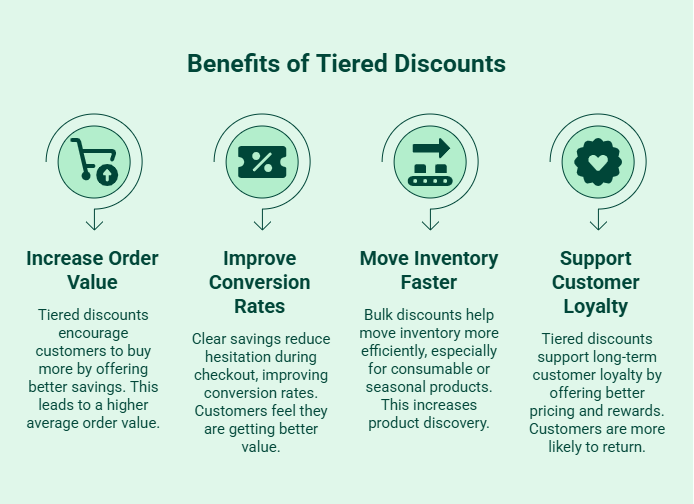
Tiered discounts work because they make larger purchases feel more rewarding instead of more expensive. Rather than pushing aggressive promotions, the pricing structure gives shoppers a clear reason to add extra products to their cart.
One of the biggest advantages of tiered pricing is a higher average order value. Customers are often willing to buy more when they can unlock better savings through quantity breaks or spend thresholds.
Even simple offers like:
can encourage larger purchases naturally. This works especially well for Shopify stores selling consumables, bundles, subscriptions, and repeat-purchase products.
Clear savings help reduce hesitation during checkout. Shoppers quickly understand offers such as:
According to e-commerce conversion research, easy-to-understand pricing incentives often improve conversion rates because customers feel they are getting better value.
For merchants, this matters because clearer incentives often improve conversion rates without requiring major product page redesigns or expensive CRO changes.
Tiered pricing also helps merchants manage inventory more efficiently. Instead of running deep markdown campaigns that hurt profitability, stores can use volume pricing and quantity breaks to increase sell-through more gradually.
This is especially useful for:
Many Shopify merchants also use tiered discounts to increase product discovery across related products and bundles.
Tiered discounts are not only useful for short-term sales. They also support repeat purchase behavior when combined with loyalty rewards, subscriptions, referrals, or VIP programs.
For Shopify merchants, this matters because returning customers usually generate stronger long-term profitability than constantly acquiring new traffic through ads and social media campaigns.
When tiered discounts feel clear, valuable, and easy to unlock, they support both conversion growth and long-term customer retention without making the shopping experience feel overly promotional.
Running a fashion or apparel brand on Shopify? Explore our guide to the best Shopify apps for clothing stores and discover tools that improve product pages, customer experience, conversions, and repeat purchases.
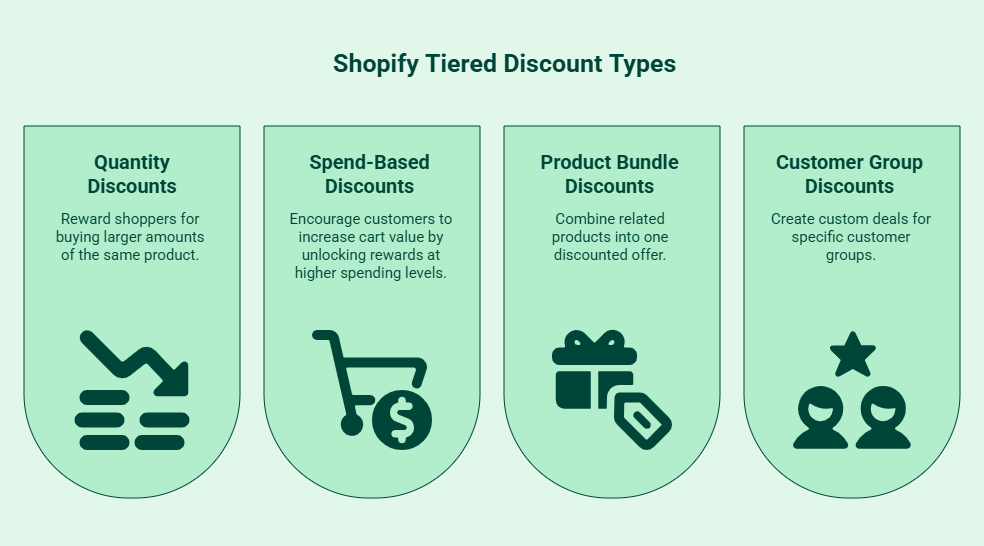
Different discount structures solve different business goals. Some are designed to boost average order value, while others help increase repeat purchases or move inventory faster. Choosing the right setup depends on your products, pricing margins, and customer behavior.
Quantity discounts reward shoppers for buying larger amounts of the same product. The more they purchase, the bigger the savings become.
Common examples include:
This setup works especially well for consumable products, repeat purchases, and bulk buying behavior.
Spend-based promotions encourage customers to increase cart value before checkout by unlocking rewards at higher spending levels.
Popular examples include:
These offers work well across multiple product categories because they focus on total order value instead of individual items.
Bundle discounts combine related products into one discounted offer. Instead of purchasing items separately, customers receive better pricing through curated product combinations.
Popular product bundles include:
This approach simplifies buying decisions while helping boost AOV naturally.
Some Shopify merchants create custom deals for specific customer groups instead of offering the same promotion to everyone.
This often includes:
Customer group discounts work especially well for B2B ecommerce, subscription businesses, and long-term customer loyalty strategies.
The best Shopify tiered discounts are usually the ones that feel simple, valuable, and easy for customers to understand quickly.
Want to improve product presentation alongside your Shopify discounts? Explore the best Shopify apps for variant image swatches and learn how cleaner product options can improve customer experience and conversions.
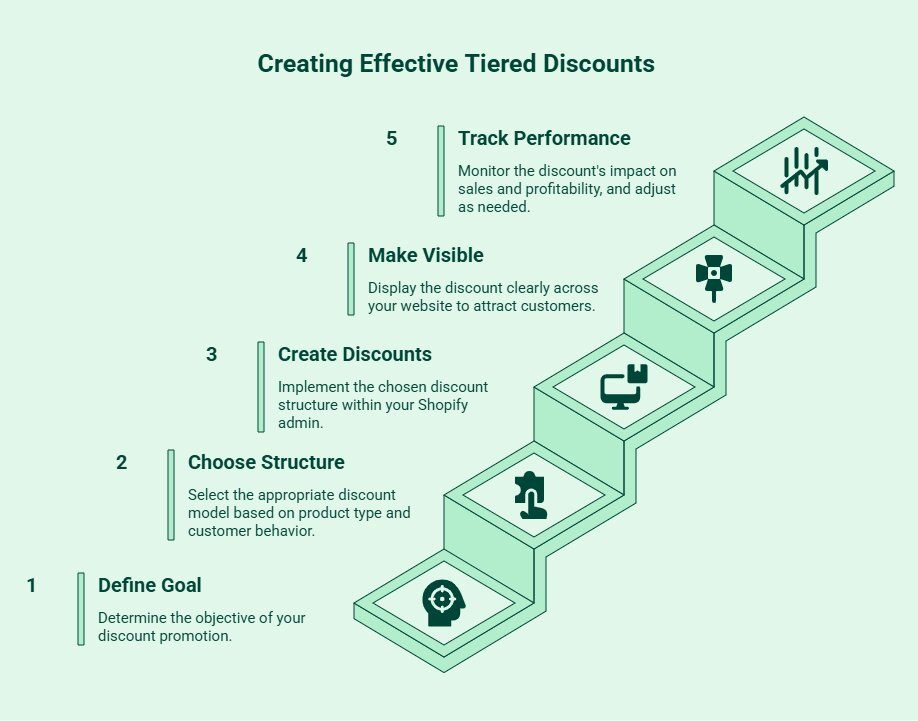
Setting up Shopify tiered discounts is much simpler than it looks. For basic promotions, Shopify’s native discount tools are often enough. And if you need advanced volume pricing, quantity breaks, or custom deals, a Shopify tiered discount app can provide more flexibility.
Before creating any promotion, decide what you want the discount to achieve. Different goals usually require different pricing structures.
Your goal may include:
Starting with a clear objective makes it easier to choose the right pricing logic and avoid unnecessary discount complexity.
Different products respond differently to promotions, so your discount structure should match customer buying behavior and profit margins.
For example:
The best Shopify tiered discounts usually feel simple enough for customers to understand immediately.
Inside your Shopify admin:
Basic Shopify discounts work well for straightforward offers. Stores needing advanced discount tiers or custom pricing may eventually benefit from a Shopify volume discount app.
Even strong promotions can underperform if customers do not notice them quickly. Your discount messaging should feel clear across the buying journey.
Display tiered discounts through:
Visible savings often improve customer confidence during checkout.
After launching the promotion, monitor how it affects:
The goal is not to offer the biggest discount possible. The goal is to create a pricing strategy that increases sales while protecting profitability.
The most effective Shopify tiered discounts are usually the simplest ones. Clear pricing, visible savings, and easy-to-understand offers often perform better than overly complicated discount structures.
Looking for more ways to increase conversions beyond tiered pricing? Explore our guide to the best Buy One Get One Shopify apps and discover how BOGO deals can help boost sales, average order value, and customer engagement.
Shopify’s native discount tools are a good starting point for basic promotions, especially for smaller Shopify stores with simpler pricing rules. But as your catalog grows and discount strategies become more advanced, managing promotions manually can quickly become limiting.
That is where a Shopify tiered discount app becomes more valuable. The right app helps merchants automate pricing logic, improve customer experience, and scale promotions without constantly adjusting discounts inside the Shopify admin.
Native Shopify discounts work well when your store only needs:
This setup keeps your Shopify account easier to manage while avoiding unnecessary app complexity or additional script load on product pages and cart pages.
A dedicated app becomes more useful when your pricing strategy requires:
This becomes especially important for larger Shopify stores, subscription businesses, wholesale sellers, and merchants managing large groups of products.
Not every discount app fits every Shopify store. Instead of choosing based only on pricing or app ratings, merchants should evaluate how the app supports long-term growth, ease of management, and customer experience.
The app should feel manageable without requiring hours of manual configuration or developer support. Clear onboarding, intuitive controls, and flexible templates usually reduce setup friction significantly.
Look for:
Advanced discount strategies often require different offers for different customer groups. A stronger app should support segmentation based on:
This helps merchants personalize offers instead of showing identical discounts to every shopper.
Some Shopify merchants only focus on short-term sales, but stronger discount strategies also support repeat purchases and long-term retention.
Look for apps that can work alongside:
This creates a more sustainable growth strategy instead of relying only on aggressive discounts.
Discount campaigns should improve profitability, not just increase order volume. A good app should help merchants track:
Access to better analytics makes optimization much easier over time.
Discount apps directly affect cart behavior, checkout flows, and product pages, so compatibility matters significantly.
Before choosing an app, review:
Heavy apps can sometimes create UX issues that hurt conversion rates instead of improving them.
Some discount apps work well for smaller stores but become harder to manage as product catalogs and campaigns grow.
Choose a platform that can scale with:
The best Shopify tiered discount app should simplify promotions as your business grows, not create more operational complexity.
For many Shopify merchants, native discounts are enough initially. But once pricing strategies become more advanced, a dedicated tiered-discount app often becomes necessary for better automation, scalability, and the customer experience.
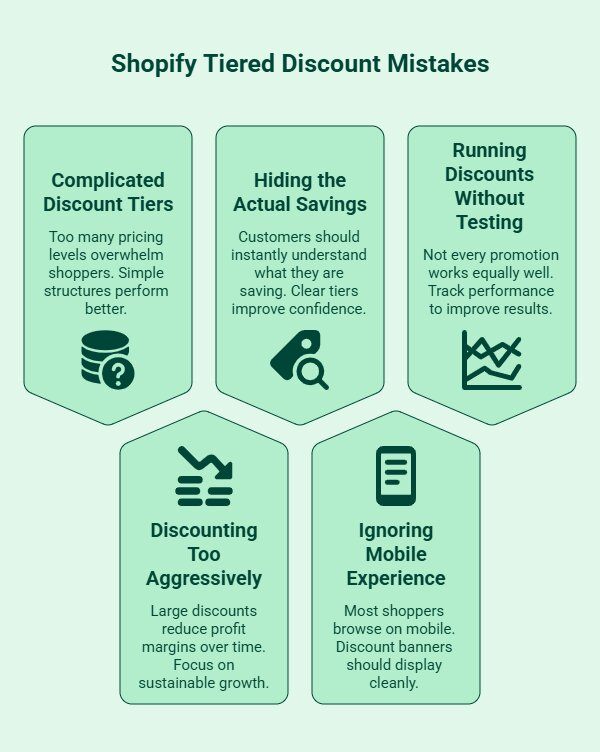
Tiered discounts can increase sales and average order value, but poorly structured promotions often create confusion or hurt profitability. The best discount strategies usually feel simple, clear, and easy to understand.
Too many pricing levels can overwhelm shoppers quickly. If customers need extra time to understand the offer, they are more likely to leave without purchasing.
Simple discount structures usually perform better because the savings feel immediate and clear.
Large discounts may drive short-term sales, but they can reduce profit margins over time. Before launching bulk discounts or volume pricing campaigns, calculate whether the promotion still supports healthy profitability.
The goal is sustainable sales growth, not just higher order volume.
Customers should instantly understand what they are saving. Clear quantity breaks, visible discount tiers, and free shipping offers help improve customer confidence during checkout.
If the savings are difficult to find, the promotion becomes less effective.
Most Shopify shoppers now browse on mobile devices. Discount banners, pricing tables, and widgets should display cleanly across different Shopify themes without cluttering the product page.
A poor mobile experience can hurt conversion rates quickly.
Not every promotion works equally well for every store. Track performance using analytics, A/B testing, and customer behavior data to understand which discount structures actually improve results.
Small pricing adjustments can sometimes create a major difference in conversions and profitability.
The best Shopify tiered discounts are usually the ones that feel valuable to customers while remaining easy for merchants to manage profitably.
Tiered discounts are not only useful for increasing short-term sales. When used strategically, they also encourage repeat purchases and help build stronger long-term customer relationships.
Customers who unlock better pricing or rewards are often more likely to return for future purchases. This works especially well for products that customers buy regularly or in larger quantities.
Tiered pricing performs particularly well for:
The savings create an extra incentive to keep purchasing from the same store.
Tiered discounts become even more effective when combined with retention strategies. Many Shopify merchants pair discount tiers with:
This helps improve customer loyalty while naturally increasing order value.
Repeat customers often generate more long-term revenue than constantly acquiring new traffic through paid ads or social media campaigns. For many e-commerce brands, combining tiered pricing with loyalty systems creates a more sustainable growth strategy focused on retention instead of one-time purchases.
When customers feel rewarded for returning, discounts become more than just promotions. They become part of the overall customer experience.
Tiered discounts can increase average order value, but long-term growth depends on getting customers to return after the first purchase. Kefi Commerce helps Shopify merchants improve customer loyalty through rewards, VIP programs, referrals, and retention campaigns that work alongside “buy more, save more” promotions.
With Kefi commerce, you can:
This works especially well for Shopify stores using tiered pricing, product bundles, free gifts, or volume discounts to boost sales.
Ready to turn first-time buyers into repeat customers? Explore Kefi Commerce on the Shopify App Store and start building smarter loyalty experiences for your Shopify store.
Shopify tiered discounts work best when the offers feel simple, valuable, and easy for customers to understand. Whether you use native Shopify discounts or a dedicated buy more save more Shopify app, the right pricing strategy can increase average order value, improve conversion rates, and encourage repeat purchases naturally.
Start with clear discount tiers, track customer behavior carefully, and focus on promotions that support both sales growth and long-term profitability.
You can create basic tier discounts directly inside the Shopify admin using Shopify automatic discounts and discount codes. For more advanced discount types like quantity breaks, VIP pricing, or different tiers, many Shopify merchants use apps that offer easier setup without coding.
Popular Shopify apps for tiered discount systems include Kefi, Bundle Bear, Monk, and Pumper Bundles. These apps support bulk purchases, tiered automatic discounts, VIP pricing, and minimum purchase requirements while helping merchants improve order size and overall sales strategy.
Shopify automatic discounts can handle basic promotions with a start date, end date, minimum order value, or discount value. However, stores needing advanced tier discounts, higher tiers, or customer-specific pricing often require a dedicated Shopify app for better flexibility.
Quantity-based tier discounts reward customers as they purchase larger amounts of specific products. For example, buying two items may unlock 10% off, while higher tiers activate bigger savings once customers reach the minimum quantity of items required for the promotion.
Yes, many Shopify apps support VIP pricing through customer tags and customer groups. This allows Shopify merchants to create exclusive discount types for new customers, loyalty members, wholesale buyers, or repeat shoppers without affecting full price offers across the online store.
Common mistakes include confusing different tiers, unclear minimum purchase requirements, poor mobile visibility, and discounts that reduce margins too aggressively. The most effective ways to improve conversions usually involve simple promotions, strong ease of use, and clear messaging throughout the online store.
.svg)
