

In today's competitive market, simply having a loyalty program is not enough to guarantee success. The real power lies in understanding the data it generates. By analyzing how customers interact with your brand, you can transform a basic rewards system into a dynamic engine for building stronger customer relationships. A well-designed loyalty platform, backed by insightful analytics, is your key to unlocking deeper customer engagement and driving sustainable growth for your business.
Loyalty program analytics is the systematic process of collecting, analyzing, and interpreting loyalty data to understand customer behavior and identify patterns that signal loyalty. By examining the performance metrics of your rewards program, you can gain valuable insights into what motivates your customers. This includes tracking everything from purchase history and reward redemptions to engagement with marketing materials and social media interactions. The goal is to move beyond assumptions and use hard data to see how your program is truly performing.
Through this analytical process, businesses can significantly improve their loyalty programs. For instance, you can determine which rewards are most effective, identify segments of your customer base that are at risk of churning, and uncover opportunities to personalize the customer experience. This allows you to make strategic adjustments to your rewards program, ensuring it remains relevant, engaging, and effective at increasing customer lifetime value and fostering long-term relationships.
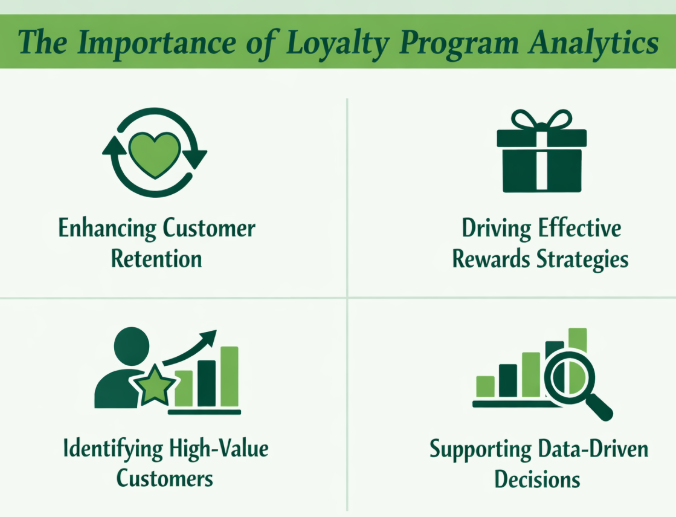
Loyalty program analytics are critical because they transform raw customer data into a roadmap for strategic decision-making. Without analyzing this information, you're essentially flying blind, unable to understand what drives repeat purchases or why some customers disengage. The following sections will explore the specific benefits in more detail.
Loyalty analytics help businesses monitor customer behavior and identify early signs of disengagement. By tracking metrics like purchase frequency and activity levels, brands can proactively target at-risk customers with personalized campaigns and incentives, turning them into loyal brand advocates. This targeted approach improves retention by addressing issues before customers churn, ensuring stronger and longer-lasting customer relationships. It also enables businesses to segment users more effectively based on engagement levels. As a result, brands can deliver timely and relevant communication that keeps customers consistently engaged.
Analytics provide valuable insights into which rewards resonate most with customers and which ones fail to drive engagement. By analyzing redemption rates and customer preferences, businesses can refine their reward structures, introduce more appealing incentives, and simplify redemption processes. This ensures that loyalty programs remain relevant, engaging, and aligned with customer expectations. Additionally, it allows brands to experiment with different reward formats and quickly identify which ones work best. Over time, this leads to a more efficient and impactful rewards strategy.
Through loyalty analytics, businesses can identify their most valuable customers based on purchase behavior and engagement levels. These high-value customers contribute significantly to revenue and can be nurtured through exclusive perks, personalized offers, and VIP experiences that foster emotional loyalty. Recognizing and investing in these customers helps maximize lifetime value and strengthens long-term brand loyalty. It also enables brands to predict which customers are likely to become high-value customers. This proactive approach ensures better resource allocation and stronger customer relationships.
Loyalty analytics eliminate guesswork by providing clear, data-backed insights into program performance. Businesses can analyze trends, measure effectiveness, and make informed adjustments to their strategies. This allows for better resource allocation, improved campaign performance, and continuous optimization of the loyalty program. It also helps teams align their decisions with measurable outcomes rather than assumptions. Over time, this leads to more consistent growth and improved return on investment.
Also Read: What are the Best Loyalty Apps for Shopify Growth?
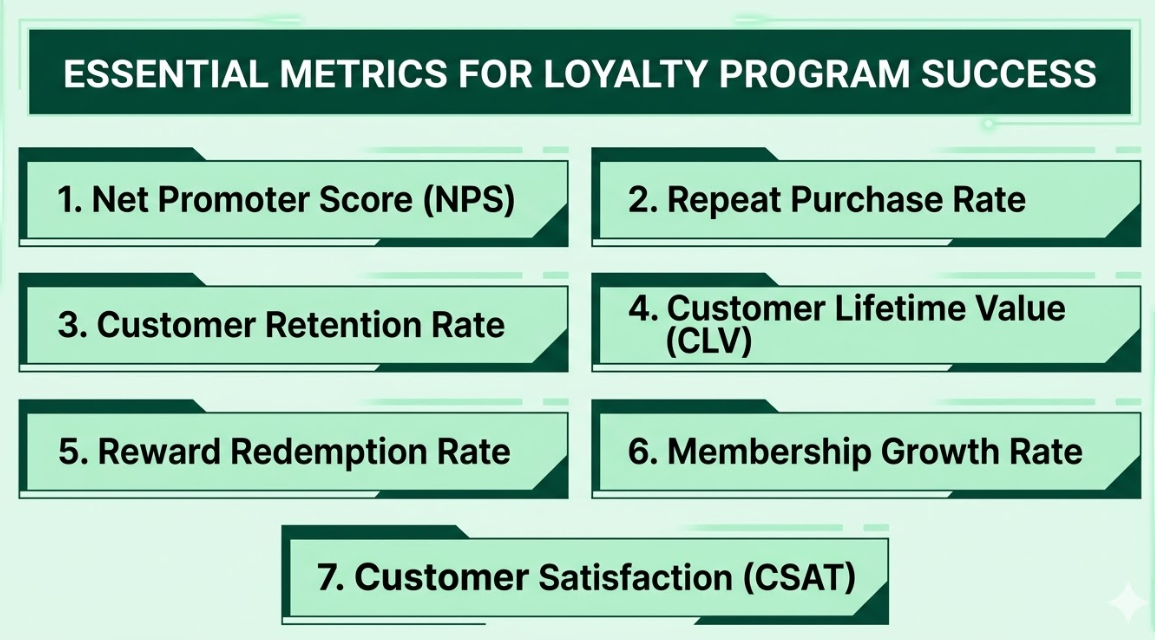
To build an effective loyalty program, you need to track the right key performance indicators (KPIs). These metrics provide a clear view of your loyalty members' behavior and your program's health and its impact on business goals. Monitoring this loyalty data helps you understand your program members' behavior and gauge overall customer satisfaction. The following sections will cover the most important metrics to track in loyalty program analytics.
Net Promoter Score measures customer loyalty by evaluating how likely customers are to recommend a brand to others. It reflects overall customer sentiment and helps identify promoters and detractors. A high NPS indicates strong customer advocacy, while a low score highlights areas that need improvement to enhance customer satisfaction and loyalty. It also serves as an early indicator of potential growth through word-of-mouth marketing. Regularly tracking NPS helps businesses stay aligned with customer expectations.
Repeat Purchase Rate indicates the percentage of customers, including new members, who return to make additional purchases. It is a direct measure of customer loyalty and the effectiveness of retention strategies. A higher rate suggests that customers value the brand, while a lower rate signals a need for improved engagement and incentives. This metric also helps identify which products or experiences drive repeat behavior. By optimizing these factors, businesses can increase long-term customer value.
Customer Retention Rate measures the percentage of customers a business retains over a specific period. It reflects how well a brand maintains customer relationships and prevents churn through effective customer service. A strong retention rate indicates consistent value delivery and customer satisfaction, making it a key indicator of long-term business health. It also highlights the effectiveness of loyalty initiatives and customer experience strategies. Improving this metric can significantly reduce acquisition costs and boost profitability.
Customer Lifetime Value estimates the total revenue a business can expect from a customer over the entire relationship. It helps businesses understand the long-term value of their customers and evaluate the return on investment of loyalty programs. A higher CLV indicates stronger loyalty and more profitable customer relationships. This metric also guides decisions around customer acquisition and retention spending. By focusing on increasing CLV, brands can build more sustainable growth strategies.
The reward redemption rate measures how frequently customers use the rewards they earn. It reflects how appealing and accessible the program's rewards are. A healthy redemption rate indicates strong engagement among the total number of customers using the program, while a low rate may suggest the need to improve reward offerings or simplify the redemption process. It also provides insight into how customers perceive the program's value. Optimizing this metric can significantly enhance overall participation and satisfaction.
Membership Growth Rate tracks how quickly new users are joining the loyalty program over a given period. It highlights the effectiveness of marketing efforts and the program's attractiveness. Consistent growth indicates strong appeal, while slow growth may signal barriers to sign-up or an unclear value proposition. This metric also helps measure the impact of promotional campaigns and onboarding strategies. By improving growth rates, businesses can more effectively expand their loyal customer base.
Customer Satisfaction measures how happy customers are with their overall experience. It is typically gathered through surveys and reflects the quality of interactions, products, and services. High satisfaction levels contribute to better retention and loyalty, while lower scores highlight areas that require immediate improvement. It also helps identify specific pain points in the customer journey. Regular monitoring ensures that businesses can continuously enhance the overall customer experience.
Also Read: How a Premier Portuguese Winery Cultivated a +16.80% AOV Lift.

Benchmarking your loyalty data against industry standards and internal trends is essential to understanding your program's performance in context. Without it, your performance metrics lack the perspective needed to determine if they are good, average, or in need of improvement. The following sections explore how to benchmark your loyalty program effectively.
Tracking industry benchmarks provides valuable context for evaluating your loyalty program’s performance. By comparing your metrics with industry averages, you can determine whether your program is performing well or falling behind. Key indicators such as repeat purchase rate, customer retention rate, reward redemption rate, and average order value offer a strong foundation for comparison. These benchmarks act as reference points that help you set realistic expectations and identify performance gaps. Regularly monitoring these standards allows businesses to stay informed about trends and continuously refine their loyalty strategies.
Analyzing performance across different customer segments helps uncover deeper insights that overall metrics often miss. Not all customers behave the same way, and segmenting them by factors such as purchase history, engagement level, or demographics enables more precise analysis. By comparing how each segment interacts with your loyalty program, you can identify which groups are highly engaged and which need attention. This approach enables businesses to tailor communication, rewards, and campaigns more effectively. As a result, brands can create more personalized experiences that improve engagement and overall program performance.
Setting realistic and measurable goals is a critical step in improving your loyalty program. Benchmarking provides the necessary context, but your targets should align with your current performance and business objectives. By establishing a clear baseline, you can set achievable goals such as increasing repeat purchase rate or improving retention over a specific period. These goals give direction to your strategy and help teams stay focused on measurable outcomes. Regularly reviewing progress against these targets ensures continuous improvement and keeps your loyalty efforts aligned with business growth.
Cohort analysis allows businesses to track groups of customers over time based on shared characteristics, such as their signup date. This method provides a deeper understanding of customer behavior compared to overall aggregated metrics. By comparing how different cohorts perform, businesses can identify patterns and determine what changes positively or negatively impact engagement and retention. It also helps isolate the effects of specific campaigns or program updates. Using cohort analysis enables more accurate decision-making and helps refine loyalty strategies based on long-term behavioral trends.
Also Read: How The Chosen Cultivated a Community through Curated Merchandise Kits.
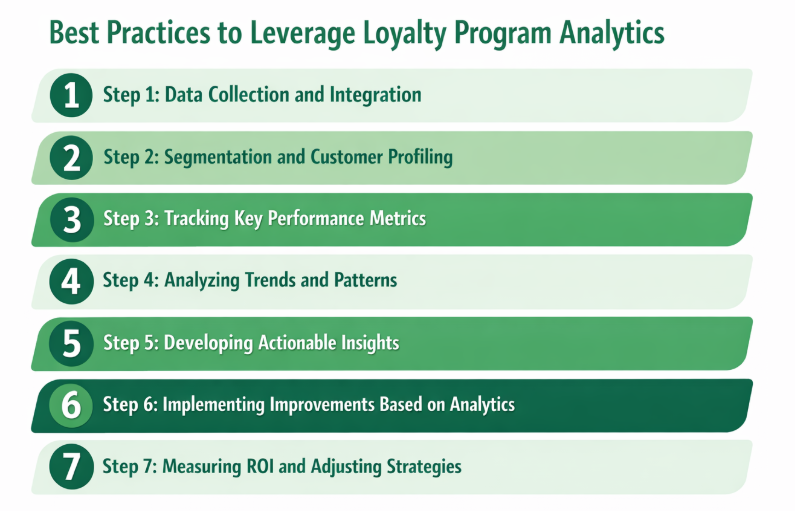
To truly leverage loyalty program analytics, you need a structured approach that transforms data into action. Following best practices ensures you are not just collecting data but using it to drive meaningful improvements. This involves everything from integration and customer segmentation to consistent tracking of performance metrics. The following steps outline a proven framework for success.
The foundation of effective loyalty analytics is comprehensive data collection and integration. This involves gathering loyalty data from every customer touchpoint, including online purchases, in-store transactions, website visits, mobile app usage, and interactions with open loyalty marketing campaigns.
To create a unified view of each customer, this data must be integrated. This often means connecting various systems, such as your point-of-sale (POS) system, e-commerce platform, and customer relationship management (CRM) software. A central repository for all customer data is essential for accurate and holistic analysis.
Without proper integration, your data remains in silos, making it impossible to get a complete picture of customer behavior. By unifying your loyalty data, you create a single source of truth that powers all subsequent loyalty analytics efforts, ensuring your insights are based on a complete and accurate dataset.
Once your data is integrated, the next step is customer segmentation and profiling. This involves dividing your customer base into distinct groups based on shared characteristics, such as demographics, purchasing habits, engagement levels, or loyalty tier. This process allows for more targeted and relevant marketing.
Customer profiling goes a step further by creating detailed personas for each segment. For example, you might create profiles for "High-Value VIPs," "Occasional Shoppers," and "At-Risk Customers." Each profile would include information about their preferences, behaviors, and potential value to the business.
This level of segmentation is crucial for developing actionable insights. Instead of treating your entire customer base as a monolith, you can tailor your strategies to the unique needs and motivations of each group. This personalized approach is far more effective at driving engagement and maximizing the value of your loyalty program.
Consistent tracking of key performance indicators (KPIs) is essential for measuring the health and success of your loyalty program. You need to establish a dashboard of core performance metrics and monitor them regularly to understand trends and identify areas for improvement.
This isn't about tracking every possible data point but focusing on the KPIs that are most aligned with your business goals. These metrics provide a clear, at-a-glance view of how your program is performing and whether you are on track to meet your objectives.
Key performance metrics to track should include:
Also Read: How to Succeed Loyalty Program Cost Calculation?
With your key metrics being tracked, the next step is to analyze the data for meaningful trends and patterns. This goes beyond looking at a single number and involves examining how metrics change over time and in response to different marketing efforts. This is where raw data begins to tell a story.
Look for correlations in customer behavior. For example, do you see a spike in purchase frequency after launching a double-points campaign? Does a particular customer segment redeem rewards more often than others? Identifying these patterns can provide valuable insights into what drives your customers.
This analysis helps you understand the "why" behind your data. It reveals the effectiveness of your strategies and uncovers opportunities you might have otherwise missed. By dedicating time to trend analysis, you can refine your marketing efforts and make your loyalty program more impactful.
The goal of all your data analysis is to develop actionable insights. An insight is more than just an observation; it's an understanding of customer behavior that you can use to make a specific, strategic improvement. This is the crucial step where data translates into business value.
For example, an observation might be that your reward redemption rate is low. An actionable insight derived from loyalty analytics is that customers in a particular segment are accumulating points but not redeeming them because the rewards don't align with their interests.
Based on this insight, you can take clear action, such as introducing new rewards tailored to that segment or running targeted loyalty campaigns to promote relevant offers. This process ensures that your marketing campaigns and program adjustments are driven by a deep understanding of customer specific needs, not just guesswork.
Developing insights is only half the battle; you must then implement improvements based on your findings, including customer feedback. This is where your loyalty strategy becomes dynamic and responsive. Use your analytics to guide changes to your loyalty rewards, communication, and overall program structure.
For instance, if your data shows that customers respond well to experiential rewards, you might shift your focus away from simple discounts. If you find that a particular marketing channel is underperforming, you can reallocate your budget to more effective channels.
To ensure success, it's important to:
The final step in the cycle is to measure the return on investment (ROI) of your loyalty program and adjust your strategies accordingly. Calculating ROI helps you justify the program's existence and ensures it is contributing positively to your bottom line.
To calculate the ROI of a loyalty program using analytics, you must compare the financial gains from the program against its costs. Gains can be measured by the incremental total revenue generated by members (e.g., higher customer lifetime value, increased purchase frequency). Costs include technology, marketing, rewards, and acquisition costs. The formula is: (Gain from Investment - Cost of Investment) / Cost of Investment.
Regularly measuring ROI allows you to demonstrate the program's value and make data-driven decisions about future investments. If the ROI is low, loyalty analytics can help you identify which parts of your strategy need to be adjusted to improve performance and deliver better financial results.
Also Read: How Squaties Scaled Order Volume via Performance Bundling.
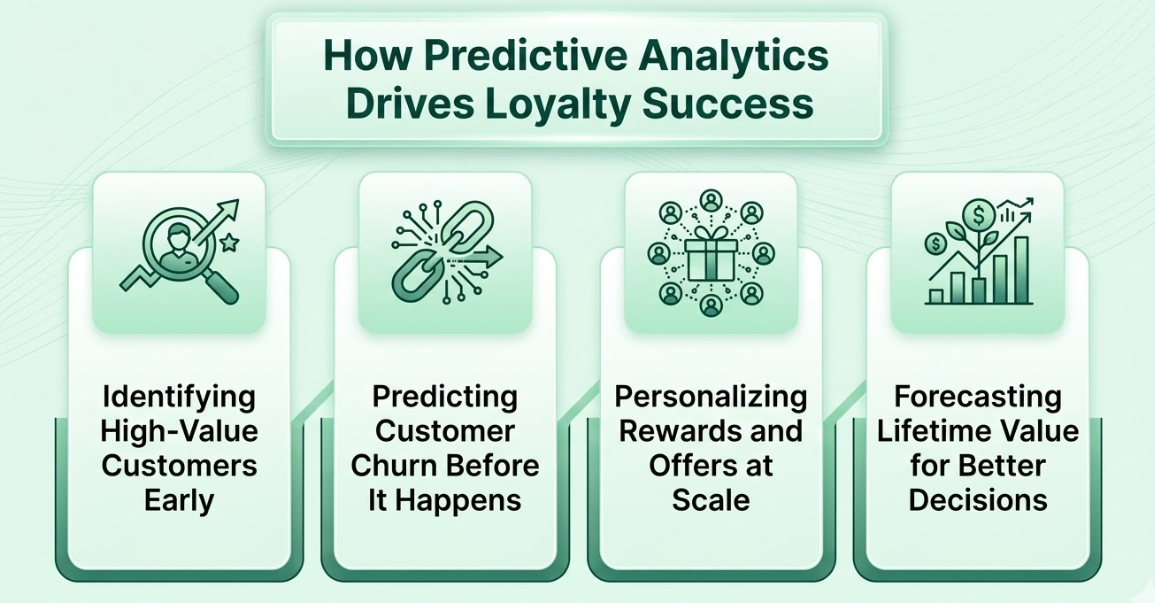
Predictive analytics takes loyalty program analysis to the next level by using historical data and AI models to forecast future customer behavior. This proactive approach allows you to anticipate customer needs, identify risks, and personalize experiences before customers even act. Predictive analytics can help optimize loyalty programs by shifting from reactive adjustments to proactive, data-driven strategies that anticipate future needs. The following points illustrate how.
Predictive analytics allows you to identify potential high-value customers long before their spending habits make it obvious. By analyzing early engagement signals, such as browsing behavior, initial purchase categories, and interaction with marketing content, predictive models can forecast which new customers have a high potential customer lifetime value.
This foresight enables you to start nurturing these relationships from day one. Instead of waiting for them to prove their customer value, you can proactively offer them personalized experiences and incentives that accelerate their journey toward becoming loyal customers.
With this capability, you can:
One of the most powerful applications of predictive analytics is its ability to forecast customer churn. By analyzing subtle changes in behavior—such as declining purchase frequency, reduced engagement with emails, or a halt in reward redemptions—predictive models can identify customers who are at high risk of leaving.
This early warning system is invaluable for customer retention. It allows you to implement proactive, targeted strategies to re-engage at-risk customers before they are lost for good. A personalized offer or a simple check-in can make all the difference in preventing churn.
By focusing your efforts on these specific customers, you can significantly improve your overall retention rate. This targeted approach is far more cost-effective than broad, untargeted retention campaigns and helps ensure the long-term health of your loyalty platform by keeping your churn rate low.
Predictive analytics enables true one-to-one personalization for your rewards program, even with millions of members. By analyzing an individual's past behavior and predicting their future interests, you can automatically tailor loyalty rewards and offers to be uniquely relevant to them.
This moves beyond basic segmentation to a level of personalization where each customer feels that the marketing campaigns are designed specifically for them. For example, the system can predict which product a customer is likely to buy next and automatically send them a relevant offer.
This hyper-personalization makes your rewards program significantly more engaging and effective. When loyalty rewards align perfectly with a customer's needs and desires, they are far more likely to take action, strengthening their connection to your brand and increasing the overall impact of your program.
Predictive analytics enhances your ability to forecast Customer Lifetime Value (CLV) with greater accuracy. Instead of relying solely on past purchase history, predictive models incorporate a wide range of behavioral data from your data collection efforts to project a customer's future worth to your business.
This forward-looking view of CLV provides powerful, actionable insights for strategic decision-making. For example, you can use these forecasts to determine how much you should invest in acquiring certain types of customers or which segments to prioritize for retention efforts.
By integrating predicted CLV into your loyalty analytics, you can allocate your resources more intelligently. This ensures that you are focusing your marketing budget and strategic efforts on the customers and activities that will generate the highest long-term return, maximizing the overall profitability of your customer base.
Also Read: How Metalbird drove consistent growth across 8 stores.
Kefi Loyalty Program, VIP Tier lets you set up a flexible points‑based loyalty system where customers earn rewards for purchases, signups, daily visits, and birthdays, and redeem those points for discounts, free shipping, or free products. It displays points in customer accounts, on a dedicated loyalty page, and in a floating widget, helping you easily track member activity and engagement. By reviewing which rewards and actions VIP members respond to most, you can understand customer behavior and tailor offers that deepen loyalty. This data can help you refine your VIP tier perks and target high‑value segments more effectively. While Kefi provides strong behavior insights, combining it with broader CRM or analytics tools gives an even clearer picture of loyalty performance and customer preferences.
Book a Demo to see how Kefi Loyalty Program, VIP Tier works.
In conclusion, leveraging loyalty program analytics is essential for driving business success and enhancing customer relationships. By understanding key metrics and applying best practices, businesses can gain valuable insights to inform data-driven decisions, optimize reward strategies, and ultimately improve customer retention. As you embrace the power of analytics, remember that every decision should aim to create a more personalized experience for your customers. This focused approach not only builds loyalty but also positions your brand as a trusted partner in your customers' journeys. Ready to take your loyalty program to the next level? Get started with Kefi's Product Bundle Builder today and unlock the full potential of your analytics!
Businesses can use data analytics to turn data collection into actionable insights. By analyzing customer behavior, they can personalize loyalty campaigns, improve rewards, and segment their audience. This data-driven loyalty strategy boosts customer satisfaction and ensures the program effectively meets customer needs, leading to higher engagement and retention.
The best tools are often integrated loyalty software or advanced customer relationship management (CRM) systems that offer dedicated dashboards for tracking performance metrics in real time. These platforms centralize loyalty analytics and provide valuable insights into customer behavior, allowing you to measure ROI and optimize your program effectively.
To calculate ROI using loyalty analytics, subtract the total program costs (rewards, technology, marketing, acquisition costs) from the incremental total revenue generated by members (e.g., increased customer lifetime value), and consider the total number of points redeemed. Divide this net gain by the total program costs to get your ROI percentage.
Yes, many modern loyalty software platforms are designed for multi-location businesses. They offer omnichannel loyalty capabilities that centralize data collection from all locations, allowing you to manage your entire customer base and track loyalty management program members seamlessly, whether they shop online or in different physical stores.
Yes, integrating customer relationship management (CRM) software with customer loyalty software and loyalty analytics tools is a common and highly effective practice. This data integration creates a unified loyalty platform that provides a 360-degree view of the customer and generates more valuable insights by combining sales, service, and loyalty data in one place.
Loyalty program analytics helps businesses track customer interactions, reward redemptions, and engagement patterns. It provides insights to improve program effectiveness and drive repeat purchases.
A restaurant loyalty program platform with analytics allows restaurants to monitor customer activity, track reward usage, and optimize campaigns. Platforms like Kefi make it easy to combine rewards and analytics in one system.
Advanced analytics for measuring loyalty program ROI calculates the financial impact of loyalty initiatives by tracking metrics such as repeat purchases, customer lifetime value, and loyalty points. This helps you understand which rewards deliver the best return.
The best customer data analytics for loyalty programs analyze purchasing behavior, segment customers, and predict engagement. These insights help brands tailor rewards and boost loyalty program performance.
Customer loyalty program analytics reveal which offers, rewards, or campaigns resonate most with customers. Using this data lets you create more personalized experiences and increase retention.
.svg)
