.jpg)

Getting customers to place their first order is only the first step. Long-term growth depends on turning those customers into repeat buyers. According to Adobe, returning customers generate around 40% of revenue while representing only about 8% of site visitors, highlighting the outsized impact of customer loyalty and retention on business growth.
Customer loyalty and retention work together but serve different purposes. Retention measures whether customers return, while loyalty reflects their preference for your brand over competitors. Building both requires more than a rewards program. It involves understanding customer behavior, offering relevant incentives, and creating consistent post-purchase experiences.
This guide explains the difference between customer loyalty and retention, how to strengthen both, which loyalty strategies work best for Shopify stores, how to measure success, and what to consider when choosing customer loyalty and retention software.
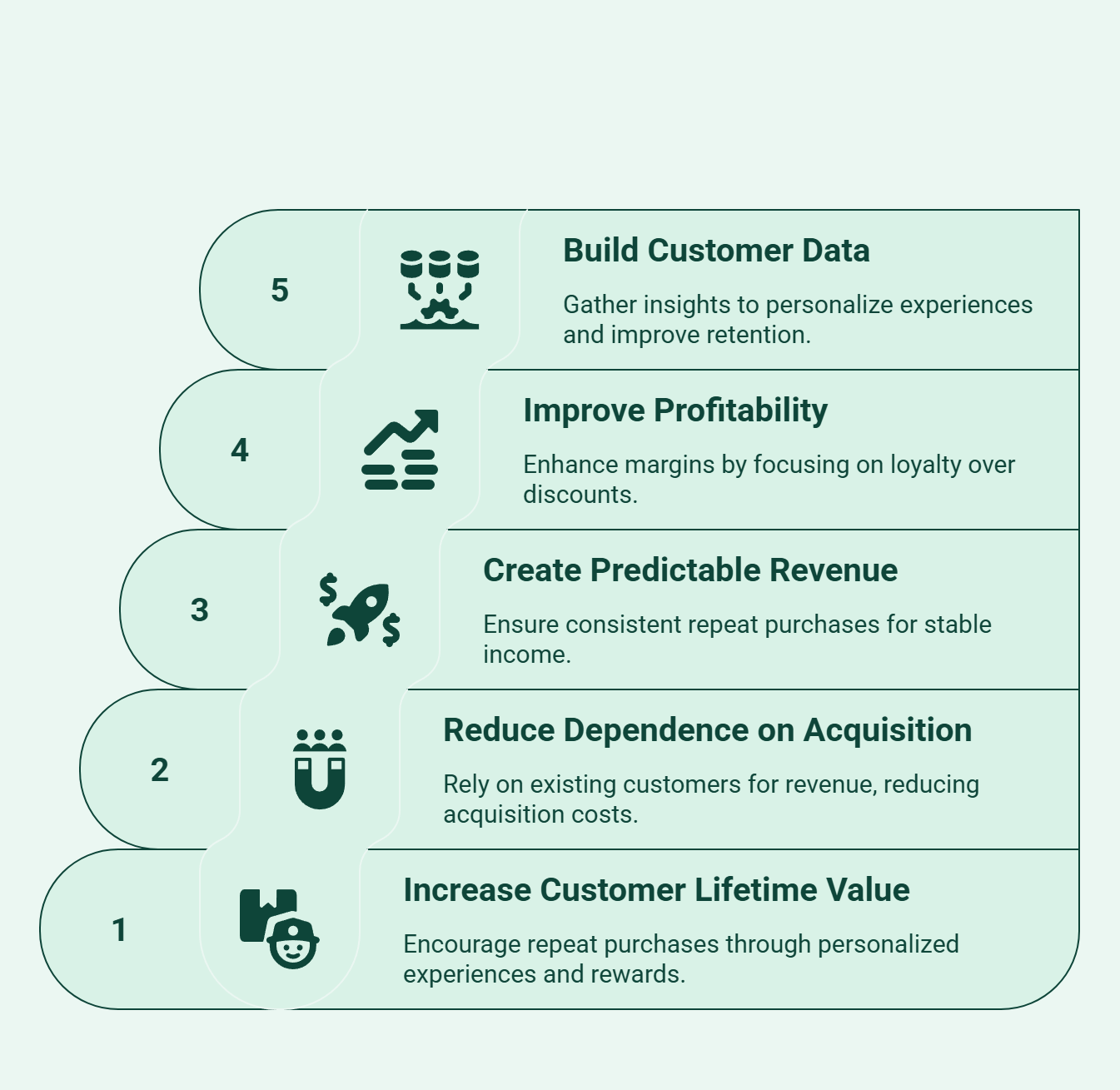
Growing a Shopify store isn't just about acquiring new customers. Long-term growth also depends on retaining existing customers and giving them reasons to keep choosing your brand. Strong customer loyalty and retention can increase customer value, improve revenue stability, and support more sustainable growth.
The first purchase is only the beginning of the customer relationship. Encouraging repeat purchases through personalized experiences, relevant rewards, and timely engagement increases customer lifetime value, allowing you to generate more revenue from every customer you acquire.
Retention doesn't directly lower the cost of acquiring an individual customer. Instead, a stronger base of repeat customers allows more revenue to come from people you've already acquired, reducing the pressure to continuously replace customers through paid acquisition and improving overall growth economics.
A healthy base of returning customers can provide greater revenue stability than relying primarily on first-time purchases. More consistent repeat purchasing can also make it easier to forecast demand, plan inventory, and make informed growth decisions.
Frequent promotions may increase sales but can put pressure on margins. Stronger loyalty and retention give customers reasons to return through personalization, convenience, relevant rewards, and better experiences rather than relying solely on price reductions.
Repeat interactions provide richer data on purchase frequency, product preferences, reward engagement, and customer value. Shopify merchants can use these insights to improve segmentation, personalize experiences, and make better-informed retention decisions.
For Shopify brands, the value of customer loyalty and retention comes from turning customer acquisition into longer-term value. The goal is not simply to generate another order, but to build a customer base that contributes more predictable and profitable revenue over time.
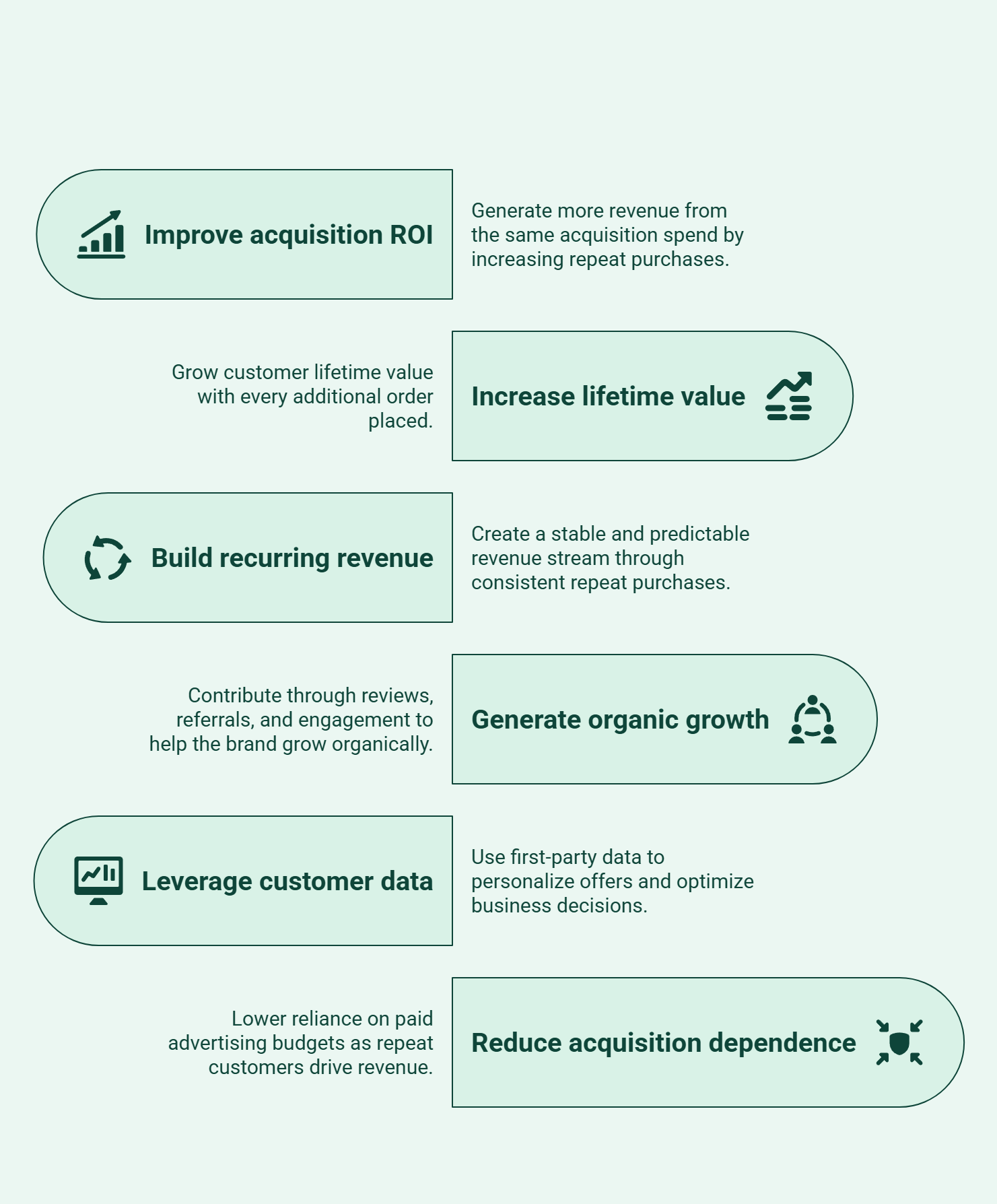
Acquiring new customers is essential for growth, but sustainable growth comes from increasing the value of the customers you already have. Every repeat purchase builds on the previous one, creating additional revenue, stronger customer relationships, and valuable insights that are difficult to achieve through acquisition alone.
Every new customer comes with an acquisition cost. When customers continue purchasing, you generate more revenue from the same acquisition spend, improving the overall return on your marketing investment.
The first order is rarely a customer's highest-value transaction. As customers place additional orders, their customer lifetime value grows, making them significantly more valuable than one-time buyers.
Repeat customers create a more stable revenue stream than constantly relying on first-time purchases. Whether through recurring orders, subscriptions, or consistent repeat purchases, they help make business growth more predictable.
Returning customers often contribute in ways that new customers don't. They leave reviews, redeem rewards, refer friends, share their experiences, and engage with new product launches, helping your brand grow organically.
Each purchase, reward redemption, and interaction generates first-party customer data. These insights help you personalize offers, improve customer segmentation, optimize retention campaigns, and make better merchandising decisions.
As repeat customers contribute a larger share of revenue, your business becomes less reliant on continually increasing advertising budgets. This creates a healthier growth model that is better equipped to adapt to rising acquisition costs and changing market conditions.
A customer's value increases with every positive interaction, not just their first purchase. As they continue engaging with your brand, they contribute more than just repeat revenue.
Each stage builds on the previous one, making the customer more valuable over time. This is why successful Shopify brands focus on nurturing long-term relationships instead of treating the first purchase as the finish line.
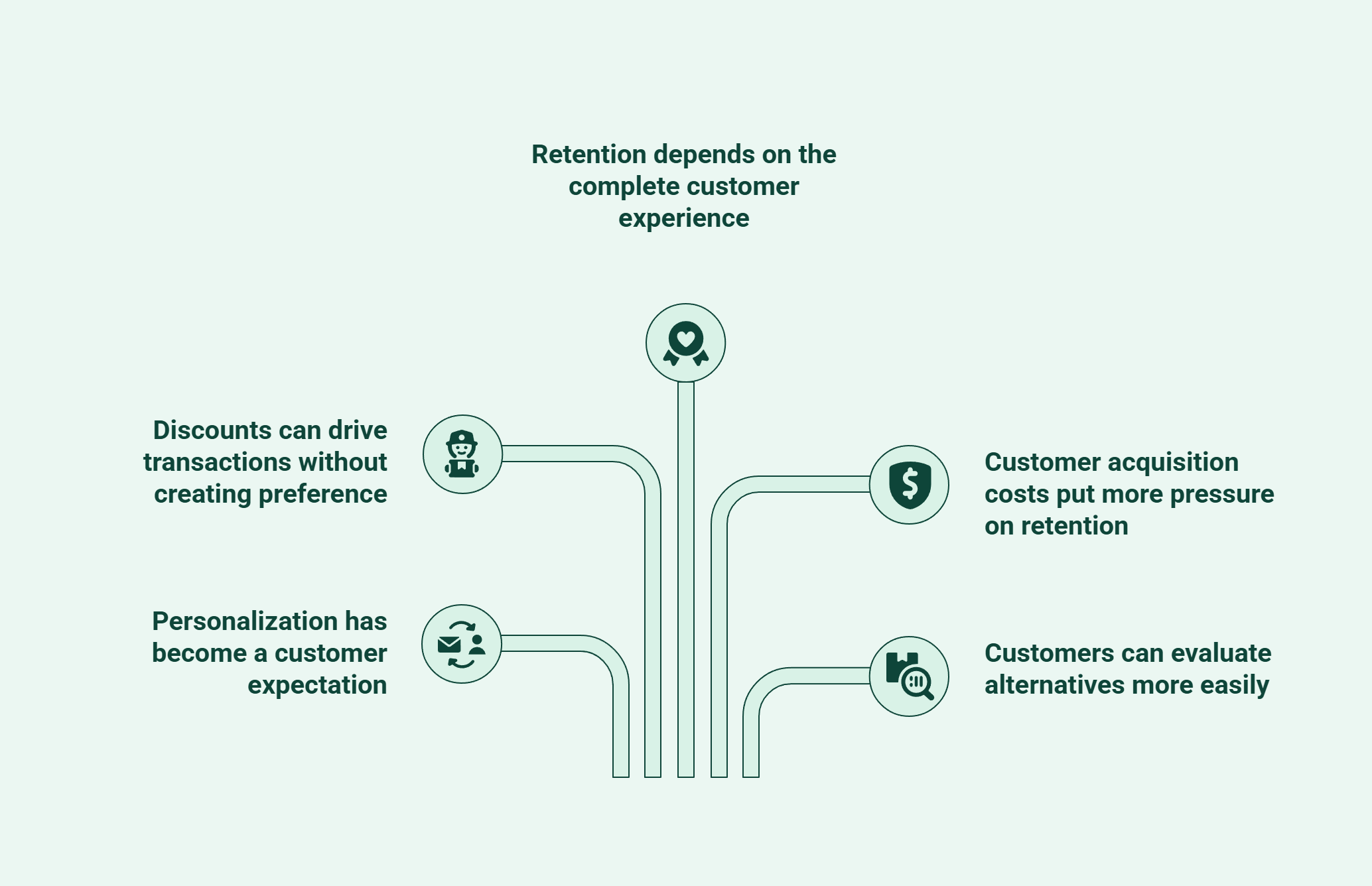
Retaining customers today requires more than it did a few years ago. Shoppers have more choices, can compare alternatives quickly, and increasingly expect brands to understand their needs. McKinsey reports that 71% of consumers expect companies to deliver personalized interactions, while 76% get frustrated when this doesn't happen. These expectations raise the standard Shopify brands must meet to retain customers.
As paid channels become more competitive, relying heavily on continuous customer acquisition can put pressure on profitability. Generating additional value from customers you've already acquired therefore becomes increasingly important to sustainable growth.
Shoppers can compare products, prices, reviews, shipping options, and competing brands within minutes. With fewer barriers to switching, a satisfactory first purchase doesn't necessarily guarantee that a customer will return for the next one.
Generic campaigns can overlook differences in customer intent, purchase history, and lifecycle stage. Relevant recommendations, communications, and incentives allow brands to respond to those differences and create a more useful experience for returning customers.
A promotion can provide an immediate reason to purchase, but the incentive may disappear as soon as the discount ends. If customers primarily associate a brand with lower prices, competitors can potentially attract the same customers with a better offer.
Customers form impressions across the entire journey, including product discovery, checkout, fulfilment, customer support, and post-purchase communication. Friction at any of these stages can weaken the reasons they have to choose the same brand again.
For Shopify brands, customer loyalty and retention require more than encouraging another transaction. The challenge is creating a consistently relevant experience that gives customers compelling reasons to return even when competing products, prices, and promotions are readily available.
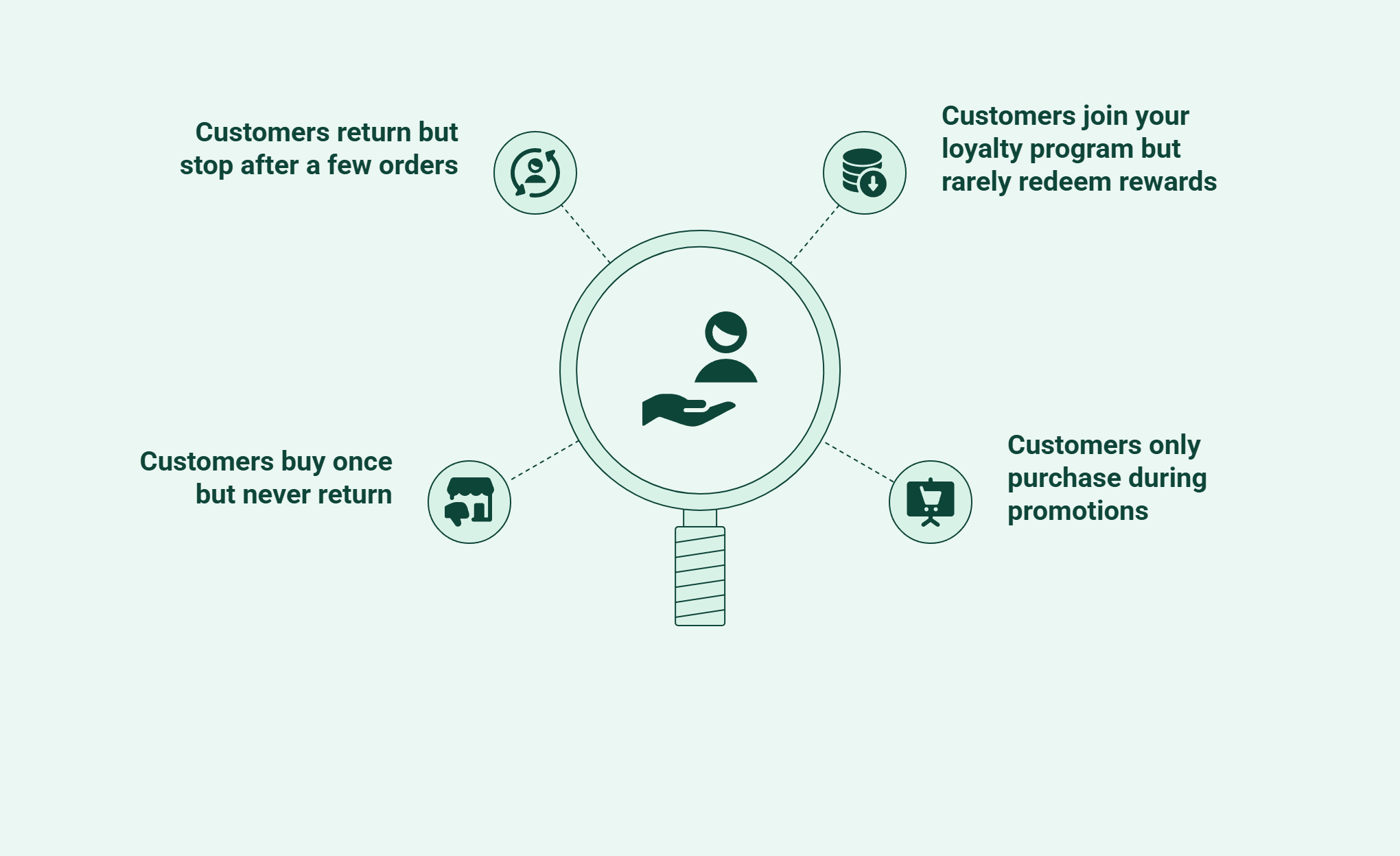
Many Shopify merchants launch loyalty programs hoping to increase repeat purchases. However, rewards alone won't solve every retention challenge. Before changing your loyalty strategy, identify where customers are dropping off and what's causing them to leave. The right solution depends on the underlying problem.
If most customers don't place a second order, the issue usually starts before loyalty becomes relevant. Customers may not have experienced enough value to return or received the right post-purchase engagement.
Common reasons:
What to review: Second purchase rate, post-purchase email flows, acquisition channels, and time between the first and second purchase.
Getting customers to purchase twice is a positive sign, but many stores struggle to keep them engaged beyond that. If customers stop returning after a few orders, your retention strategy may not be giving them enough reasons to stay.
Common reasons:
What to review: Repeat purchase rate by order, VIP progression, customer segments, and personalized campaign performance.
Low redemption doesn't always indicate a weak loyalty program. More often, customers don't see enough value in the rewards or aren't aware of the benefits available.
Common reasons:
What to review: Reward redemption rate, average points balance, reward visibility, and customer feedback.
If repeat purchases increase only during sales, customers may be responding to discounts instead of your brand. This makes retention more expensive and reduces long-term profitability.
Common reasons:
What to review: Sale vs. non-sale purchase behavior, promotion frequency, loyalty engagement, and customer communication between campaigns.
Every retention challenge has a different cause. Identify the behavior first, then choose a strategy that addresses the root problem instead of simply rewarding purchases.
Customer loyalty and customer retention work together, but they solve different business challenges. Instead of trying to improve both at once, identify your biggest gap first. Prioritizing the right strategy helps you focus resources where they can have the greatest impact.
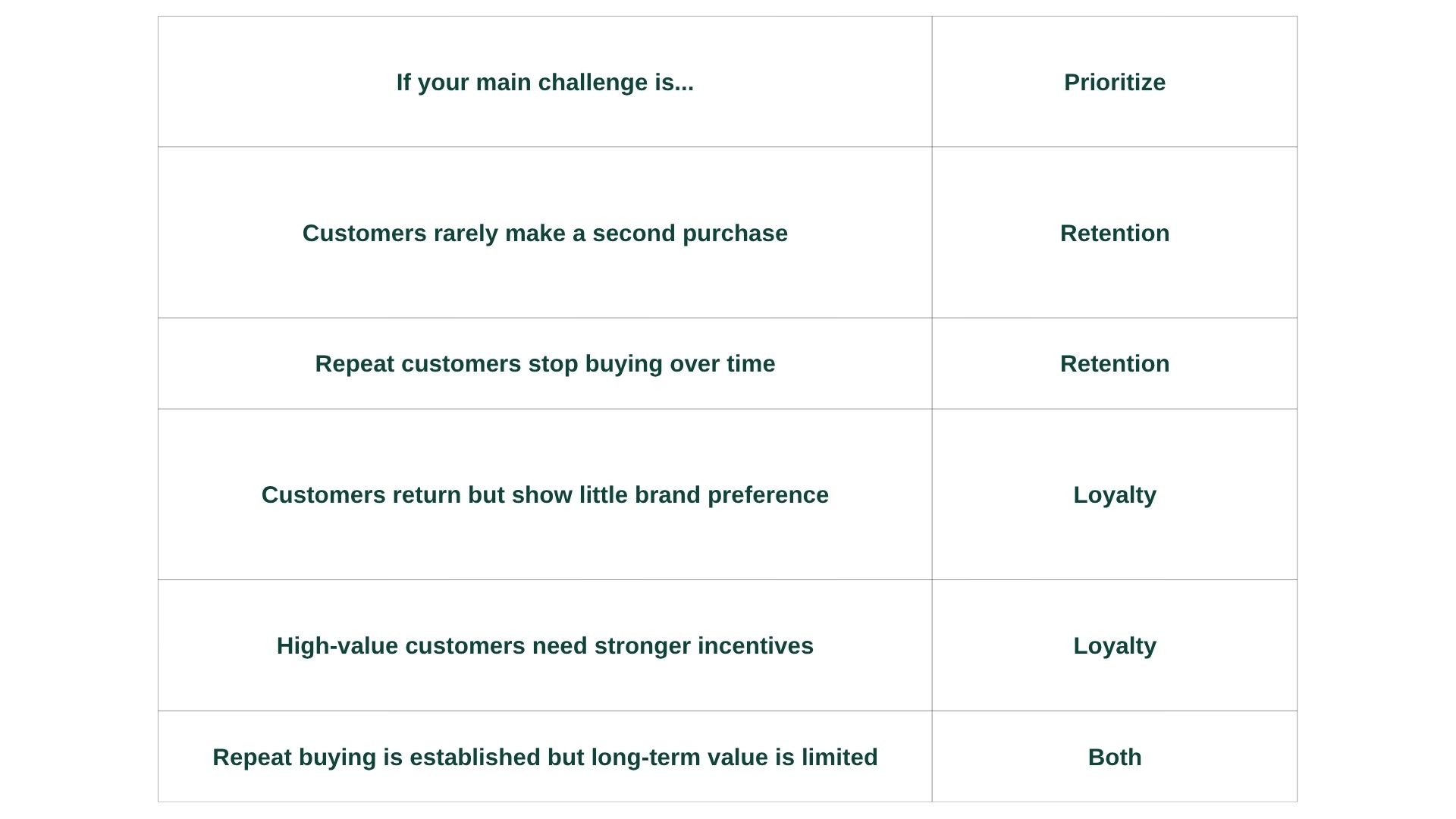
If customers rarely place a second or third order, focus on removing the barriers preventing them from returning before investing heavily in loyalty initiatives.
Focus on customer retention if you want to:
Common retention strategies include personalized post-purchase communication, replenishment reminders, lifecycle campaigns, and timely follow-ups.
If customers already make repeat purchases, focus on strengthening their preference for your brand. Loyalty initiatives can deepen engagement, recognize valuable customers, and encourage behaviors that extend beyond another transaction.
Focus on customer loyalty if you want to:
Common loyalty strategies include points programs, VIP tiers, milestone rewards, referral incentives, and exclusive member benefits.
Combine both once repeat purchasing is established and the opportunity shifts toward increasing the value of those relationships. Retention can bring customers back, while loyalty gives them additional reasons to keep choosing your brand.
For example, a replenishment reminder might drive a customer's second purchase. That purchase could then earn points or contribute toward VIP status, connecting the immediate retention objective with longer-term loyalty.
Rather than running isolated campaigns, connect both strategies across the customer journey. Retention should establish repeat behavior, while loyalty builds on that behavior to increase long-term customer value and advocacy.
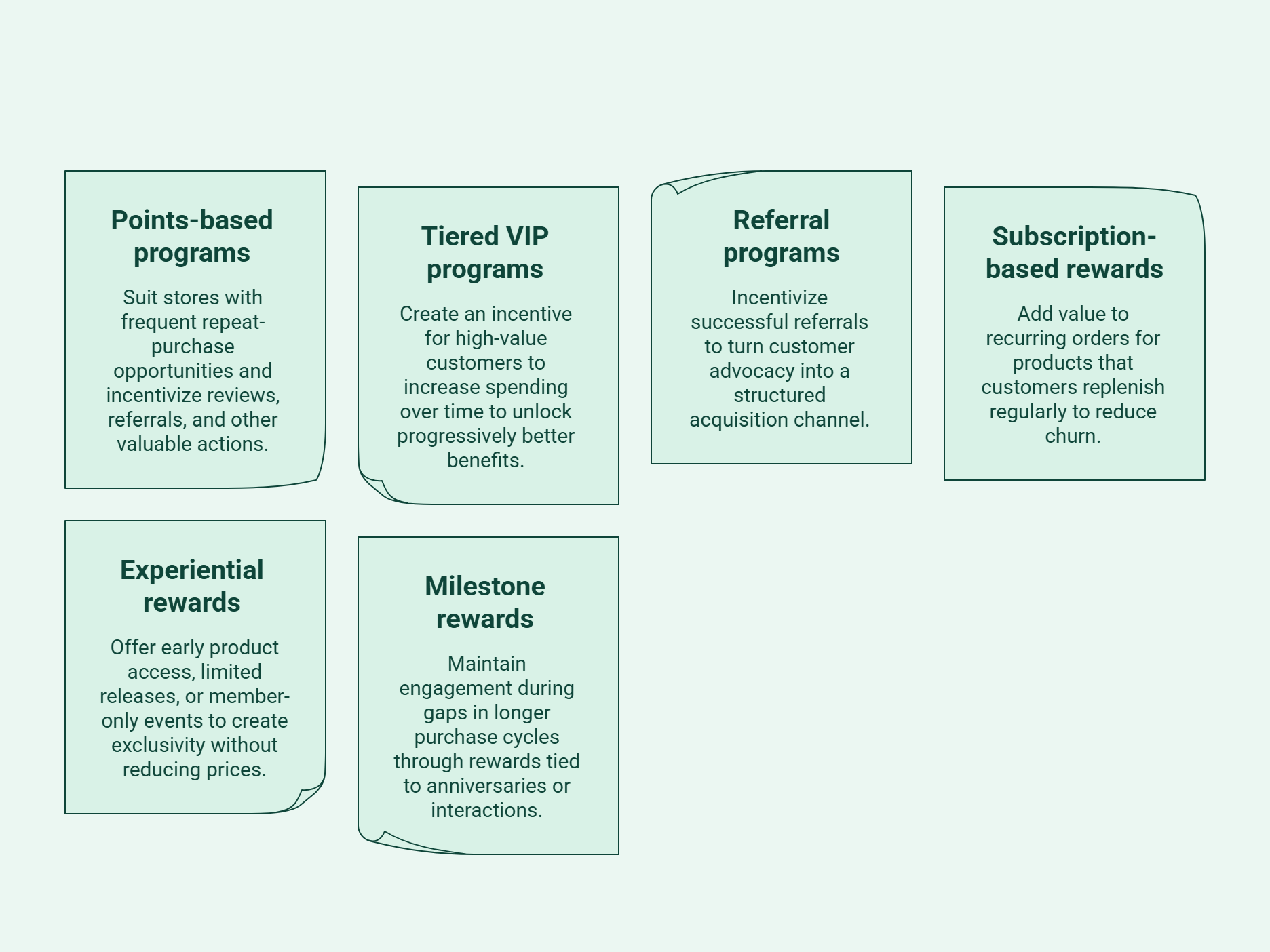
Not every loyalty strategy delivers the same results. The right choice depends on purchase frequency, customer value, buying cycles, and the behavior you want to encourage. Prioritize the mechanics that address the biggest opportunity in your customer journey.
Points programs suit stores with frequent repeat-purchase opportunities because customers can make steady progress toward a reward. They can also incentivize reviews, referrals, and other valuable actions. A beauty brand, for example, could award points across purchases and engagement to encourage continued participation.
For stores with a clear group of high-value customers, VIP tiers can create an incentive to increase spending over time. A fashion retailer could unlock progressively better benefits at higher spending levels, giving customers a reason to reach the next tier and maintain their status.
Strong customer advocacy creates a natural opportunity for referral rewards. If customers already recommend your products, incentivizing successful referrals can turn that behavior into a structured acquisition channel. A pet supplies brand could reward existing customers for introducing new shoppers who complete a purchase.
Products that customers replenish regularly are particularly suited to subscription rewards. Bonus points, free shipping, subscriber pricing, or exclusive benefits can add value to recurring orders and give customers fewer reasons to cancel or switch to a competitor.
Discounts aren't always the strongest loyalty incentive, particularly for premium or community-driven brands. Early product access, limited releases, member-only events, or premium services can create a sense of exclusivity while strengthening loyalty without repeatedly reducing prices.
Longer purchase cycles create a different challenge because customers may go months without needing another product. Rewards tied to anniversaries, reviews, referrals, or other meaningful interactions can maintain engagement during those gaps and keep the brand relevant until the next purchase.
You don't need every loyalty mechanic. The strongest starting point is the strategy that reflects how your customers already buy while encouraging the next behavior that matters most to your business.
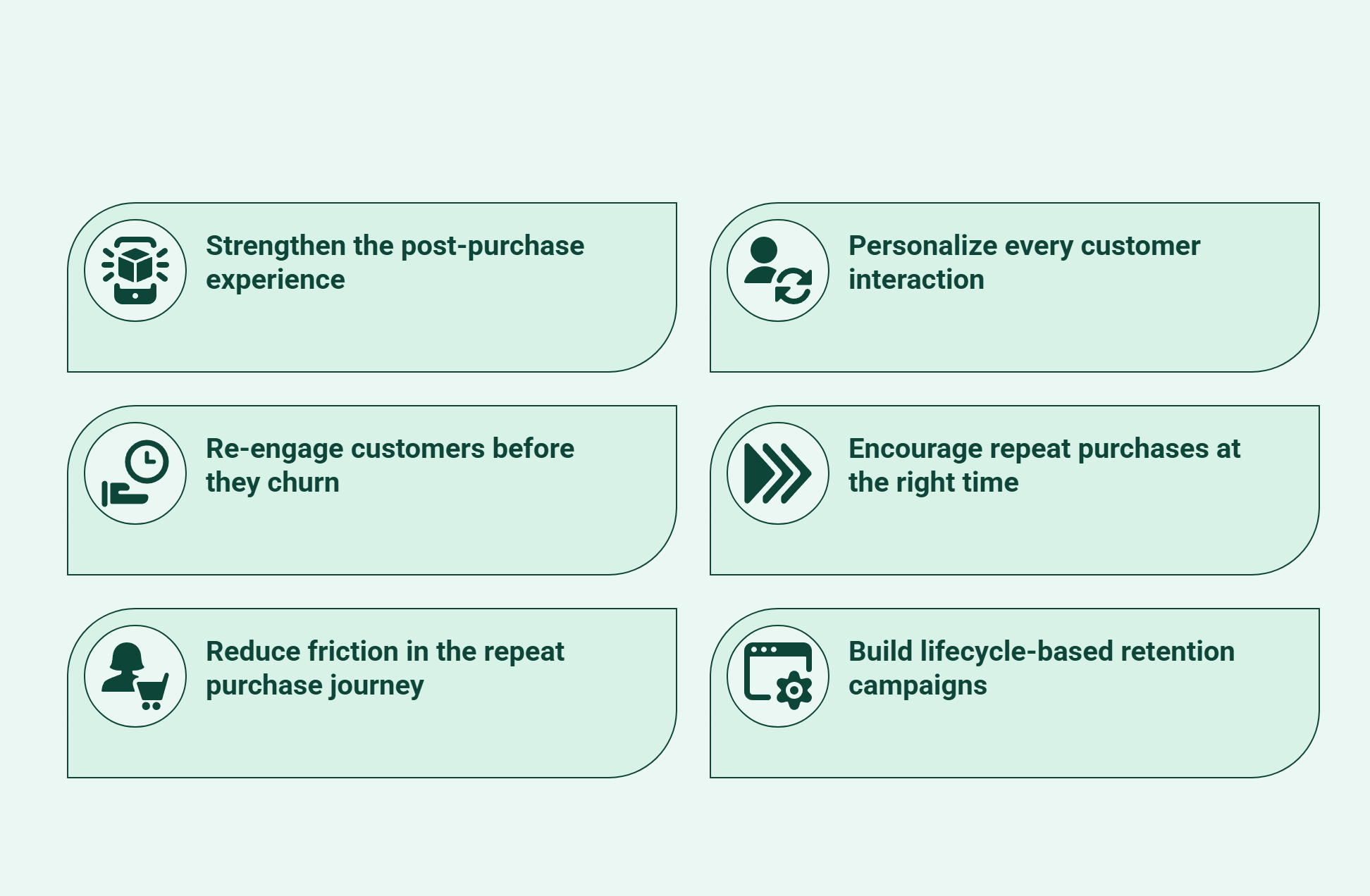
Customer retention strategies encourage customers to return after their first purchase and continue buying over time. Rather than relying on one-time promotions, these strategies improve the customer experience, strengthen engagement, and reduce customer churn.
The customer journey doesn't end at checkout. Timely order updates, product education, onboarding, and relevant recommendations reinforce the value of the purchase while encouraging customers to return for a second order.
Customers are more likely to return when communication reflects their purchase history, browsing behavior, and preferences. Personalized recommendations, offers, and messaging create more relevant experiences than generic campaigns.
Customers who become inactive aren't always lost. Identifying changes in purchase behavior or extended gaps between orders allows you to reconnect with relevant reminders, personalized offers, or product recommendations before they disengage completely.
Timing can be just as important as the offer itself. Replenishment reminders, complementary product recommendations, and follow-up campaigns delivered around expected buying cycles can encourage customers to return when another purchase is most relevant.
Customers may intend to return but abandon the process if purchasing again requires unnecessary effort. Features such as saved customer information, simple reordering, subscription management, and convenient checkout can make it easier for existing customers to complete their next purchase.
Customers need different communication depending on where they are in their relationship with your store. Separate first-time buyers, active repeat customers, at-risk customers, and lapsed customers, then create campaigns that address the next action each group is most likely to take.
Customer retention ultimately depends on making the next purchase relevant, timely, and easy. Once that repeat behavior is established, loyalty strategies can build on it by giving customers stronger reasons to prefer your brand over alternatives.
The best loyalty programs and customer retention examples show how specific mechanics influence repeat behavior. Rather than focusing only on rewards, these examples demonstrate how brands use progression, convenience, exclusivity, and ongoing incentives to give customers stronger reasons to return.
Sephora combines points with tiered membership, allowing customers to access greater benefits as their annual spending increases. This creates visible progression and gives shoppers an incentive to consolidate more of their beauty spending with Sephora rather than spreading purchases across competing retailers.
Starbucks combines rewards with mobile ordering, personalized offers, and convenient redemption. Because coffee is purchased frequently, the program fits naturally into existing buying routines while providing additional incentives to choose Starbucks for the next purchase.
Amazon Prime combines delivery benefits, member offers, entertainment, and other services within a paid membership. Because customers receive value across different purchases and services, membership extends beyond individual transactions and encourages continued use of the Amazon ecosystem.
DTC beauty and personal care brand Blume uses its Blumetopia loyalty program to reward purchases and customer engagement. Customers can accumulate points toward future rewards, creating another incentive to return when they need to replenish products rather than purchasing elsewhere.
DTC plant retailer The Sill uses Green Rewards to reward purchases and qualifying customer activities. This approach is particularly relevant in a category where customers may not need to repurchase the same product frequently, making continued engagement between purchases more important.
The key takeaway is that retention improves when the loyalty mechanic matches how customers naturally buy. Whether the goal is increasing purchase frequency, consolidating spend, or maintaining engagement between orders, the program should create a clear reason for customers to return.
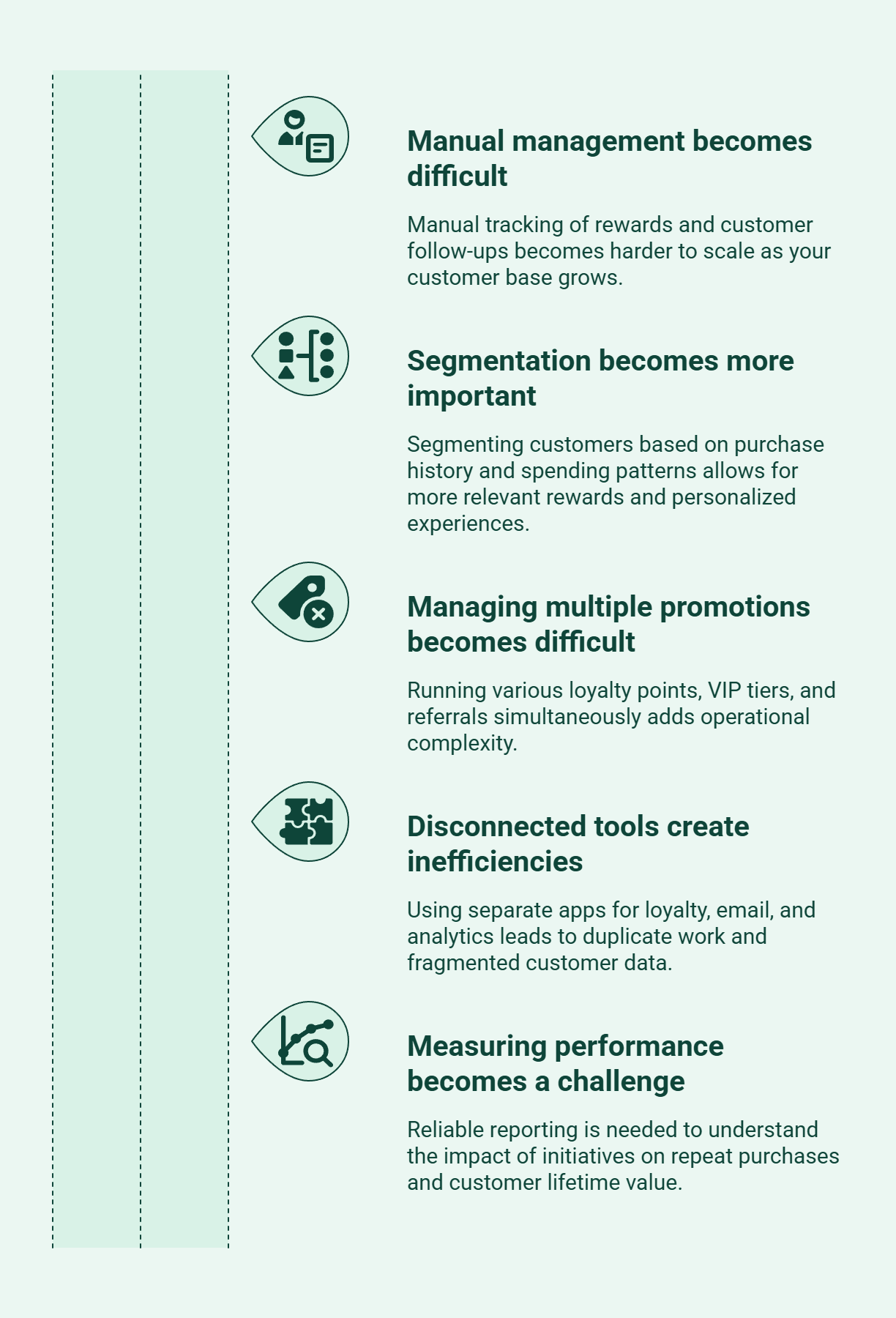
Customer loyalty and retention software isn't essential for every Shopify store. However, as your business grows, managing rewards, customer engagement, and retention campaigns manually or across multiple tools becomes more challenging. Use the considerations below to determine whether dedicated software makes sense.
If your team manually tracks rewards, updates customer segments, or manages customer follow-ups, execution becomes harder as your customer base grows. Automation can trigger welcome journeys, replenishment reminders, win-back campaigns, birthday rewards, and milestone incentives based on customer behavior without requiring constant manual intervention.
Sending the same campaign to every customer rarely delivers the best results. Segmenting customers based on purchase history, spending patterns, loyalty status, or engagement allows you to deliver more relevant rewards, offers, and personalized experiences.
Running loyalty points, VIP tiers, referrals, bundles, seasonal offers, and personalized discounts simultaneously adds operational complexity. Dedicated software can make it easier to coordinate these initiatives and create a more consistent experience across campaigns.
Using separate apps for loyalty, promotions, email marketing, segmentation, and analytics can lead to duplicate work and fragmented customer data. Connected tools make it easier to coordinate campaigns and maintain a unified customer loyalty and retention strategy.
Running campaigns is only useful if you can determine their impact. Reliable reporting helps you understand which initiatives influence repeat purchases, customer lifetime value, reward redemption, and retention rates, so you can decide what to optimize or discontinue.
If several of these challenges apply to your business, customer loyalty and retention software may be worth considering. The deciding factor isn't simply store size. It's whether software can reduce operational complexity, improve personalization, and give you better control over how your retention strategy is executed and measured.
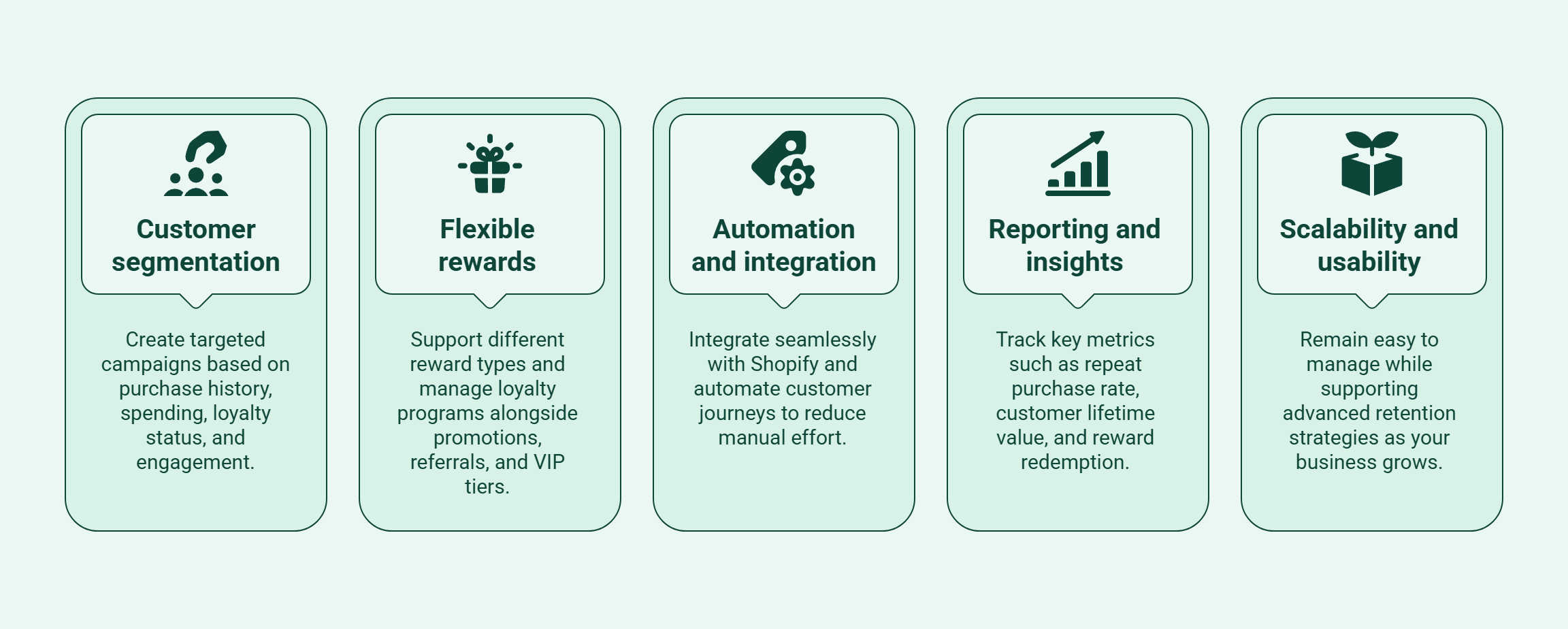
Choosing customer loyalty and retention software isn't about finding the platform with the most features. It's about selecting a solution that supports your retention goals today while giving you the flexibility to scale as your Shopify store grows.
Every customer behaves differently, so your software should let you create targeted campaigns based on purchase history, spending, loyalty status, and engagement. This allows you to deliver relevant rewards and offers instead of generic promotions.
Your retention strategy will likely include more than just points. Look for software that supports different reward types and can manage loyalty programs alongside promotions, referrals, VIP tiers, and other campaigns without creating conflicts.
Retention relies on timely engagement. Your software should integrate seamlessly with Shopify and automate customer journeys such as welcome rewards, replenishment reminders, milestone rewards, and win-back campaigns, reducing manual effort while improving consistency.
You should be able to measure whether your retention strategy is delivering results. Look for reporting that tracks key metrics such as repeat purchase rate, customer lifetime value, reward redemption, and campaign performance so you can optimize your strategy over time.
The right solution should grow with your business. As your customer base and campaigns expand, the software should remain easy to manage while supporting more advanced retention strategies without adding unnecessary operational complexity.
The best customer loyalty and retention software doesn't just help you launch rewards. It helps you create personalized customer experiences, manage multiple retention initiatives efficiently, and make better decisions as your business grows.
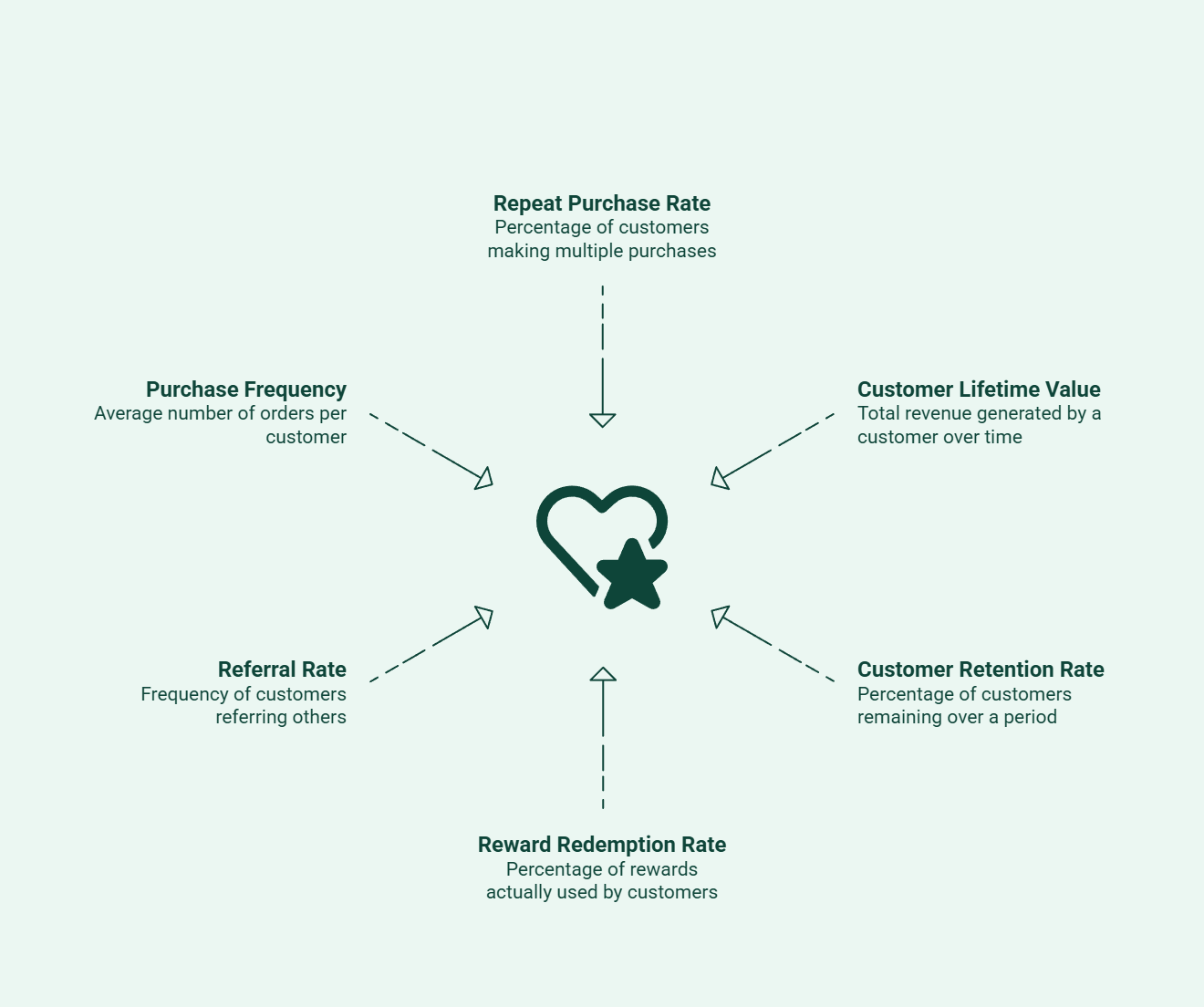
Not every metric reflects the health of your retention strategy. Focus on metrics that show whether customers are returning, spending more over time, engaging with your loyalty initiatives, and building stronger relationships with your brand.
Repeat purchase rate measures the percentage of customers who make more than one purchase during a given period. A declining rate may indicate gaps in your post-purchase experience, customer engagement, or retention efforts.
Formula:
Repeat purchase rate = (Customers who purchased more than once ÷ Total customers) × 100
Customer lifetime value estimates how much revenue a customer generates throughout their relationship with your business. As customers purchase more frequently, spend more per order, or remain customers for longer, their lifetime value increases.
Customer retention rate measures the percentage of customers who remain customers during a specific period, excluding customers newly acquired during that period. It helps you determine how effectively your business is retaining its existing customer base.
Formula:
Customer retention rate = ((Customers at end of period − New customers acquired) ÷ Customers at start of period) × 100
Reward redemption rate measures the percentage of issued or earned rewards that customers actually redeem. Low redemption may indicate that rewards lack value, thresholds are too difficult to reach, or customers aren't sufficiently aware of their available benefits.
Formula:
Reward redemption rate = (Rewards redeemed ÷ Rewards issued) × 100
Referral rate helps you understand how frequently existing customers generate referrals. Strong referral activity can indicate greater customer satisfaction, trust, and willingness to advocate for your brand.
Purchase frequency measures the average number of orders customers place during a specific period. Tracking it over time helps determine whether your retention efforts are successfully encouraging customers to purchase more often.
Effective measurement of customer loyalty and retention requires looking at these metrics together. Tracking repeat purchases, retention, CLV, reward engagement, and referrals reveals whether your strategy is building stronger customer relationships over time.
Building customer loyalty and retention takes more than points or discounts. It requires a connected strategy that combines rewards, personalization, customer segmentation, referrals, and engagement to encourage repeat purchases and increase customer lifetime value.
Kefi Commerce brings these capabilities together in a single Shopify-native platform. From loyalty programs and VIP tiers to referrals, gamification, and personalized promotions, it helps you create a seamless retention strategy without relying on multiple apps.
See how Kefi Commerce can help you build stronger customer relationships and drive long-term growth. Try Kefi Commerce for free and discover how a connected loyalty and retention strategy can increase repeat purchases and customer lifetime value.
Customer loyalty and retention are strongest when they are built around customer behavior rather than isolated rewards or campaigns. Start by understanding why customers leave, choose strategies that address those gaps, and measure whether they improve repeat purchases, engagement, and customer lifetime value.
For Shopify brands, the goal is not simply to bring customers back once. It is to create a connected experience that gives them compelling reasons to keep choosing your brand, strengthening customer relationships while building a more predictable and sustainable source of growth.
Strong customer satisfaction retention and loyalty go hand in hand. Happy customers are more likely to make repeat business, develop brand loyalty, recommend your business through word of mouth, and become brand advocates over time.
The best strategies include personalized rewards, exceptional customer service, customer segmentation, loyalty programs, and regular customer surveys. These effective strategies strengthen customer loyalty and retention while supporting sustainable business growth.
Loyalty programs and customer retention work together by rewarding repeat purchases and encouraging ongoing engagement. Well-designed types of loyalty programs can reduce churn rate, strengthen emotional connection, and increase the number of loyal customers.
No. The difference between customer retention and customer loyalty is that retention measures whether customers return, while loyalty reflects their preference for your brand. Strong loyalty often leads to higher retention over a longer period of time.
Key benchmarks include customer satisfaction scores, customer retention rate, repeat purchase rate, net promoter score, customer lifetime value, and churn rate. Together, these metrics show how satisfied customers are, whether they return, and how loyal they become.
.svg)
