
Getting a customer to place their first order is expensive. Losing them after that first purchase is even more expensive because you're forced to keep investing in acquisition instead of generating revenue from customers who already trust your brand.
That's why successful Shopify merchants don't just track sales. They track how many first-time buyers come back for another purchase. Your repeat purchase rate shows whether your post-purchase experience, customer engagement, and retention efforts are creating loyal customers or simply generating one-time transactions. The answer influences everything from customer lifetime value to how efficiently you spend your marketing budget.
In this guide, you'll learn how to calculate repeat purchase rate, perform a repeat purchase rate calculation manually and in Excel, understand what your results actually mean, and identify practical ways to improve them. As your store grows, platforms like Kefi Commerce can help you turn those insights into loyalty campaigns, personalized offers, bundles, and other retention strategies that encourage more customers to buy again.
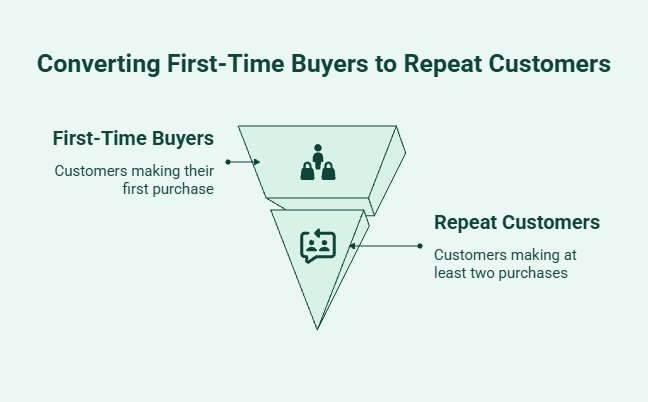
Repeat purchase rate measures the percentage of customers who return to buy from your Shopify store more than once within a specific time period. Instead of tracking orders alone, it shows how effectively your Shopify store converts first-time buyers into returning customers, making it a valuable indicator of customer retention.
A repeat customer is anyone who places at least two completed orders within your chosen reporting period. Customers who make only one purchase remain part of your total customer count but aren't included as repeat buyers. Measuring customers rather than orders prevents frequent shoppers from skewing your results and gives you a more accurate view of customer retention.
For example, if your store has 1,000 customers during a quarter and 280 of them place a second order within that same quarter, only those 280 customers count toward your repeat purchase rate. The remaining 720 customers contribute to your total customer count but aren't classified as repeat customers.
Your reporting period should reflect how often customers naturally buy from your store. Whether you calculate the repeat purchase rate monthly, quarterly, or annually, use the same reporting window every time. Consistent reporting helps you identify meaningful trends and evaluate whether your retention strategies are improving customer behavior.
For example, a coffee subscription brand may review the repeat purchase rate monthly because customers reorder frequently, while a furniture retailer may measure it annually due to longer buying cycles. Rather than comparing monthly results with annual ones, compare the same reporting period over time to measure real improvements in customer retention.
Calculating repeat purchase rate starts with identifying how many customers return after their first purchase. Once you know your repeat customer count and total unique customers for the same reporting period, you can calculate the metric in one simple step. Using a consistent reporting window ensures your results accurately reflect customer retention rather than overall sales activity.
Calculating repeat purchase rate requires two numbers: the customers who made more than one purchase and the total number of unique customers during the same reporting period.
Repeat Purchase Rate (%) = (Repeat Customers ÷ Total Unique Customers) × 100
Although the formula is simple, accurate data is essential. You're measuring customers, not orders. A shopper who places five orders still counts as one repeat customer, while someone who buys only once contributes only to your total customer count.
Before calculating your repeat purchase rate, verify that you:
Getting these inputs right helps ensure your repeat purchase rate reflects real customer behavior instead of inflated or misleading results.
Imagine your Shopify store acquired 1,000 unique customers over the last 12 months. During that same period, 300 customers returned to place at least one additional order.
Your repeat purchase rate calculation would be:
(300 ÷ 1,000) × 100 = 30%
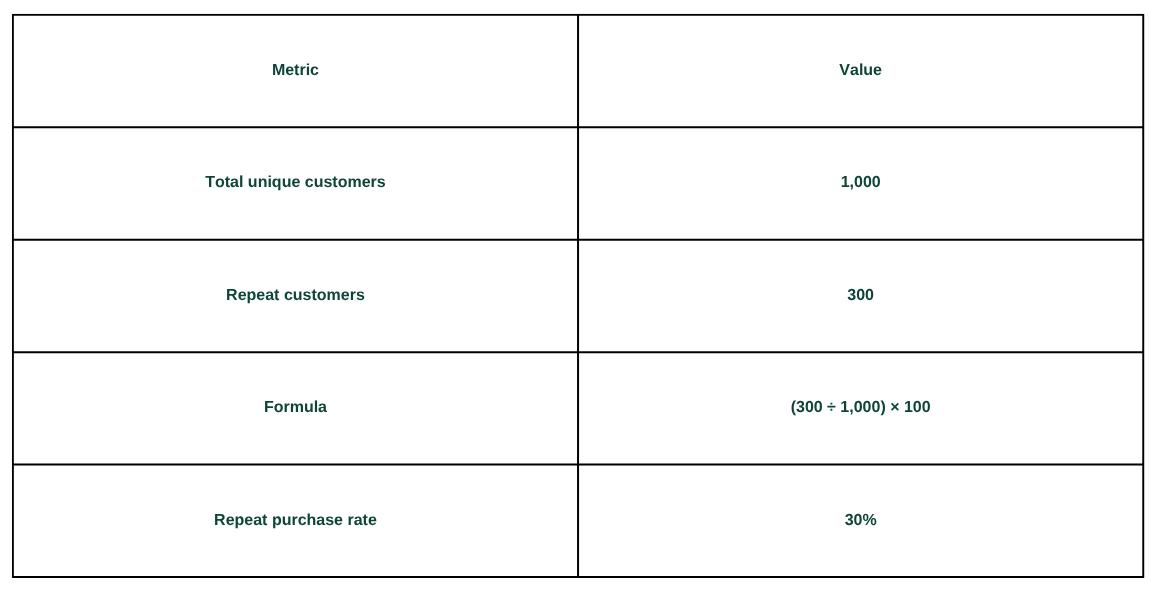
A 30% repeat purchase rate means nearly one in three customers returned to make another purchase. While a good repeat purchase rate varies by industry and buying cycle, many ecommerce businesses typically fall between 20% and 40%. Stores selling consumable products often achieve even higher rates because customers naturally reorder more frequently.
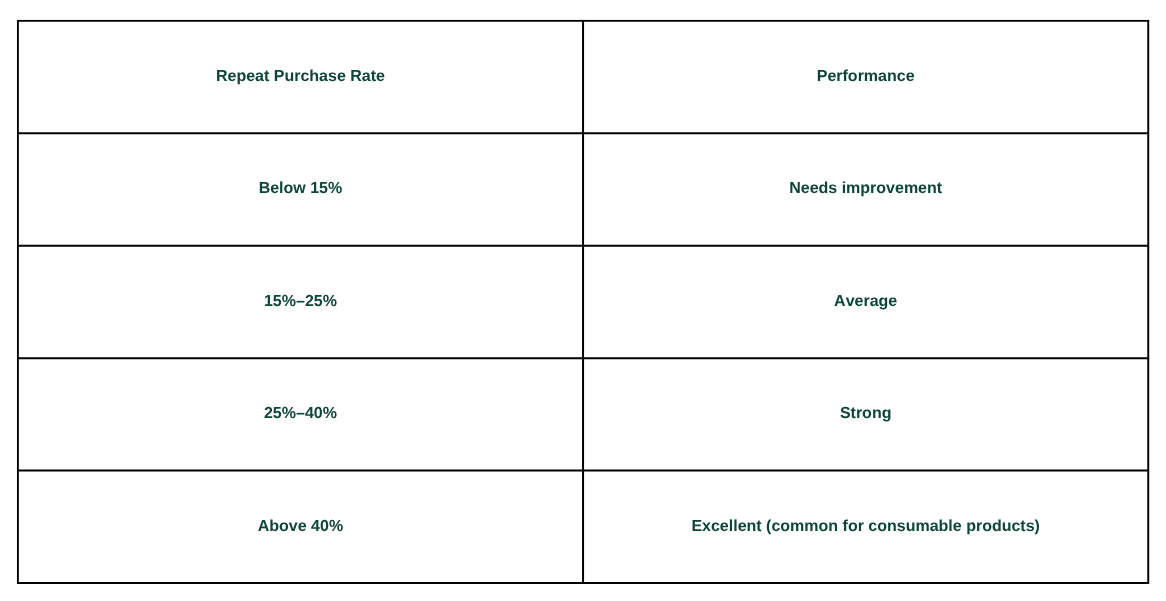
The percentage itself is only part of the story. Measuring repeat purchase rate consistently helps you understand whether changes to your customer experience, loyalty programs, or post-purchase marketing are encouraging more customers to return over time.
Even a small reporting error can make your repeat purchase rate appear higher or lower than it actually is, leading to decisions based on inaccurate customer data rather than real buying behavior.
One of the most common mistakes is counting orders instead of customers. Another is using different reporting periods for repeat customers and total customers, which creates misleading results. Including cancelled or refunded orders can also distort your calculation if they aren't treated consistently in your reporting.
Before finalizing your numbers, make sure you:
A consistent calculation gives you confidence that changes in your repeat purchase rate reflect genuine shifts in customer behavior. Once your reporting process is reliable, you can track retention trends more efficiently in Excel or automate reporting as your Shopify store grows.
Excel and Google Sheets are practical options for calculating the repeat purchase rate from exported Shopify data. By organizing customer purchases, identifying returning buyers, and applying the repeat purchase formula, you can track customer retention without additional software. As reporting becomes more frequent or your store grows, automation can save time and reduce manual work.
Start by exporting your Shopify orders for a single reporting period into Excel or Google Sheets. Your spreadsheet should include a unique customer identifier, order date, and order number. Before calculating anything, remove duplicate records and confirm every order falls within the same reporting period. Clean data is the foundation of an accurate repeat purchase rate.
At a minimum, your spreadsheet should include:
Once your data is organized, it's much easier to identify which customers returned to place another order.
Group your data by customer and count how many completed orders each person placed during the selected period. Customers with two or more purchases belong in your repeat customer count, while customers with a single purchase remain part of your total customer count.
This step does more than prepare your calculation. It also helps you identify how many first-time buyers you're successfully converting into returning customers, making it easier to evaluate the impact of retention campaigns over time.
Once you've counted your repeat customers and total unique customers, apply the formula:
Repeat Purchase Rate (%) = (Repeat Customers ÷ Total Unique Customers) × 100
For example, if 300 out of 1,000 customers placed another order during the same reporting period, your repeat purchase rate is 30%.
Recording this calculation every month or quarter makes it easier to spot trends and measure whether changes to your customer experience, loyalty programs, or post-purchase marketing are increasing repeat purchases.
Excel works well when you're validating a metric, creating occasional reports, or managing a relatively small customer database. However, as your Shopify store grows, manual reporting often becomes harder to maintain. Tracking multiple customer segments, monitoring trends across different time periods, and sharing reports with your team can quickly turn into a time-consuming process.
If repeat purchase rate is a metric you monitor regularly, automating the process can provide faster insights and reduce manual effort. Platforms like Kefi Commerce help merchants go beyond reporting by combining customer insights with loyalty campaigns, personalized offers, product bundles, and other retention strategies that encourage customers to return and purchase again.
Excel is a good choice when you:
Consider automation when you:
Whether you're using Excel, Google Sheets, or an automated platform, consistent reporting is what turns repeat purchase rate from a simple metric into actionable insights that support better retention decisions.
Your repeat purchase rate helps you understand whether customers see enough value to return after their first order. More importantly, it shows whether your retention efforts are creating long-term revenue or whether your business still depends heavily on acquiring new customers to maintain sales.
A low repeat purchase rate isn't always a product problem. More often, it highlights gaps in the customer journey that discourage shoppers from returning.
Look for patterns such as:
Instead of reacting to one reporting period, compare trends over several months. A gradual increase is often more meaningful than chasing an industry benchmark.
An improving repeat purchase rate shows that more customers are choosing your store again instead of starting their search elsewhere.
A positive trend often indicates that:
Rather than celebrating the percentage alone, connect improvements to recent campaigns. If repeat purchases increase after launching a loyalty program or personalized offers, you have stronger evidence that those initiatives are influencing customer behavior.
Repeat purchase rate answers one question: Are customers returning? It doesn't explain how valuable those customers are or how frequently they buy.
Review it alongside these metrics:
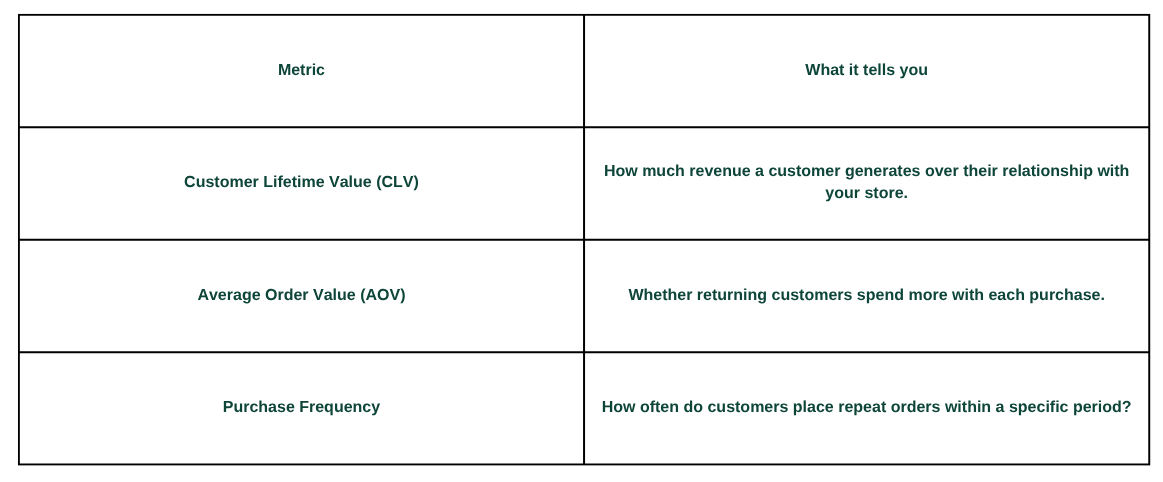
Looking at these metrics together helps you identify what's driving retention instead of relying on a single percentage. As your reporting becomes more sophisticated, platforms like Kefi Commerce can combine these insights with loyalty programs, personalized offers, and retention campaigns, helping you act on the data instead of simply reporting it.
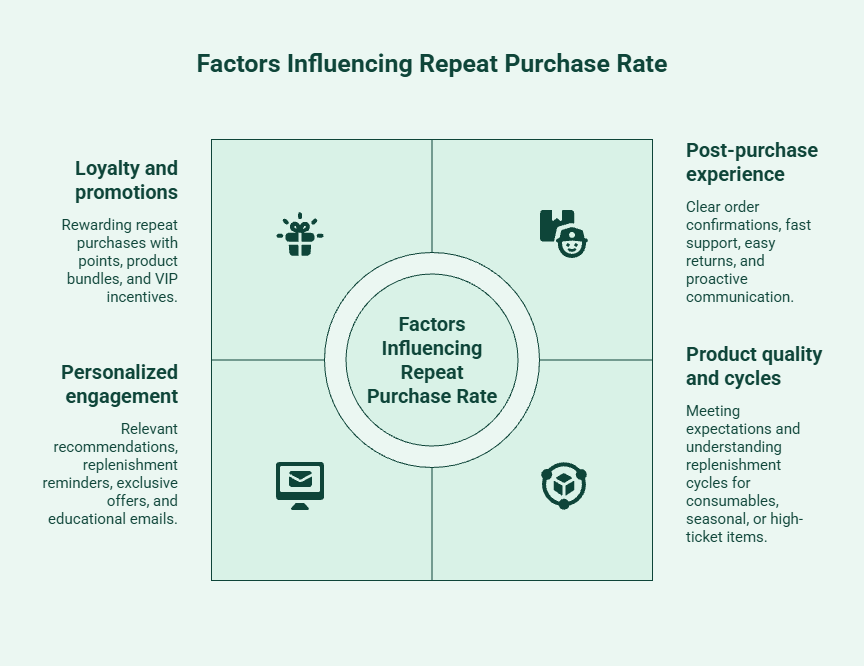
Repeat purchase rate is shaped by everything customers experience after their first order. Product quality, post-purchase communication, customer service, and personalized offers all influence whether shoppers return. Improving retention isn't about one tactic. It's about removing friction at every stage of the customer journey.
The buying experience doesn't end at checkout. In fact, the period immediately after the first order often determines whether a customer trusts your brand enough to buy again.
According to PwC, 73% of consumers say customer experience influences their purchasing decisions, yet many businesses still underestimate its impact. For Shopify merchants, that means every interaction after checkout can shape future buying behavior.
A strong post-purchase experience includes:
Customers who know what to expect are far more likely to return than those left chasing updates or resolving avoidable issues.
Even the best retention strategy can't compensate for a product that fails to meet expectations. If customers feel disappointed with their first purchase, they're unlikely to return regardless of discounts or marketing campaigns.
Purchase frequency also depends on what you sell.
For example:
Instead of comparing your repeat purchase rate with every e-commerce store, compare it with businesses that have similar products and purchasing patterns.
Most customers don't return simply because they remember your brand. They return because you give them a relevant reason to come back at the right time.
Effective post-purchase engagement often includes:
At the same time, make sure the products customers want to reorder are actually available. If popular items are frequently out of stock, even highly engaged customers may purchase from a competitor instead of waiting for inventory to return.
Returning customers are more likely to purchase again when there's additional value beyond the product itself. Loyalty rewards, product bundles, and targeted promotions create that incentive while strengthening long-term customer relationships.
Consider strategies such as:
As your retention strategy grows, platforms like Kefi Commerce help bring these initiatives together through loyalty programs, bundles, personalized promotions, and other tools designed to encourage repeat purchases without relying on constant discounts.
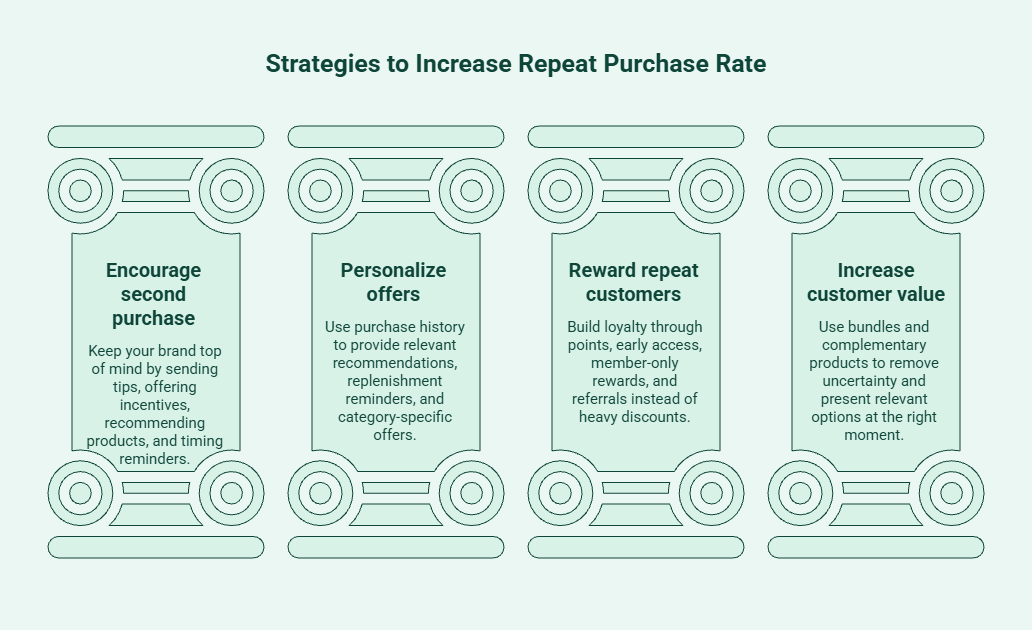
Improving repeat purchase rate starts with giving customers a compelling reason to return after their first order. The most effective retention strategies reduce friction, personalize the shopping experience, and reward repeat behavior, helping you build long-term revenue instead of relying solely on new customer acquisition.
The second purchase is one of the strongest indicators of future customer loyalty. The longer customers go without returning, the less likely they are to buy again.
Keep your brand top of mind by:
The goal isn't to rush customers. It's to reconnect while your brand is still fresh in their minds.
Customers are far more likely to engage with recommendations that reflect what they've already purchased than with generic promotions sent to everyone.
Focus on personalization strategies such as:
Relevant experiences reduce decision fatigue and make repeat purchases feel like the natural next step.
Heavy discounting may increase short-term sales, but it rarely builds lasting customer loyalty. Reward programs encourage customers to return because they see ongoing value in shopping with your brand, not simply because prices are lower.
Effective loyalty incentives include:
This approach strengthens customer relationships while protecting your profit margins.
Customers don't always know what to buy next. Bundles and complementary product recommendations remove that uncertainty by presenting relevant options at the right moment.
For example:
For Shopify merchants, Kefi Commerce makes these strategies easier to execute through product bundles, personalized offers, loyalty campaigns, and other retention tools that encourage customers to return without creating a discount-first shopping experience.
Tracking repeat purchase rate tells you how well your retention strategy is performing. The next challenge is turning those insights into actions that encourage more customers to return. That's where Kefi Commerce helps Shopify merchants move beyond reporting and build retention strategies that support long-term revenue growth.
With Kefi Commerce, you can:
Instead of managing multiple tools, Kefi Commerce brings these retention strategies together in one platform, making it easier to increase repeat purchases, improve customer lifetime value, and build more predictable revenue as your Shopify store grows.
Repeat purchase rate is more than a retention metric. It helps you understand whether your Shopify store is turning first-time buyers into loyal customers who continue to generate revenue over time. By calculating it consistently, interpreting the results in context, and acting on the insights, you can identify opportunities to strengthen customer relationships and improve long-term growth.
As your business scales, managing retention manually becomes more challenging. Kefi Commerce helps simplify that process by combining loyalty programs, personalized offers, product bundles, and customer insights in one platform, making it easier to increase repeat purchases and build sustainable revenue.
Repeat purchase rate and repeat customer rate are often used interchangeably. Both measure the percentage of customers who make more than one purchase during a specific period, helping merchants evaluate customer retention and loyalty.
Compare your repeat purchase rate over time and against businesses with similar products. A steadily improving rate usually indicates stronger customer retention, even if it hasn't reached broader ecommerce benchmarks yet.
Monitor customer lifetime value (CLV), purchase frequency, and average order value (AOV) alongside repeat purchase rate. Together, these metrics reveal how often customers return, how much they spend, and the long-term revenue they generate for your business.
Compare your repeat purchase rate with businesses that have similar products and buying cycles. Industry benchmarks provide useful context, but a consistently improving rate over time is often a stronger indicator of healthy customer retention and long-term growth.
Repeat purchase rate and repeat customer rate generally refer to the same metric. Both measure the percentage of customers who make more than one purchase within a specific time period, helping you evaluate customer retention and repeat buying behavior.
Repeat purchase rate helps you measure whether customers return after their first order, making it a key indicator of customer retention and long-term revenue. A consistently improving rate suggests your post-purchase experience, loyalty initiatives, and customer engagement strategies are encouraging more customers to buy again.
.svg)
