

Let's take a closer look,
You've probably seen it happen. A customer adds a product to their cart, gets close to checkout, and then leaves. Not because they didn't want the product, but because they didn't feel there was enough value to buy right now.
That's where free gift promotions can make a difference. Instead of offering another discount and cutting into your margins, you give shoppers an extra reason to complete their purchase. A customer who ignores a 10% discount might happily add another item to their cart to unlock a free sample, accessory, or bonus gift. It feels like a reward rather than a discount, which is why free gift campaigns can be so effective at increasing average order value.
The challenge is creating offers that drive additional revenue instead of simply increasing giveaway costs. In this guide, we'll explore proven free gift promotion strategies, how to choose the right rewards, and how Shopify merchants can use them to increase AOV, improve conversions, and encourage repeat purchases.
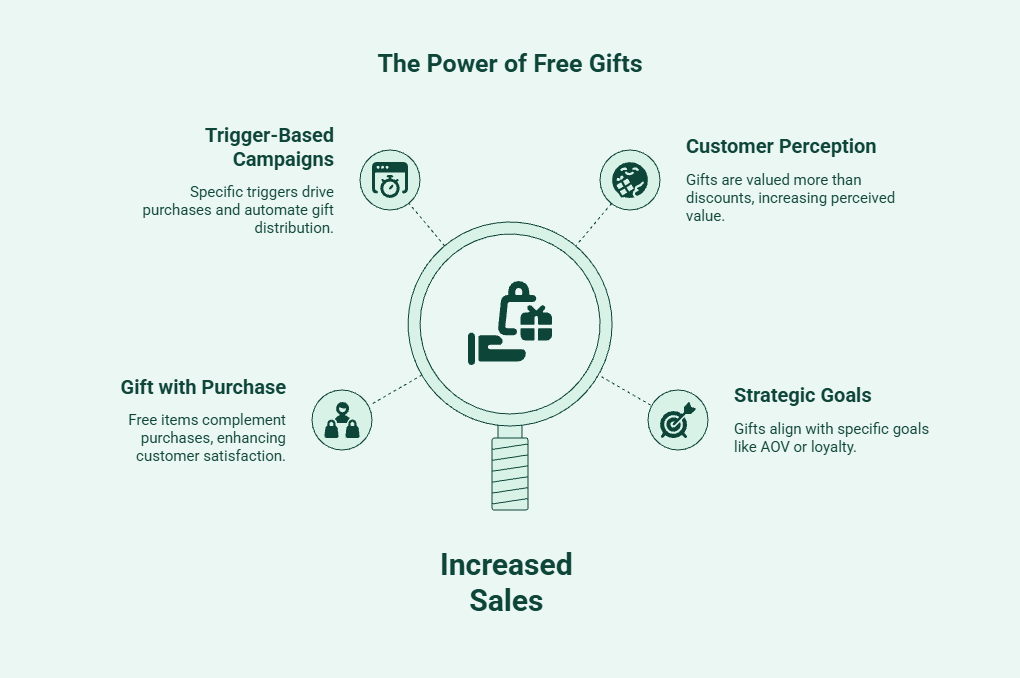
A free gift promotion strategy rewards customers with a free product when they meet a purchase condition, such as spending a certain amount or buying specific items. Unlike discounts, free gifts increase perceived value and encourage larger orders without reducing product prices.
A gift-with-purchase (GWP) promotion gives customers a free item when they complete a qualifying purchase. The qualification can be based on cart value, specific products, or product categories.
The most effective gifts complement what customers are already buying. A skincare brand might offer a travel-size serum with a moisturizer purchase, while a coffee brand could include a branded mug with a bundle. Relevant gifts feel more useful than generic giveaways and can introduce customers to products they may purchase again.
Every free gift campaign starts with a trigger. Common triggers include reaching a minimum order value, purchasing a specific product, or buying a certain quantity of items.
For example, a merchant might offer a free sample kit with orders over $75 or a free accessory with purchases of a newly launched product. Shopify merchants can run simple gift-with-purchase offers using native discount tools, while more advanced campaigns often use promotion platforms to automatically add gifts, manage eligibility rules, and support multiple offers. Solutions like Kefi Commerce help automate gift eligibility, cart additions, and promotion rules without requiring manual setup for every campaign.
For customers, the incentive is simple: add one more item, reach the threshold, and unlock the reward.
A free gift gives customers something extra to receive, rather than simply reducing what they pay. Even when the value is similar, shoppers often perceive the gift as the better deal.
For example, many customers respond more positively to a free $10 travel-size product than to a $10 discount on a $100 order. The gift is visible, tangible, and often introduces them to a product they have never tried before.
This is one reason free gift promotions can increase cart value without training customers to wait for sales.
Free gift promotions work best when tied to a specific goal. A minimum-order gift can help increase cart value, a free sample can support a product launch, and an exclusive reward can encourage repeat purchases.
Common use cases include Black Friday promotions, product launches, loyalty rewards, customer re-engagement campaigns, and inventory-clearing initiatives.
A free gift campaign designed to increase AOV should look different from one designed to drive product trials or reward loyal customers. The stronger the connection between the gift and the goal, the more likely the campaign is to deliver measurable results.
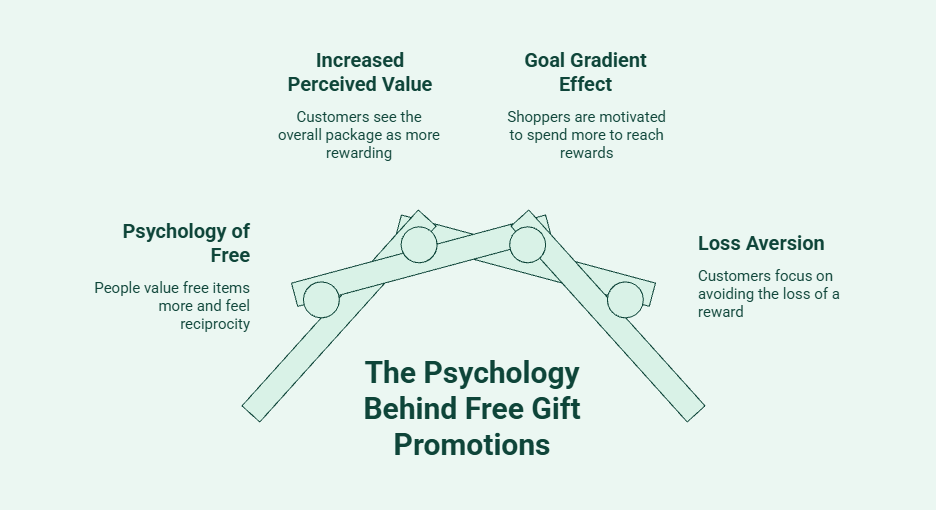
Free gift promotions influence customer behavior in ways that traditional discounts often do not. Instead of focusing solely on price, they increase perceived value, create stronger emotional engagement, and encourage shoppers to take action before missing out on a reward.
Several well-known consumer psychology principles help explain why these campaigns work.
People tend to place a disproportionately high value on items they perceive as free. Even when the monetary value is modest, the reward can feel more attractive than an equivalent discount because it is seen as an additional gain rather than a price reduction.
Free gifts also benefit from the principle of reciprocity. When customers receive something extra, they often view the brand more positively and feel a stronger sense of goodwill toward the purchase.
A free gift increases perceived value without changing the listed price of the product. Instead of evaluating the purchase based only on cost, customers evaluate the overall package they are receiving.
This can make the order feel more rewarding while helping brands maintain pricing integrity. A travel-size skincare product, bonus accessory, or sample pack often creates a stronger value perception than a small discount of equal cost.
When customers are close to qualifying for a reward, they become more motivated to reach the goal. This behavior is explained by the goal gradient effect, which suggests that people increase effort as they get closer to a desired outcome.
For example, a shopper with $45 in their cart may be willing to add another product to reach a $50 free gift threshold. The reward creates a clear target, making the additional purchase feel worthwhile.
Free gifts can outperform discounts because they tap into loss aversion. Once shoppers see a reward they could receive, they often focus on avoiding the loss of that reward rather than on the additional amount they need to spend.
A discount lowers the price. A free gift creates the feeling of gaining something extra while preserving the value of the main products. This is one reason many brands use free gifts to increase order value without relying on recurring markdowns.
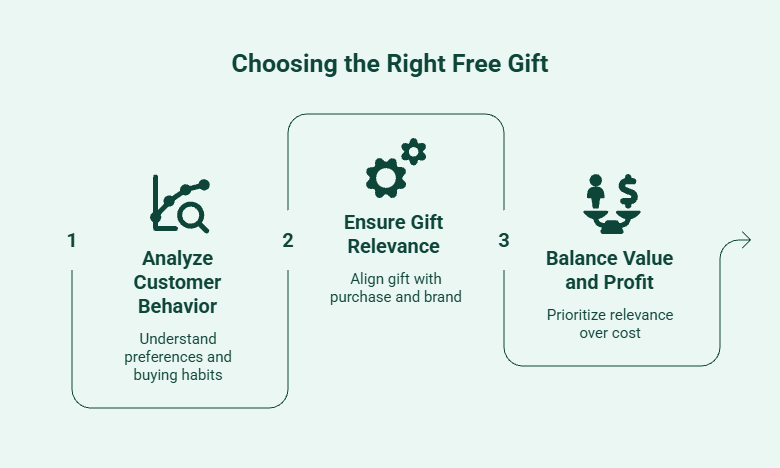
The best free gift isn't necessarily the most expensive one. It's the gift customers are most likely to value and the one that supports your campaign goal. Before choosing a reward, look at customer behavior, your product catalog, and the cost of the promotion.
Start with what customers already buy. Your order data often reveals which gifts are most likely to resonate.
Look for:
For example, if shoppers regularly purchase travel-size products alongside full-size versions, a travel-size gift will usually outperform an unrelated giveaway.
The most effective free gifts feel like a natural extension of the purchase. Customers are more likely to value and use a reward when it aligns with what they already bought or with the brand they're shopping from.
For example:
Relevant gifts do more than improve the offer. They can introduce customers to complementary products and create opportunities for future purchases.
Not every gift needs to be tied directly to the product. Branded merchandise, seasonal items, or lifestyle gifts can also work when they fit your brand. The key is making the reward feel intentional. If customers immediately understand why the gift is included, the promotion is usually more effective.
The most effective free gifts are often inexpensive to fulfill. Customers care more about relevance than cost, which means a low-cost reward can still influence purchasing decisions.
For example, a skincare sample, coffee tasting pack, or branded accessory may cost only a few dollars but can help customers reach a higher spending threshold. If a $3 gift encourages a shopper to increase their order from $65 to $80, the promotion is usually more profitable than offering a storewide discount.
Before launching a campaign, estimate the cost of the gift against the additional revenue you expect it to generate. The goal is to increase order value without letting the reward cost outweigh the benefit.
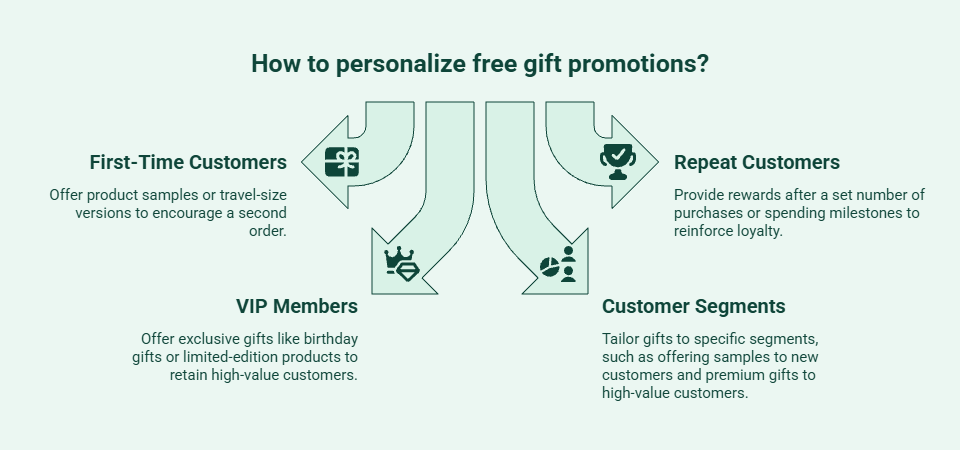
Not every customer responds to the same incentive. A gift that motivates a first-time buyer may do little for a loyal customer who has already purchased several times. Personalizing free gift offers helps merchants match rewards to customer behavior, making promotions more relevant and cost-effective. As campaigns become more sophisticated, many Shopify brands use platforms like Kefi Commerce to target different customer segments with tailored promotions instead of showing the same offer to every shopper.
First-time buyers often decide whether your brand is worth purchasing from again. Free gifts can help introduce additional products and increase the chances of a second order.
Good options include:
For example, a coffee brand might include a sample roast with a first order, encouraging customers to try another blend without committing to a full bag.
Repeat customers already know your products, so the goal shifts from discovery to retention. A well-timed gift can reinforce purchasing habits and encourage another order.
Examples include:
These campaigns work best when the reward feels earned rather than automatically available to everyone.
High-value customers contribute a disproportionate share of revenue, making them ideal candidates for exclusive gift campaigns.
Popular approaches include:
The gift doesn't need to be expensive. What matters is that it feels exclusive and reinforces the benefits of remaining a loyal customer.
Different customer segments often respond to different rewards. Someone purchasing from a skincare collection may value a sample, while a subscription customer may prefer an exclusive bonus product.
Examples:
Matching gifts to customer segments can improve campaign performance while reducing unnecessary giveaway costs.
Free gifts and discounts can both increase sales, but they influence customer behaviour differently. Discounts focus on reducing cost, while free gifts focus on increasing value. The better option depends on whether you're trying to increase AOV, clear inventory, encourage product trials, or protect margins.
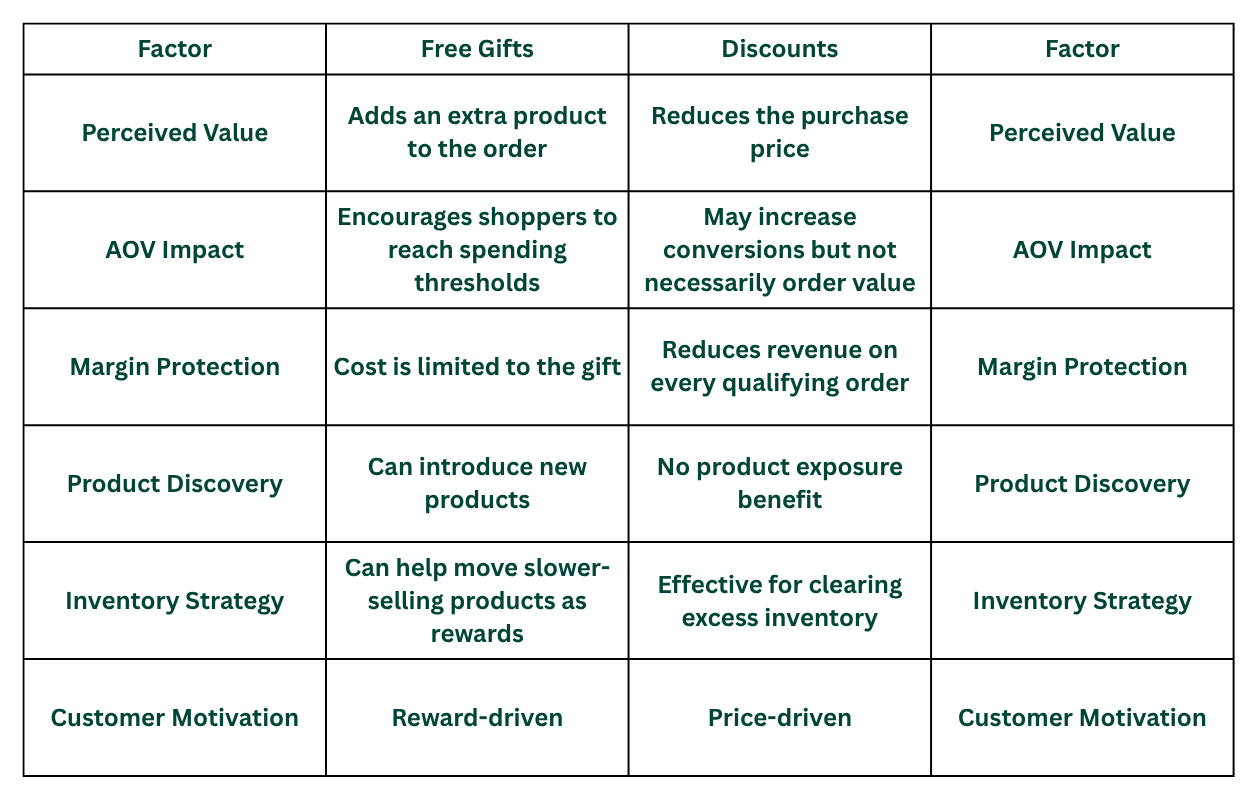
In many cases, free gifts create stronger perceived value because customers receive something additional rather than paying less for the same order. For example, a free coffee mug with a bundle often feels more rewarding than a small discount of similar value.
The effect is especially noticeable when the gift is tied to a spending threshold. Instead of focusing on the price, customers focus on reaching the reward, which can encourage larger orders.
Discounts reduce revenue on every qualifying order. Free gifts incur an additional cost, but the selling price of the main products remains unchanged.
For example, a merchant may offer a $3 gift to encourage customers to spend an additional $15 or $20. If the increase in order value outweighs the cost of the reward, the promotion can be more profitable than a percentage discount applied across the entire order.
This is one reason many brands use free gifts for cart-building campaigns while reserving discounts for inventory clearance or short-term sales events.
Free gifts are often a better fit when the goal is to:
Discounts are often a better fit when the goal is to:
Some merchants combine both approaches. For example, a Black Friday campaign might offer a free gift above a spending threshold alongside free shipping or a limited-time discount. The key is keeping the promotion simple. If customers need to calculate multiple thresholds, coupon conditions, and gift rules before qualifying, they are less likely to act on the offer.

Setting up a free gift campaign is relatively simple. The bigger challenge is choosing a setup that matches your promotion goals. A campaign designed to give every customer the same reward requires very different tools from one offering multiple gifts based on cart value, products purchased, or customer segments.
Most free gift campaigns start with a qualification rule. Common examples include:
The simpler the rule, the easier it is for customers to understand and act on it.
Automatic gift addition removes an extra step from the buying process. Instead of asking customers to find and add the reward themselves, the gift appears once they qualify.
This becomes particularly important for threshold-based campaigns. If customers have to claim the reward manually, some will miss it, creating frustration and reducing the promotion's impact.
Shopify's native tools can support basic gift-with-purchase campaigns, but limitations appear as promotions become more sophisticated.
For example, merchants often want to:
These scenarios typically require a dedicated promotion app rather than native discount functionality.
The right app depends on the campaigns you want to run.
If your strategy revolves around spend thresholds, automatic gift addition, and cart progress indicators may matter most. If you're running loyalty campaigns, customer segmentation and reward targeting become more important.
As stores grow, many merchants choose platforms like Kefi Commerce because they can manage free gifts alongside product bundles, upsells, and other promotions from a single workflow rather than relying on multiple disconnected apps.
Free gift campaigns tend to perform best when they are promoted before customers reach checkout.
Common placements include:
For example, a customer who sees "Spend $100 and receive a free travel kit" before adding products to the cart is more likely to work toward that threshold than someone discovering the offer at checkout.
Most abuse happens when qualification rules are unclear or poorly tested.
Before launching a campaign, check scenarios such as:
The goal is to make qualifying easy for legitimate customers while ensuring the promotion remains profitable as order volume grows.
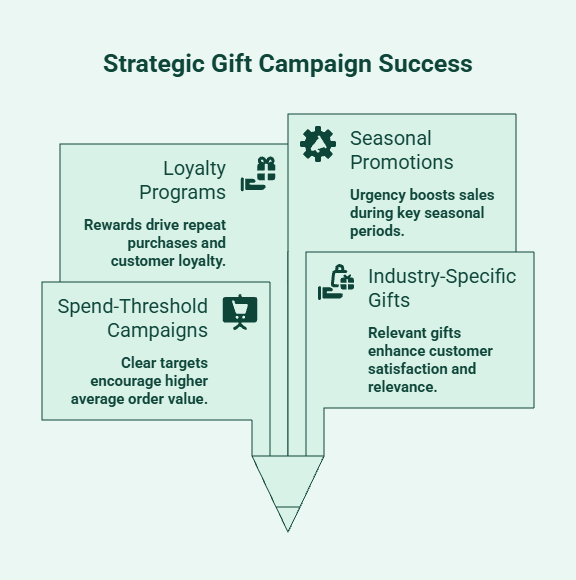
The strongest free gift campaigns are built around a specific objective. Some are designed to increase average order value, while others encourage repeat purchases or create urgency during key sales periods. Instead of running the same promotion year-round, successful brands adjust the offer based on the outcome they want to achieve. Platforms like Kefi Commerce make it easier to run these campaigns from a single promotion strategy, whether the goal is increasing cart value, rewarding loyal customers, or supporting seasonal sales.
Spend-threshold campaigns consistently perform well because they give shoppers a clear target. When customers are close to unlocking a reward, adding another item often feels more worthwhile than missing the gift altogether.
For example:
Thresholds are often set slightly above a store's current average order value. This encourages larger orders without making the spending requirement feel unrealistic.
The most effective gifts reflect how customers shop within a particular category. A reward that feels useful in one industry may feel out of place in another.
Beauty brands often use sample-size products because customers are already comfortable trying new formulas before committing to a full-size purchase. Apparel stores frequently offer accessories or branded merchandise that complement the main order. Coffee brands may offer sample roasts that let customers explore a different blend without purchasing an additional bag.
The goal is not to give away the most expensive item. It's to offer something that naturally fits alongside the purchase and strengthens the overall offer.
Not every campaign needs to focus on acquiring new customers. Free gifts can also encourage shoppers to return by rewarding continued purchasing behavior.
A reward might be tied to:
For example, a supplement brand could include an exclusive sample product bundle after a customer's fifth order. The reward recognizes continued engagement without relying on recurring discounts to drive retention.
Seasonal campaigns work particularly well because they combine added value with a deadline. Customers already shopping during Black Friday, holiday periods, or product launches are often more responsive to rewards that won't be available indefinitely.
A promotion such as "Spend $100 and receive a free travel kit this weekend only" gives shoppers a reason to act now rather than delaying their purchase. The urgency comes from the limited availability of the reward, not from reducing product prices.
These campaigns are most effective when the offer is visible before customers reach checkout. Product pages, email campaigns, announcement bars, and cart messaging can all help reinforce the reward and encourage shoppers to qualify before the promotion ends.
A free gift campaign should do more than increase redemptions. Tracking the right metrics helps determine whether the promotion increased order value, improved conversions, and generated profitable growth.
Looking at these metrics together provides a clearer picture of performance than AOV alone. They help identify whether the promotion is driving larger orders, improving conversion efficiency, and generating profitable revenue growth.
Free gift campaigns become harder to manage as promotion strategies grow. A simple spend-threshold offer is relatively easy to launch, but running multiple gift rules, customer segments, and cart incentives often requires more control.
Kefi Commerce helps Shopify merchants manage free gift promotions alongside bundles, volume discounts, cart incentives, and upsell campaigns from a single platform. Instead of relying on separate tools for different promotions, brands can create coordinated offers designed to increase average order value and drive more revenue from every customer journey.
With Kefi Commerce, merchants can:
For brands looking to grow AOV without relying heavily on discounts, free gifts often work best as part of a broader promotion strategy rather than a standalone campaign.
Ready to increase AOV without relying on constant discounts? Explore with Kefi Commerce and see how free gifts, bundles, upsells, and volume discounts can work together to drive more revenue from every order.
Free gift promotions give Shopify merchants a way to increase order value without relying on deeper discounts. The most effective campaigns use relevant rewards, clear qualification rules, and offers that align with customer buying behavior.
Success depends on more than the gift itself. Tracking performance, refining campaign rules, and combining free gifts with a broader promotion strategy can help drive higher spending, stronger retention, and more profitable growth over time.
The most effective free gifts are complementary products, samples, travel-size items, accessories, and branded merchandise. A great way to enhance these gifts is by ensuring they align with the original purchase, as this tends to generate higher engagement, stronger perceived value, and better results than unrelated giveaways.
Set up a qualification rule, such as "Spend $75 and receive a free gift for a specific item," then use a Shopify free gift app to automatically add the reward when the cart meets the required value. Additionally, reach out to customer support to test the campaign and ensure the gift is added and removed correctly as cart conditions change.
Common mistakes include choosing irrelevant gifts, setting qualification thresholds too high, running overly complex rules, failing to test gift eligibility, and ignoring profitability. The most effective promotions are easy to understand, simple to redeem, and aligned with customer purchase behavior.
Choose a free gift that complements your products, appeals to your target audience, and supports can support your Shopify store campaign goal. Low-cost samples, accessories, or add-ons often perform well because they feel valuable to shoppers while keeping promotion costs manageable.
Yes. Common mistakes include offering gifts that don't relate to the purchase, setting spending thresholds too high, creating complicated qualification rules, allowing promotion stacking that hurts margins, and failing to test how the gift behaves when cart conditions change.
.svg)
