Let's have a deep dive into this.
Getting more traffic isn't always the fastest way to grow your Shopify store. If customers are already placing orders, there's often a bigger opportunity sitting right in front of you: increasing the value of each purchase without making checkout more complicated.
That's where one-click upsells come in. Instead of asking customers to add another product before checkout, you can show them a relevant offer after they've already completed their purchase. Because customers don't need to go through checkout again, accepting the offer takes just a single click.
If you're already getting orders, one-click upsells can help you generate more revenue from those customers without needing to find new ones. The stores that see the best results focus on relevant offers, smart timing, and a post-purchase experience that feels helpful rather than pushy.
A one-click upsell is a post-purchase offer shown after a customer completes checkout. Instead of ending the transaction, you can present a relevant product that complements the original order, and the customer can add it with a single click without re-entering payment or shipping details.
For example, if someone buys a coffee machine, you might offer coffee pods or a cleaning kit immediately after checkout. Because the original purchase is already complete, accepting the offer feels like a simple add-on rather than a new purchase. This reduced friction is one reason one-click upsells often achieve higher acceptance rates than traditional upsell offers.
A one-click upsell funnel adds a post-purchase offer between checkout and the final order confirmation. Instead of ending the customer journey immediately after payment, Shopify merchants can present an additional product that customers can accept with a single click.
A typical one-click upsell funnel works like this:
This process reduces friction while creating an opportunity to increase order value after the initial purchase.

Yes. Most Shopify post-purchase upsell apps use Shopify Payments to support one-click purchases after checkout. When a customer completes an order using Shopify Payments, eligible apps can display a post-purchase offer that can be accepted without requiring a second checkout.
Post-purchase offers appear only after the original payment has been approved. This allows supported upsell apps to present an additional product without interrupting the completed order. If the customer accepts the offer, the upsell is added through the post-purchase flow rather than sending them back through a new checkout process.
One-click upsells rely on payment tokenization. During the original transaction, payment information is securely authorized and tokenized, allowing supported apps to process an accepted upsell without asking customers to enter their card details again.
For example, if a customer purchases a smartphone and accepts a post-purchase offer for a screen protector, they can add the accessory with a single click rather than starting a separate transaction.
Before installing an upsell app, confirm that it supports Shopify Payments and post-purchase offers. Some apps specialize in product page, cart, or checkout upsells, while others support dedicated post-purchase funnels. Verifying this up front can help you choose a tool that aligns with your upsell strategy.
If post-purchase upsells are a priority, look for apps that support Shopify Payments, post-purchase offer placement, audience targeting, and reporting that tracks acceptance rates, incremental revenue, and average order value impact.
For most Shopify stores, post-purchase upsells are the best place to start. Because the original order is already complete, you can present additional offers without risking checkout abandonment. Product page, cart, and checkout upsells can still increase order value, but they influence customers before payment and require more careful testing.
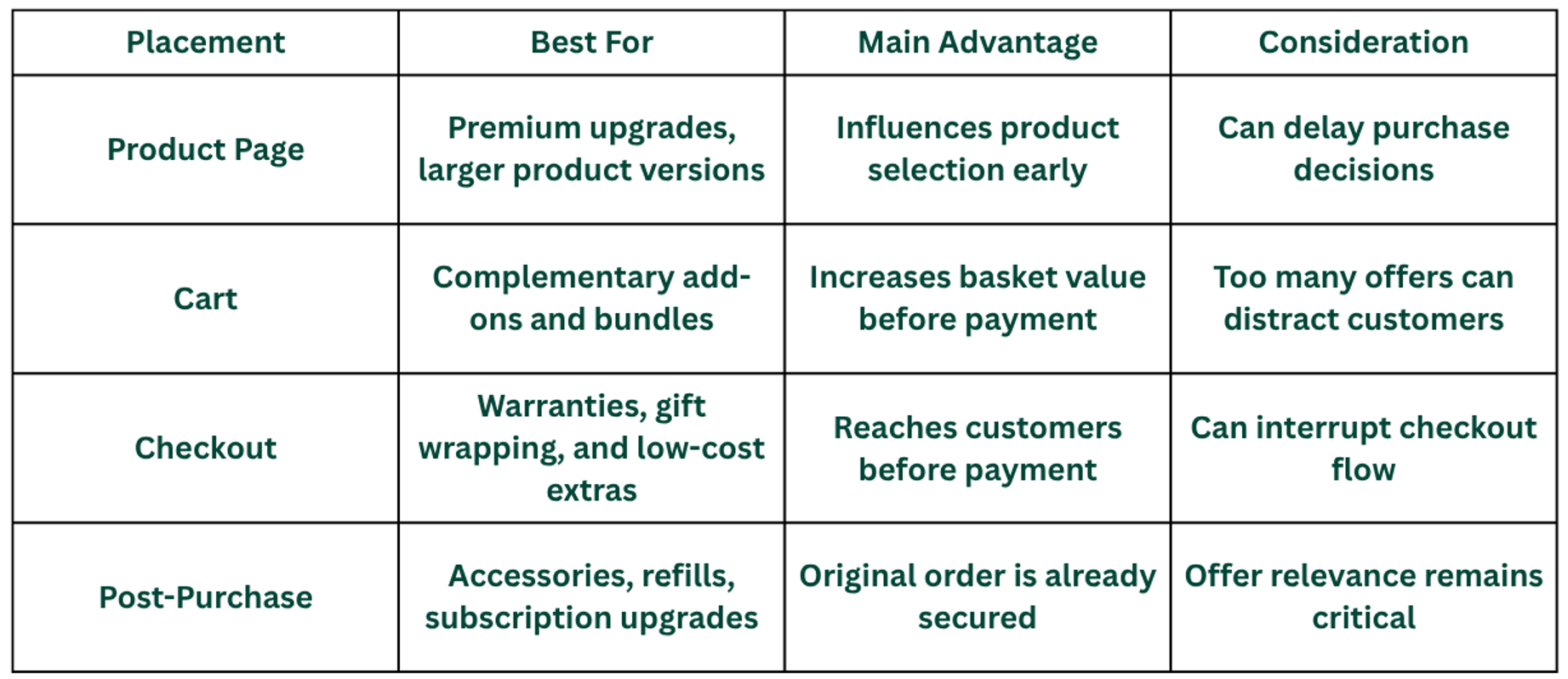
If you're launching your first upsell funnel, start with post-purchase offers. Once you have a consistent performer, test additional placements across the customer journey.
One-click upsells appear after the original purchase is complete, which changes how customers evaluate the offer. Instead of deciding whether to buy, they're deciding whether a related product is worth adding to an order they've already placed.
For example, a customer buying a $900 smartphone may skip a $30 screen protector before checkout to keep the order total lower. After checkout, that same offer feels easier to evaluate on its own.
Post-purchase upsells often convert better because they benefit from:
This combination makes post-purchase upsells particularly effective for accessories, refills, warranties, subscriptions, and other products that naturally complement the original purchase.
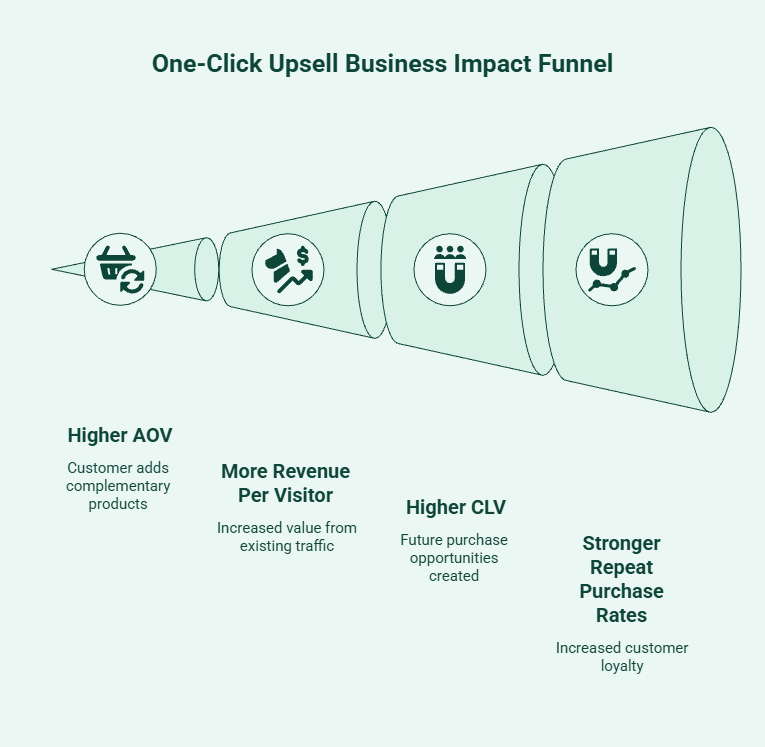
One-click upsells help Shopify merchants generate more value from customers who have already decided to buy. Instead of relying entirely on new customer acquisition, they create additional revenue opportunities within existing orders.
The biggest business impacts typically include:
The strongest upsell funnels improve more than a single order. They help merchants increase AOV, generate more revenue from existing traffic, and create additional opportunities for repeat purchases over time.
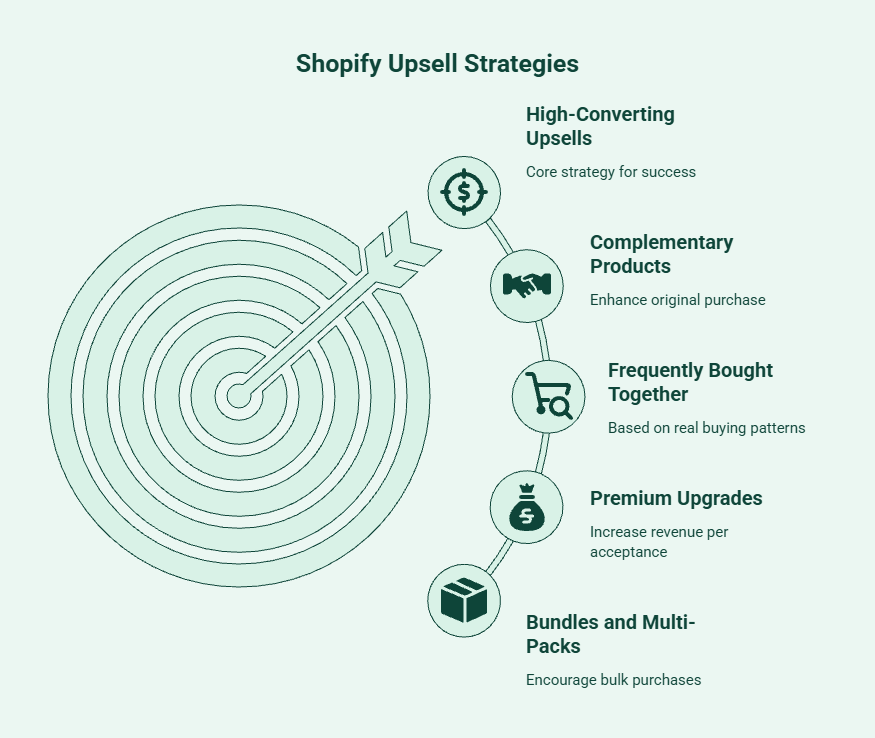
The highest-converting upsells usually solve a need created by the original purchase. If customers immediately understand why the additional item is useful, acceptance becomes much easier.
For most Shopify stores, complementary products, purchase-data-driven recommendations, replenishment offers, and bundles tend to outperform complex or unrelated offers because they require very little explanation.
Complementary products solve a related need created by the original order. These offers are typically selected by the merchant because they naturally enhance the customer's purchase.
For example:
These offers work because customers can immediately see how the products fit together.
Frequently bought together recommendations are based on actual purchasing behavior. Instead of relying on merchant assumptions, these offers use order data to identify products customers commonly purchase together.
For example:
Because these recommendations reflect real buying patterns, they often feel more relevant to customers.
Premium upsells focus on increasing revenue per acceptance rather than maximizing acceptance rates.
Examples include:
While fewer customers may accept these offers, each successful upgrade typically generates more revenue.
Replenishment offers work best when customers will eventually need the product again.
Examples include:
Because the future need is predictable, these offers can support both immediate revenue and repeat purchases.
Product Bundles and quantity-based offers encourage customers to purchase more of a product they already want.
Examples include:
These offers are particularly effective for consumables and products that customers purchase repeatedly.
Protection-focused offers are most effective when the original purchase carries a higher value or long-term use.
Examples include:
Unlike complementary products, these offers sell reassurance rather than additional functionality.
Based on merchant reviews and common e-commerce use cases, the upsell categories that most consistently perform well include:
These offers tend to convert because customers can immediately understand their value without needing additional education or consideration.
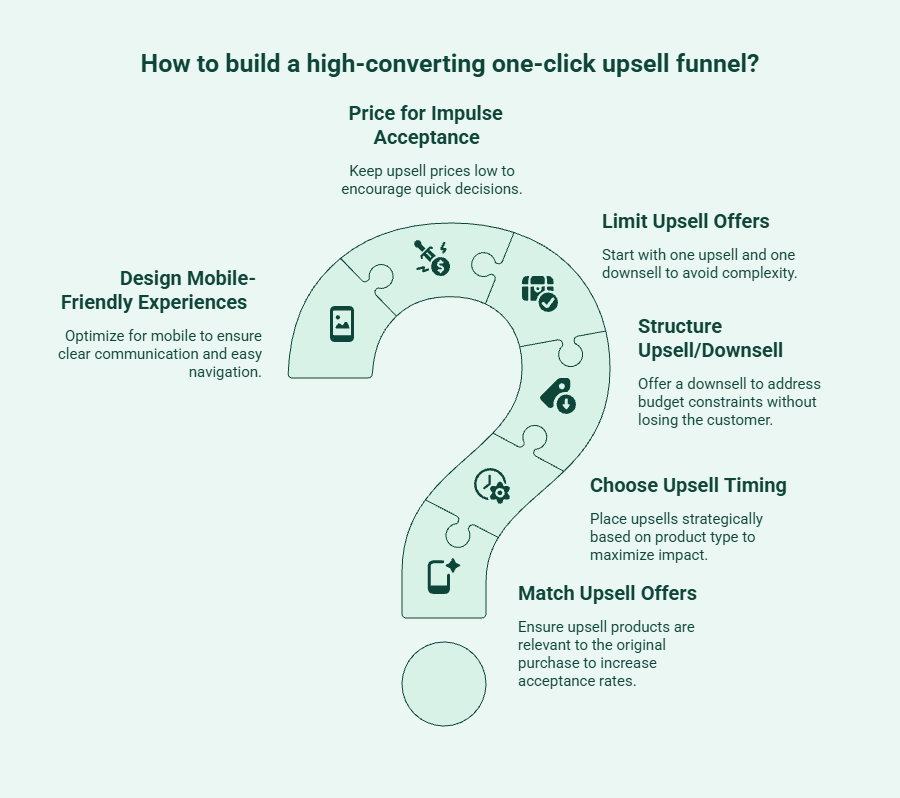
Building a high-converting one-click upsell funnel is less about adding more offers and more about showing the right offer at the right moment. The strongest funnels typically use relevant products, simple offer structures, and ongoing testing to improve results over time.
The biggest reason upsell offers get ignored is poor product fit. Customers are far more likely to accept an offer that extends the value of what they just purchased.
For example:
If the customer immediately understands why the product is useful, the offer has a much higher chance of converting.
The best upsell placement depends on the product. Premium upgrades often work before checkout when customers are comparing options, while accessories, refills, and protection plans typically perform better after purchase.
For most one-click upsell funnels, the post-purchase stage is the best place to start because the original order has already been completed.
A downsell should solve the same problem as the original upsell with a lower commitment level.
For example:
Instead of introducing a completely different product, reduce the price, quantity, or commitment required.
Most merchants see better results with one primary upsell and one downsell. Adding multiple offers often creates more complexity without increasing revenue.
Start simple, then expand only if testing shows additional offers improve performance.
The best post-purchase offers feel easy to justify relative to the original order.
For example, adding a $25 screen protector to a $900 smartphone purchase requires much less consideration than accepting another high-ticket item. The smaller the decision feels, the easier it is for customers to say yes.
Many customers will see your upsell offer on a mobile device. Keep the experience focused on:
If customers cannot quickly understand the offer or find the next step, acceptance rates will suffer regardless of product quality.
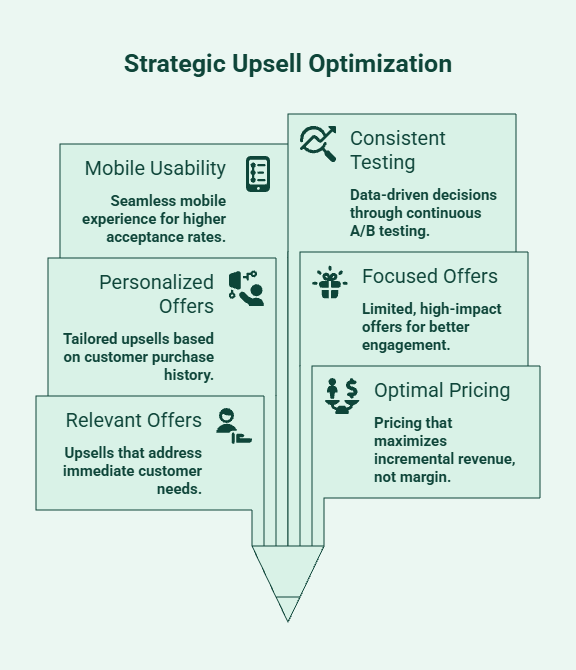
Many merchants assume upsell performance depends primarily on the app they choose. In reality, results are usually determined by the offer, pricing, and funnel structure. Before changing tools or adding more campaigns, review these common mistakes:
Most upsell funnels don't need more complexity to improve performance. They need more relevance, better offer selection, and consistent testing.
The goal of tracking upsell performance isn't to collect more data. It's to understand why customers are accepting, rejecting, or ignoring your offers. Some metrics measure overall funnel performance, while others help identify which products and offers drive the strongest results.
Rather than focusing on a single metric, look at how these numbers work together. A funnel with a lower acceptance rate can still outperform another if it generates higher order values, stronger repeat purchase rates, or more incremental revenue.
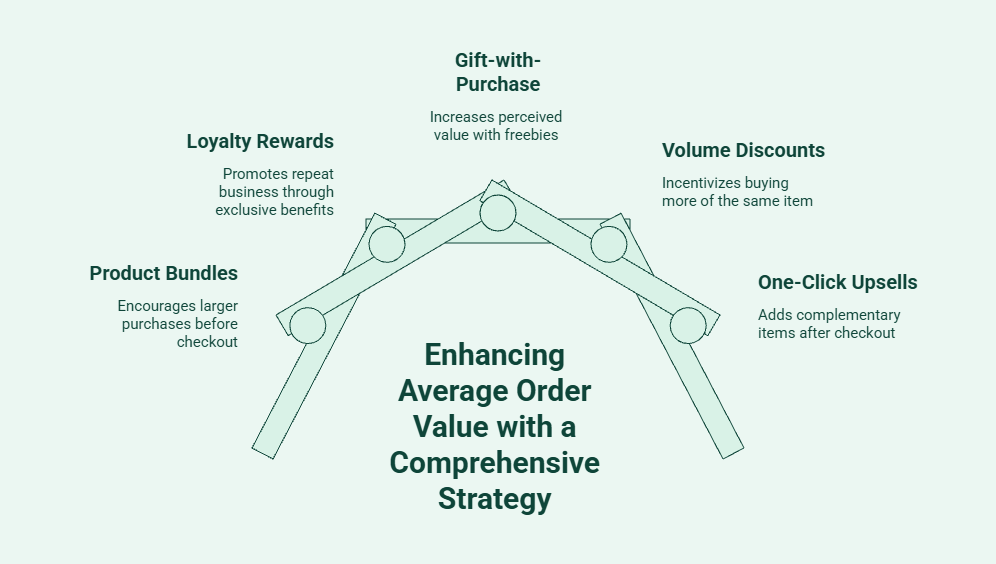
One-click upsells are rarely the only tactic successful Shopify stores use to increase average order value. They work best as part of a broader strategy where different promotions influence different stages of the customer journey.
Bundles and one-click upsells solve different problems. Product bundles encourage customers to buy more before checkout, while post-purchase upsells increase order value after the original purchase is already secured.
For example, a skincare brand might use a cleanser-and-moisturizer bundle on the product page, then offer a replenishment subscription after checkout. The bundle increases the initial order value, while the upsell creates an additional revenue opportunity.
One-click upsells focus on the current transaction. Loyalty programs focus on future transactions.
A customer who accepts a post-purchase offer may still need a reason to return later. Loyalty rewards help extend the value of the relationship by encouraging repeat purchases after the initial order is complete.
Gift-with-purchase campaigns increase perceived value, while upsells increase order value.
For example, a customer may qualify for a free gift after reaching a spending threshold, then see a post-purchase offer for a complementary product. The gift rewards the purchase, while the upsell creates an additional revenue opportunity.
Volume discounts and one-click upsells increase order value in different ways. Volume discounts encourage customers to buy more of the same product before checkout, while one-click upsells introduce an additional product after the original purchase is complete.
For example, a supplement brand might run a Buy More Save More offer where customers receive a discount for purchasing three protein tubs instead of one. After checkout, the store could present a shaker bottle or subscription offer as a one-click upsell.
The most effective stores typically assign a specific role to each tactic:
When each tactic serves a different purpose, merchants can increase average order value without overwhelming customers with multiple offers at the same stage of the buying journey.
The best one-click upsell app depends on what you're trying to achieve. Some apps focus exclusively on post-purchase funnels, while others help merchants combine upsells with broader average-order-value strategies, such as bundles, loyalty programs, and promotional campaigns.
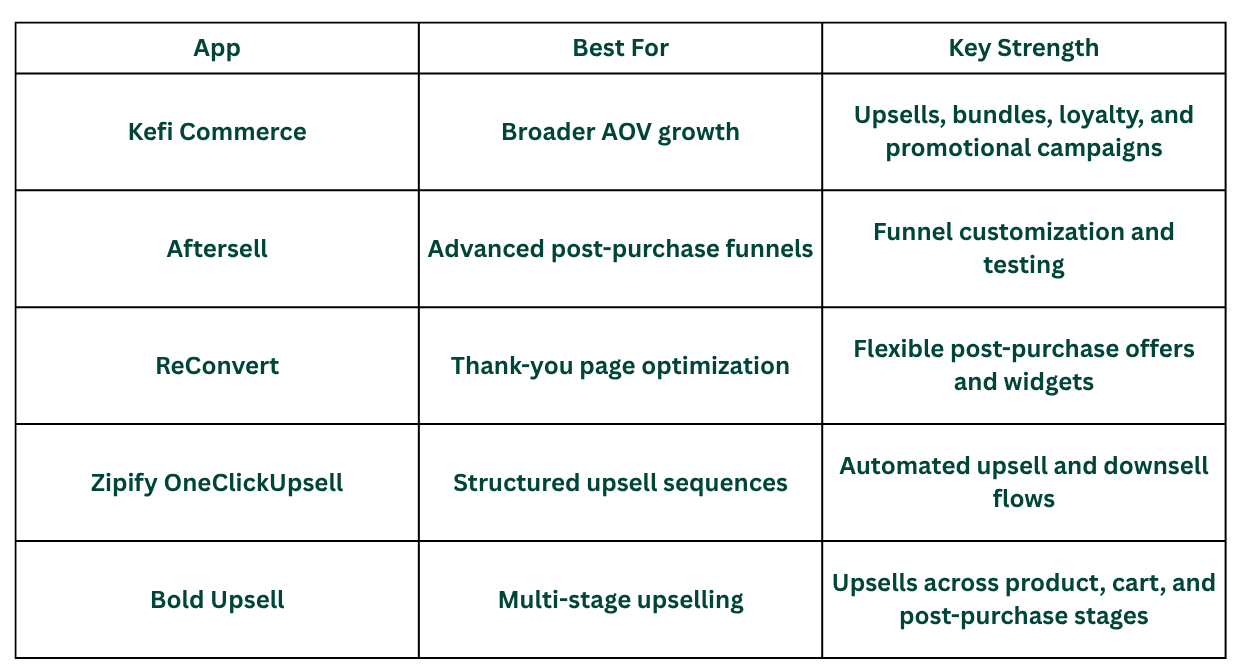
Kefi Commerce is designed for merchants who want to increase average order value by using multiple strategies rather than relying solely on post-purchase upsells. Alongside one-click upsells, merchants can run bundles, loyalty rewards, volume discounts, and gift-with-purchase campaigns from a single platform.
For example, a skincare brand might bundle a cleanser and moisturizer before checkout, present a replenishment serum as a post-purchase upsell, and reward customers with loyalty points for future purchases. Instead of managing several apps to execute each tactic, merchants can coordinate them under a single revenue growth strategy.
Merchants using Kefi Commerce often highlight the impact of combining bundles and upsells within a single platform. In a Shopify App Store review, Stellacouture. in shared:
"We've used the Kefi Bundle Builder to offer curated sets. Their upsell suggestions during checkout have been a game-changer, boosting our average cart value without being pushy."
Kefi Commerce is particularly well-suited for stores that want to:
Merchants using Kefi Commerce often highlight its ability to increase order value without disrupting the shopping experience. In a Shopify App Store review, StudioMikula shared:
"We've tried a few cart apps before, but nothing blended into our theme as smoothly as Kefi Bundle & Cart. The upsell feature is subtle yet effective. AOV has gone up noticeably."
For merchants focused on long-term revenue growth rather than a single upsell tactic, Kefi Commerce offers a broader approach to customer value optimization.
Aftersell is best suited for merchants who want to actively optimize post-purchase funnels rather than simply launch them. Its strength is funnel testing and customization, allowing merchants to experiment with different products, pricing strategies, offer sequences, and customer segments.
For example, a merchant selling coffee equipment could test whether coffee beans, filters, or a subscription offer generates the highest post-purchase revenue. Instead of relying on a single upsell, they can continuously refine funnel performance using real customer data.
If your goal is maximizing post-purchase conversion rates through testing and optimization, Aftersell is one of the strongest options available.
ReConvert focuses on helping merchants generate additional revenue after checkout through thank-you page optimization. Rather than building complex funnel logic, it allows merchants to turn a page that typically receives little attention into another revenue opportunity.
For example, a pet supply brand could use the thank-you page to promote subscription refills, recommend related products, or offer a discount on a future purchase. This approach works particularly well for merchants who want additional post-purchase revenue opportunities without building advanced upsell sequences.
ReConvert is often a good fit for stores looking for a simpler and more accessible entry point into post-purchase selling.
Zipify OneClickUpsell is built around structured offer sequences. Instead of presenting a single upsell, merchants can create a path where a declined offer automatically triggers a second recommendation.
For example, a customer purchasing an air purifier could first see a 12-month replacement filter bundle. If they decline, Zipify could automatically present a lower-priced 6-month bundle. This helps merchants recover revenue that might otherwise be lost after an initial rejection.
Stores that want more control over upsell-downsell logic often choose Zipify because of its focus on sequential offers rather than standalone recommendations.
Bold Upsell stands out because it supports upsell placements throughout the customer journey rather than concentrating exclusively on post-purchase offers.
For example, a laptop retailer could show a storage upgrade on the product page, recommend a laptop sleeve in the cart, and present an extended warranty after checkout. This allows merchants to test where customers are most likely to accept additional offers, rather than relying on a single placement.
Bold Upsell is often a better fit for stores that want a broader upselling strategy across product pages, cart pages, and post-purchase experiences.
The right app depends on the role upsells play within your overall growth strategy:
The most successful merchants rarely rely on a single tactic to increase average order value. Instead, they choose the platform that best supports how they want to grow revenue across the customer journey.
One-click upsells help Shopify merchants increase average order value after checkout without relying on additional traffic or ad spend. The most successful funnels focus on relevant offers that naturally complement the original purchase, making it easy for customers to add value with a single click.
If you're new to one-click upsells, start with a simple post-purchase offer tied to one of your best-selling products. As you learn what customers respond to, you can combine upsells with bundles, loyalty rewards, and gift-with-purchase campaigns to create more revenue opportunities across the customer journey.
Install a compatible Shopify upsell app, choose the products you want to promote, configure when offers appear, and customize the post-purchase experience to match your store.
Yes. Shopify merchants can use one-click upsell features after checkout through compatible upsell apps. These apps display post-purchase offers after the original order is completed, allowing customers to add an additional product with a single click without returning to checkout.
Yes. Most Shopify merchants can set up a one-click upsell funnel using an upsell app. After installation, you simply choose the offer, set when it appears, and customize the post-purchase experience without requiring custom development.
Results vary by store and offer quality, but merchants commonly use one-click upsells to increase average order value, generate additional revenue from completed purchases, and encourage repeat purchases through relevant add-ons, refills, or subscription offers.
Post-purchase upsell apps display a relevant offer after a customer completes checkout on the checkout page, but before they reach the thank-you page. Customers can accept the offer with one click, allowing the additional item to be added without re-entering payment details.
Not always. One-click upsell Shopify Payments functionality depends on the payment gateway and the upsell app being used. Merchants should review app compatibility to ensure post-purchase offers work with their preferred payment methods.
Many one-click upsell Shopify reviews focus on ease of setup, offer customization, AOV growth, and post-purchase conversion performance. Merchants also frequently evaluate apps based on reporting capabilities and customer support quality.
.svg)
