
Let's break down both metrics,
If you've come across both ACV and AOV, it's easy to assume they measure similar things. After all, both are revenue metrics, and both can influence how businesses evaluate growth. The difference is that they answer very different questions.
For Shopify merchants, understanding that difference matters. AOV focuses on how much customers spend each time they place an order, while ACV is designed for businesses that generate revenue through contracts and recurring agreements. Looking at the wrong metric can make it harder to understand what's actually driving revenue performance.
Take a skincare brand selling cleansers, serums, and moisturizers. The team is less concerned with annual contract revenue and more focused on whether shoppers are purchasing one product or building a complete routine. In that situation, AOV provides a much clearer view of revenue opportunities. Understanding how ACV and AOV work can help you focus on the metrics that align with your business model and growth strategy.
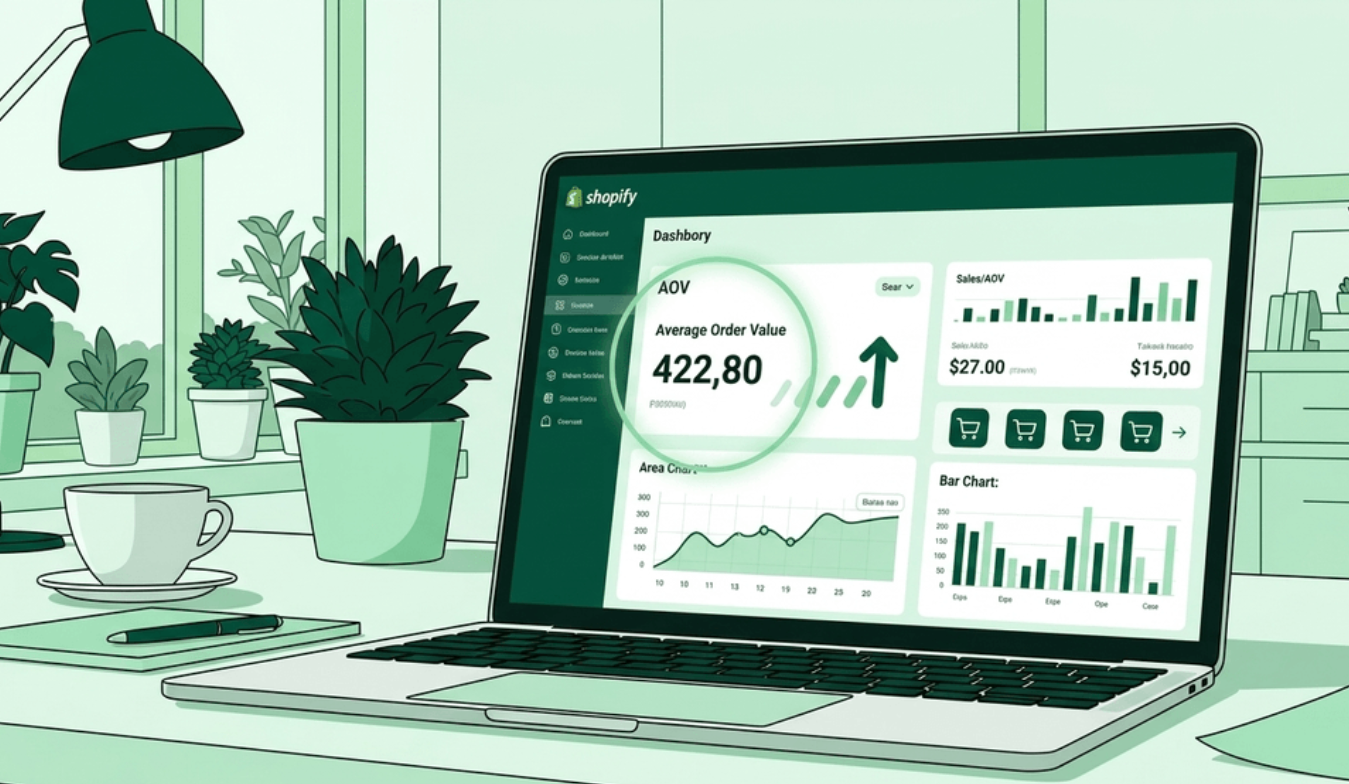
AOV stands for Average Order Value. It measures the average amount a customer spends per order during a specific period.
For example, a Shopify store with a $100 AOV generates an average of $100 per purchase. While the metric itself is simple, it provides valuable insight into how customers shop and how revenue is generated.
For e-commerce brands, changes in AOV can reveal shifts in purchasing behavior. A rising AOV may indicate that customers are buying multiple products in a single transaction or choosing higher-value items. A declining AOV can signal changes in product mix or buying patterns that may require closer attention.
Common factors that influence AOV include:
Because it focuses on order-level spending, AOV helps merchants understand the quality of each transaction, not just the quantity of orders being placed.
ACV stands for Annual Contract Value. It measures the annual revenue generated from a customer contract and is commonly used by SaaS and subscription-based businesses.
For example, a three-year contract worth $30,000 generates an ACV of $10,000 per year. Looking at revenue on an annual basis helps businesses compare contracts more consistently and evaluate the value of different customer accounts.
Businesses often use ACV to:
Because ACV focuses on customer agreements rather than individual transactions, it provides a clearer view of revenue generated through subscriptions, managed services, and recurring contracts.
Although ACV and AOV are both revenue metrics, they measure different types of business activity. AOV focuses on the value of individual purchases, making it relevant for e-commerce businesses that generate revenue through transactions. ACV focuses on the annual value of customer agreements, making it more relevant for SaaS and subscription-based companies that rely on contracts.
As a result, the two metrics support different business decisions. A Shopify merchant may use AOV to evaluate purchasing patterns and order performance, while a SaaS company may use ACV to assess contract value and customer accounts. The most useful metric is usually the one that reflects how revenue is generated.
The acronyms look similar, and both involve measuring revenue, which makes them easy to confuse at first glance. However, they serve different purposes. One focuses on customer spending within a transaction, while the other focuses on the annual value of a customer relationship.
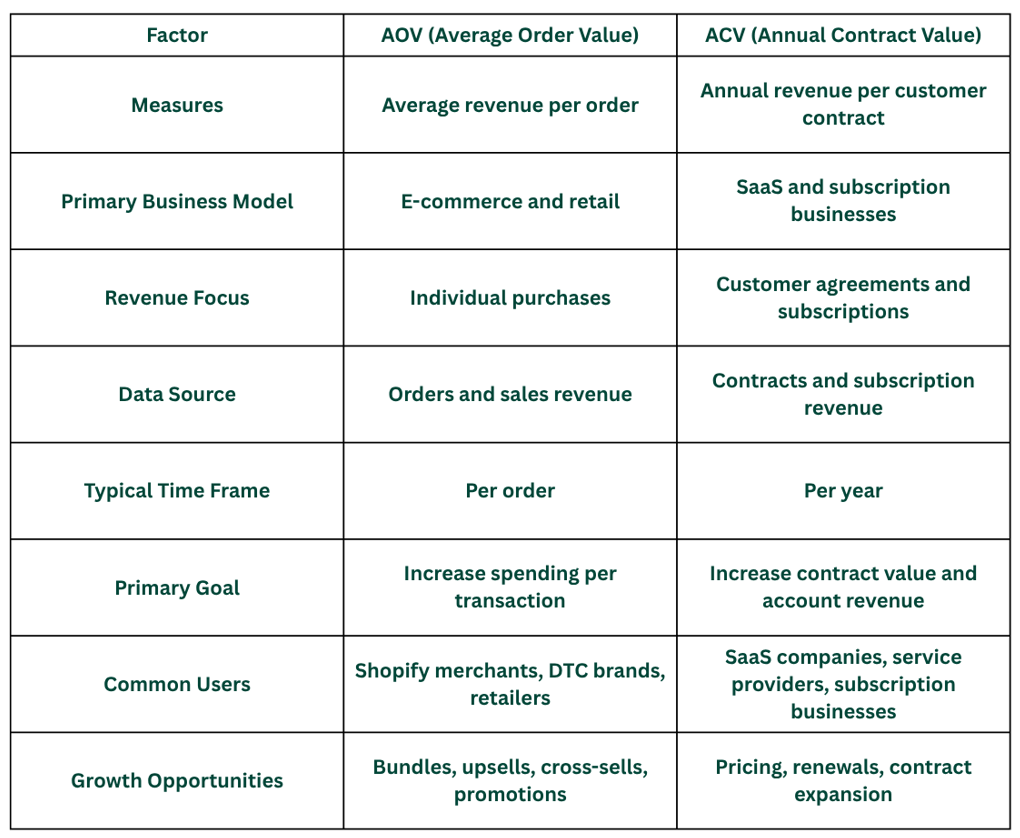
For most businesses, the choice is straightforward. E-commerce brands typically rely on AOV because revenue is generated through customer purchases, while SaaS and subscription companies are more likely to prioritize ACV because revenue is tied to ongoing customer agreements.
Calculating ACV and AOV is relatively straightforward. While the formulas use different inputs, both metrics help businesses quantify the revenue generated from customer purchases or agreements.
AOV Formula
Average Order Value = Total Revenue ÷ Total Number of Orders
For example, if a Shopify store generates $10,000 in revenue from 200 orders during a month:
$10,000 ÷ 200 = $50 AOV
This means customers spend an average of $50 per order. Tracking AOV over time can help merchants identify shifts in purchasing patterns and evaluate the impact of pricing changes, promotions, or merchandising initiatives.
ACV Formula
Annual Contract Value = Total Contract Value ÷ Contract Length (in Years)
For example, if a customer signs a three-year contract worth $30,000:
$30,000 ÷ 3 = $10,000 ACV
In this case, the customer contract generates $10,000 in annual revenue. SaaS and subscription businesses use ACV to compare contract sizes, assess customer segments, and understand the annual revenue potential of their customer accounts.
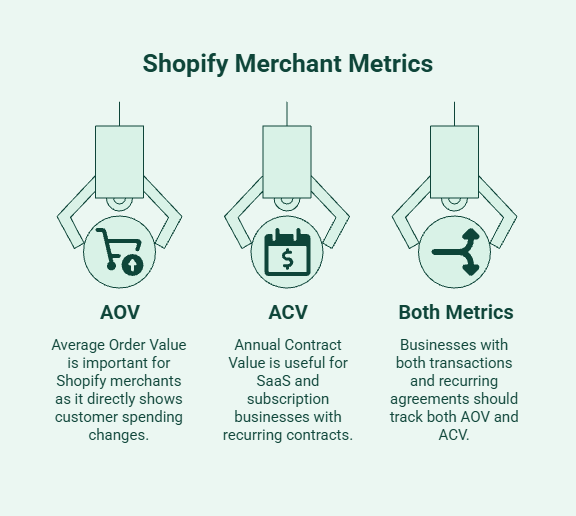
For most Shopify merchants, AOV is the metric that deserves the most attention. E-commerce businesses generate revenue from individual purchases, so changes in average order value provide a direct view of how customer spending changes over time. When shoppers start purchasing more products per order or choosing higher-value items, AOV reflects that shift immediately.
Because revenue is generated one transaction at a time, AOV provides a more relevant performance signal than ACV for most online stores. Merchants often use AOV to evaluate the effectiveness of pricing adjustments, product assortment changes, and promotional campaigns. A consistent increase in AOV can indicate that customers are finding more value in each purchase, even when traffic levels remain unchanged.
ACV is more useful for businesses that depend on recurring contracts rather than individual purchases. In these models, contract value has a greater impact on revenue performance than transaction size. Tracking ACV helps teams assess the value of customer agreements, compare account segments, and understand the revenue generated from long-term customer relationships.
Some businesses generate revenue through both transactions and recurring agreements. For example, a brand may sell products through Shopify while also offering subscription programs, memberships, or annual service plans. In these cases, AOV helps evaluate purchasing activity, while ACV provides visibility into contract-based revenue.
Tracking both metrics allows businesses to measure transaction revenue and recurring revenue separately. This creates a clearer view of how different revenue streams contribute to overall business performance and reduces the risk of relying on a single metric to evaluate growth.

Two Shopify stores can generate the same number of orders but produce very different revenue results. The difference often comes down to how much customers spend during each transaction. AOV helps merchants understand that gap, making it one of the most useful metrics for evaluating revenue performance and identifying growth opportunities.
A study featured in Harvard Business Review found that increasing customer retention rates by just 5% can increase profits by 25% to 95%, highlighting why many growth-focused brands prioritize maximizing revenue from existing customers.
Revenue growth does not always require more traffic. In many cases, increasing the value of existing orders can have a meaningful impact on sales performance. AOV helps merchants identify whether customers are purchasing more products per transaction, choosing higher-priced items, or responding to offers designed to increase order size.
For example, a store generating 1,000 monthly orders with a $50 AOV produces $50,000 in revenue. Increasing AOV to $60 raises monthly revenue to $60,000 without requiring additional orders. This makes AOV an important indicator of how efficiently a store converts customer demand into revenue.
Customer acquisition costs continue to rise across many e-commerce categories, making revenue efficiency increasingly important. Research from SimplicityDX found that customer acquisition costs for e-commerce brands have increased by approximately 60% over the past five years, putting greater pressure on merchants to maximize revenue from every order.
AOV also provides valuable context when evaluating campaign performance. Two campaigns may generate the same number of purchases, but the campaign producing larger orders often contributes more revenue and profitability. Looking at conversions alone would not reveal that difference.
In addition, larger orders can improve margin efficiency by spreading fulfillment, payment processing, and acquisition costs across more products. This helps merchants evaluate growth based on profitability, not just sales volume.
AOV is one of the most practical metrics for measuring the impact of merchandising and promotional strategies. When merchants introduce product bundles, volume discounts, free shipping thresholds, or product recommendations, changes in AOV can reveal whether those initiatives are encouraging customers to spend more per transaction.
This makes AOV especially useful for testing and optimization. Instead of relying on assumptions, merchants can measure how different offers influence purchasing behavior and compare the revenue impact of each strategy. It helps identify which promotions encourage larger purchases and which tactics increase revenue without creating excessive dependence on discounts.
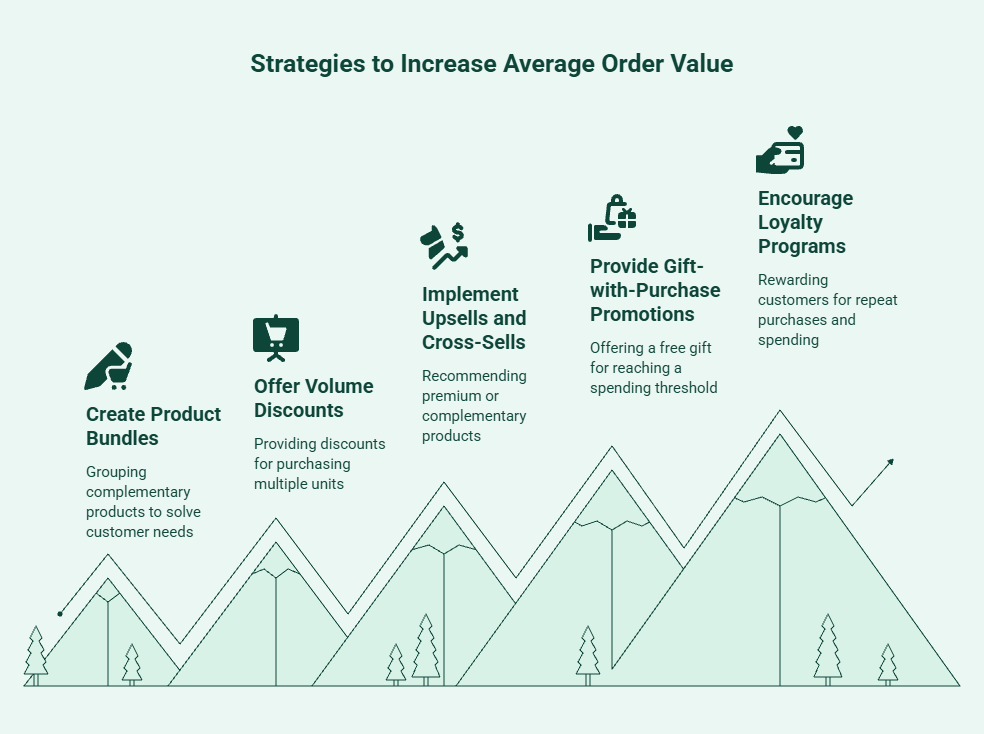
Increasing AOV is often more efficient than constantly chasing new traffic because it focuses on customers who have already decided to make a purchase. The most effective marketing strategies help shoppers discover relevant products, unlock better value, or build a more complete purchase without creating friction in the buying experience.
Product bundles work best when they solve a broader customer need rather than simply grouping products together. A skincare customer purchasing a cleanser may also need a serum and moisturizer, while a coffee enthusiast buying a machine may need filters and accessories. Bundling these products is a great way to reduce decision-making and makes the purchase feel more complete.
Purchase history can help identify products that customers frequently buy together. Building bundles around actual buying behavior often produces stronger results than relying on assumptions about what shoppers might want.
When built around real purchasing behavior, bundles can increase order value while making shopping decisions easier for customers. For many Shopify brands, product bundling strategies are one of the most effective ways to encourage larger purchases while improving the customer experience.
Volume discounts are particularly effective for products that customers buy repeatedly or use regularly. When shoppers know they will need additional units in the future, purchasing more in a single order often feels like a practical decision rather than an impulse purchase.
Free shipping thresholds can strengthen this behavior. For example, a customer who is only a few dollars away from qualifying for free shipping may be more willing to add another item to their cart than pay an additional shipping fee.
The most effective offers create a clear value exchange, where customers understand exactly what they gain by increasing their order size.
Many customers purchase only what they initially searched for, even when related products could improve their experience. Targeted upsells and cross-sells in marketing campaigns help bridge that gap by introducing relevant products at the right stage of the buying journey.
Upsells encourage shoppers to consider a premium version of a product with additional features or benefits. Cross-sells recommend complementary products that naturally fit with the original purchase. The goal is not to increase cart value at any cost but to surface products that genuinely add value.
When recommendations align with customer intent, they improve both product discovery and order value.
Gift-with-purchase promotions encourage customers to reach a spending threshold by adding perceived value instead of increasing discounts. Rather than reducing the price of an order, merchants reward higher spending with an additional product.
This approach works particularly well when the gift complements the products already being purchased. A beauty brand might offer a travel-size product, while a supplement company could include sample packs related to the customer's purchase.
Because the reward feels earned rather than discounted, gift-with-purchase offers can increase order value while protecting margins.
Loyalty programs can influence purchasing behavior by giving customers a reason to increase spending over time. Instead of rewarding a single transaction, they create ongoing incentives that encourage larger and more frequent purchases, enhancing customer service satisfaction.
The most effective programs are easy to understand. Customers should immediately know how points are earned, what rewards are available, and how close they are to unlocking additional benefits.
When structured correctly, loyalty programs increase the value of individual orders while strengthening customer retention and long-term revenue growth. Many brands also use loyalty programs to increase subscription AOV by rewarding customers for higher spending and repeat purchases over time.
Increasing AOV often depends on executing multiple strategies consistently across the customer journey. While bundles, upsells, volume discounts, and promotional offers can increase cart value, managing them across multiple apps and campaigns can quickly become difficult as stores grow. Merchants often struggle to test offers, maintain a consistent customer experience, and measure what is actually driving revenue.
Kefi Commerce helps Shopify merchants bring these strategies together in a single platform, making it easier to create higher-value shopping experiences without adding operational complexity.
With Kefi Commerce, merchants can:
Many Shopify brands combine these strategies to increase revenue per order while creating a smoother customer experience. Managing them from a single platform makes it easier to test, optimize, and scale what works.
For merchants looking to increase AOV without adding operational complexity, Kefi Commerce provides the tools needed to launch, manage, and optimize revenue-driving campaigns throughout the customer journey.
The metric you prioritize should reflect how your business generates revenue. For most Shopify merchants, AOV and conversion rate are the more relevant metrics because revenue is driven by individual purchases rather than long-term contracts. Changes in AOV can quickly show whether pricing, merchandising, product assortment, or promotional strategies are influencing how much customers spend per order.
ACV becomes more important when revenue is tied to subscriptions, retainers, or annual agreements. Businesses that combine e-commerce sales with recurring services may benefit from tracking both metrics in real time, using AOV to evaluate transaction-based revenue and ACV to monitor contract-based revenue. For most e-commerce brands, however, AOV remains the more actionable metric because it is closely connected to day-to-day revenue performance.
No. While AOV is most commonly used in e-commerce, any business that relies on individual transactions can track it. Retail stores, restaurants, and service-based businesses can also use AOV to understand customer spending patterns.
Common mistakes include offering irrelevant upsells, relying too heavily on discounts, setting unrealistic free shipping thresholds, and focusing on order value without considering profit margins. Many merchants also skip testing, making it difficult to identify which strategies actually improve AOV.
Yes. Increasing AOV allows businesses to generate more revenue from existing customers and traffic, enhancing customer loyalty. When shoppers spend more per order, brands can improve revenue efficiency, recover acquisition costs faster, and grow sales without relying solely on attracting new customers.
Yes. Brands commonly increase AOV through product bundles, upsells, free shipping thresholds, loyalty rewards, and volume discounts, creating a sense of urgency. Beauty, fashion, and electronics retailers often use these strategies to encourage larger purchases and increase revenue per transaction.
Marketers improve AOV through product bundles, upsells, cross-sells, volume discounts, free shipping thresholds, gift-with-purchase offers, and loyalty programs, using insights into customer behavior. These strategies encourage customers to spend more per order while improving the overall shopping experience.
Tracking AOV helps businesses measure how much revenue each order generates over a specific time period. A higher AOV can improve revenue efficiency, increase profitability, and help merchants optimize their marketing efforts to earn more from existing customers without relying solely on additional traffic or customer acquisition.
.svg)
