

In the competitive e-commerce landscape, understanding how effectively your online store converts traffic into revenue is paramount. While many metrics like conversion rates and average order value are valuable, they don't tell the whole story. Revenue per visitor (RPV) is one of the most powerful performance metrics for any ecommerce business, offering a comprehensive look into the health of your sales funnel. By focusing on RPV, you can gain deeper insights into your user experience and identify precise opportunities to drive sustainable growth.
Revenue per visitor is one of the most telling e-commerce metrics, representing the average revenue you generate for each visitor to your website. To calculate it, you simply divide your total revenue over a specific period by the total number of visitors during that same timeframe. This single figure encapsulates the effectiveness of your entire customer journey, from initial attraction to final purchase.
For an online business, RPV provides a clear, high-level snapshot of performance. It is essential to use the number of unique visitors, not total sessions, for an accurate calculation. A unique visitor is an individual counted only once, regardless of how many times they visit your site within the reporting period. This distinction prevents inflated numbers and gives you a true measure of how much each potential customer is worth to your business, making it a foundational metric for strategic planning.
Also Read: How The Chosen Cultivated a Community through Curated Merchandise Kits.
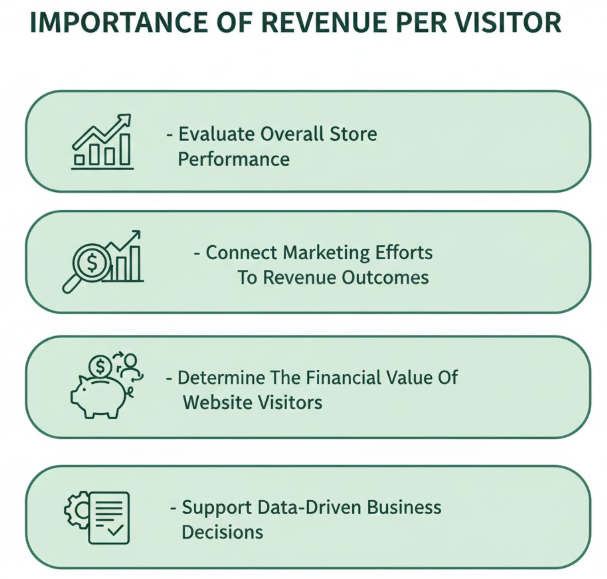
Tracking revenue per visitor is vital for any e-commerce business aiming for long-term success. As a critical key performance indicator, RPV provides a holistic view of your store’s financial health by directly linking top-of-funnel activities to your total revenue. It helps you understand the real value generated by your traffic.
Revenue per visitor is an excellent barometer for your overall store performance. It combines the impact of your conversion rates and average order values into a single, cohesive metric. This gives you a powerful, at-a-glance understanding of how effectively your entire sales funnel is working to generate overall revenue. For an ecommerce business, monitoring RPV trends over time reveals the health of your operations. A rising RPV indicates that your strategies are working, perhaps your marketing is attracting more qualified buyers, or your on-site experience is successfully encouraging larger purchases.
One of the greatest strengths of RPV is its ability to link your marketing efforts directly to tangible revenue. Instead of just measuring clicks or traffic volume, RPV tells you which campaigns are actually bringing in valuable customers who spend money. By segmenting your RPV by traffic source, you can gain powerful insights. For example, you can compare RPVs across different channels to identify the most profitable.
This analysis helps you understand:
This data-driven approach allows you to optimize your marketing spend by reallocating your budget to the channels with the highest revenue per visitor. It ensures that every dollar you spend on marketing is working as hard as possible to grow your business and improve profit margins.
Do you know how much a single website visitor is worth to your business? Revenue per visitor answers this question directly. This key metric calculates the average amount of revenue generated by each person who lands on your site, giving you a concrete financial value for your traffic.
Understanding this value is crucial for making strategic decisions about customer acquisition. For instance, if your RPV is $5, you know that you can spend up to $5 to acquire a new visitor and still break even on the first purchase. This information is invaluable when setting budgets for paid advertising campaigns on platforms like Google or Facebook.
In the world of e-commerce, data is king. The revenue per visitor metric provides the clear, actionable data you need to make smarter business decisions. It serves as a guiding star for your optimization efforts, helping you prioritize changes that will have the biggest impact on your bottom line.
When you track RPV, you can confidently assess the impact of various initiatives. This allows you to move beyond guesswork and base your strategy on hard numbers. For example, RPV can help you evaluate:
By integrating RPV into your regular analysis of ecommerce metrics, you empower your ecommerce business to make strategic, data-backed decisions. This ensures that your resources are allocated to the optimization efforts that will drive the most significant and sustainable growth.
Also Read: How to Master Customer Revenue Optimization Strategies?
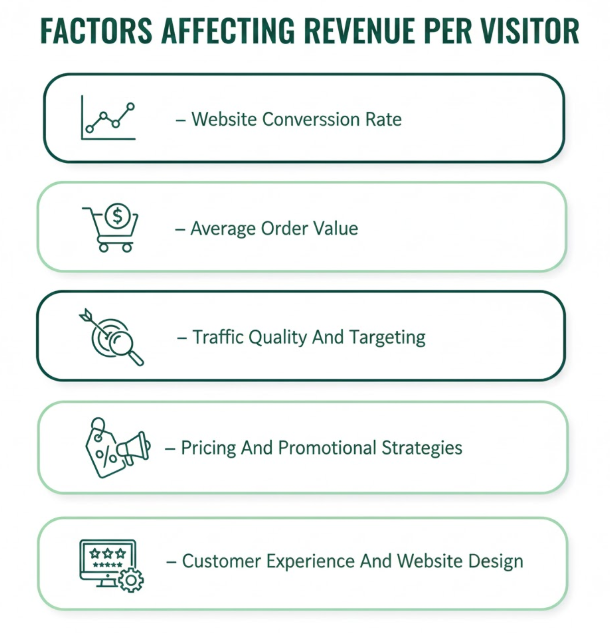
Revenue per visitor is a composite metric, meaning it is directly influenced by several other key performance indicators. Understanding these underlying factors is the first step toward improving your RPV. From the quality of your traffic and the effectiveness of your pricing to your on-site customer experience, each element plays a role.
Your website's conversion rate is a primary driver of your revenue per visitor. The conversion rate measures the percentage of your visitors who complete a purchase during a given time period. A higher conversion rate means more visitors become customers, which naturally increases revenue per visitor. Optimizing for conversions is, therefore, a direct way to boost your RPV. Some key areas for improvement include:
For any ecommerce business, even a small improvement in conversion rate can significantly impact RPV. It's about making it as easy as possible for interested shoppers to complete their purchase, thereby maximizing the value you get from every visitor.
Average order value (AOV) is the second core component that determines your revenue per visitor. AOV measures the average amount a customer spends per transaction in your online store. When you successfully encourage customers to spend more per order, your total revenue increases, which in turn boosts your RPV.
While conversion rate focuses on the number of transactions, AOV focuses on the value of each transaction. You can have a great conversion rate, but if customers are only making small purchases, your RPV will remain low. This is why looking at RPV is so important; it combines both the frequency and the value of purchases.
Not all traffic is created equal. The quality of the visitors coming to your site has a massive impact on your revenue per visitor. High-quality traffic consists of users who match your target audience and have a genuine interest in your products. These visitors are far more likely to convert and make larger purchases, leading to a higher RPV.
To improve the quality of your traffic, you should refine your targeting strategies. This can involve:
By prioritizing traffic quality, you ensure your marketing dollars attract visitors more likely to contribute to your online sales and boost your revenue per visitor.
Your product pricing and promotional offers directly influence how much money visitors are willing to spend, which in turn affects your revenue per visitor. A pricing strategy that is too high might deter purchases and lower your conversion rate, while one that is too low might result in a high conversion rate but a low AOV. Finding the right balance is key.
Promotional offers, such as discounts or free shipping, can be powerful tools for increasing RPV if used strategically. For example, offering free shipping over a certain order threshold can encourage customers to add more items to their cart to qualify, thereby increasing the average order value.
A seamless and positive customer experience is fundamental to maximizing revenue per visitor. Your website design and overall user experience can either guide a visitor smoothly toward a purchase or create friction that causes them to leave. A poorly designed site often leads to high bounce rates and increased cart abandonment, both of which are detrimental to your RPV.
To improve the customer experience, focus on key areas of your website design. This includes:
By investing in a superior user experience, you not only reduce cart abandonment and bounce rates but also build trust, encouraging visitors to complete their purchases and ultimately increasing your revenue per visitor.
Also Read: How Squaties Scaled Order Volume via Performance Bundling.
Calculating RPV involves analyzing the amount of revenue generated per visit to your ecommerce store. Start by determining your total revenue over a specific period. Divide this by the total number of unique visitors during that period, yielding a clear figure for RPV. This calculation is crucial for understanding and enhancing your ecommerce performance metrics.
The formula for calculating revenue per visitor (RPV) is simple yet highly valuable for measuring ecommerce performance. It shows how much revenue each visitor generates for your store during a specific period. The basic formula is:
RPV = Total Revenue ÷ Total Unique Visitors
Using unique visitors instead of total visits ensures more accurate results because each individual is counted only once, regardless of how many times they return to the site.
Another useful approach links RPV to its core drivers: the conversion rate (CR) and average order value (AOV). This component-based formula is:
RPV = Conversion Rate (CR) × Average Order Value (AOV)
For example, if your store generates $20,000 in revenue from 10,000 unique visitors, your RPV would be $2.00. This metric helps businesses understand how effectively their website converts traffic into revenue.
Also Read: How a Premier Portuguese Winery Cultivated a +16.80% AOV Lift.
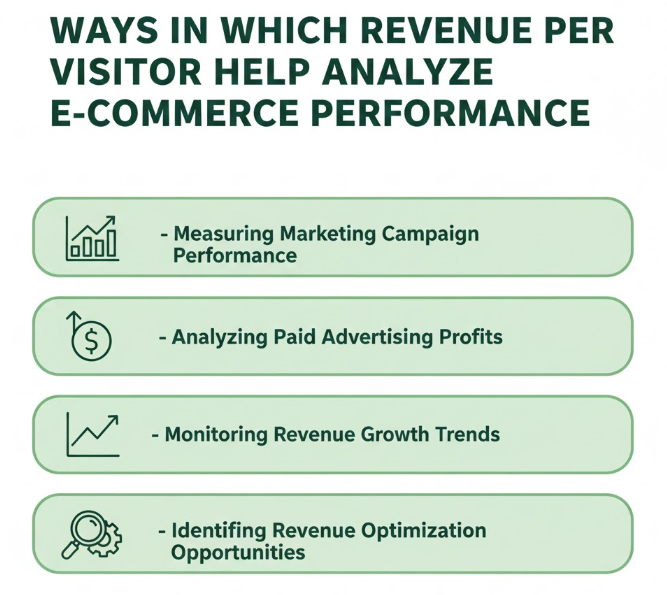
Revenue per visitor is more than just a simple calculation; it's a diagnostic tool for analyzing your overall e-commerce performance. It provides a unified view of how effectively your entire customer journey, from marketing campaigns to final checkout, converts traffic into online sales. By tracking RPV, you can move beyond surface-level metrics and gain a deeper understanding of your business's health. Let's explore some specific ways RPV can sharpen your analysis.
One of the most powerful applications of RPV is in evaluating the true success of your marketing campaigns. It connects your marketing spend directly to your online sales, offering a clear measure of ROI. By calculating the RPV for each of your marketing channels, you can identify which ones are delivering the most valuable visitors. For example, you might discover that your email marketing campaigns have a much higher RPV than your social media ads, even if the latter drives more traffic.
This insight allows you to make data-driven decisions about your marketing budget. You can:
Ultimately, using revenue per visitor to measure campaign performance ensures your marketing efforts are focused on attracting customers who will positively impact your bottom line, rather than a simple focus on conversion rate.
For any online business investing in paid advertising, understanding profitability is essential. Revenue per visitor is a crucial metric for this analysis. It allows you to determine how much you can afford to spend to acquire a visitor while still maintaining healthy profit margins. By comparing your RPV to your customer acquisition cost (CAC) for each paid advertising channel, you get a clear picture of its financial viability.
This data-driven approach helps you move beyond guesswork and make informed decisions about where to invest your advertising dollars. Tracking RPV alongside other ecommerce metrics ensures that your paid campaigns are not just driving traffic, but contributing to sustainable growth.
Tracking your revenue per visitor over a consistent time period is an excellent way to monitor your business's revenue growth trends. A steadily increasing RPV is a strong indicator of a healthy, growing business. It shows that your strategic initiatives, whether in marketing, pricing, or website optimization, are successfully improving your ability to monetize your traffic.
By monitoring RPV trends, you can:
This ongoing analysis allows you to distinguish between growth driven by increased traffic and growth driven by improved efficiency, giving you a more accurate picture of your business's financial health.
For ecommerce businesses aiming to grow sustainably, identifying areas for revenue improvement is essential. Revenue per visitor helps uncover opportunities to optimize different aspects of the customer journey, including pricing, product positioning, and promotional strategies. By analyzing RPV trends, businesses can determine which changes lead to higher revenue generation.
This insight enables companies to refine their ecommerce strategies with greater precision. Monitoring RPV regularly helps identify underperforming areas and implement improvements that enhance overall revenue performance and long term business growth.
Also Read: How to Master Searchandising to Boost Sales?
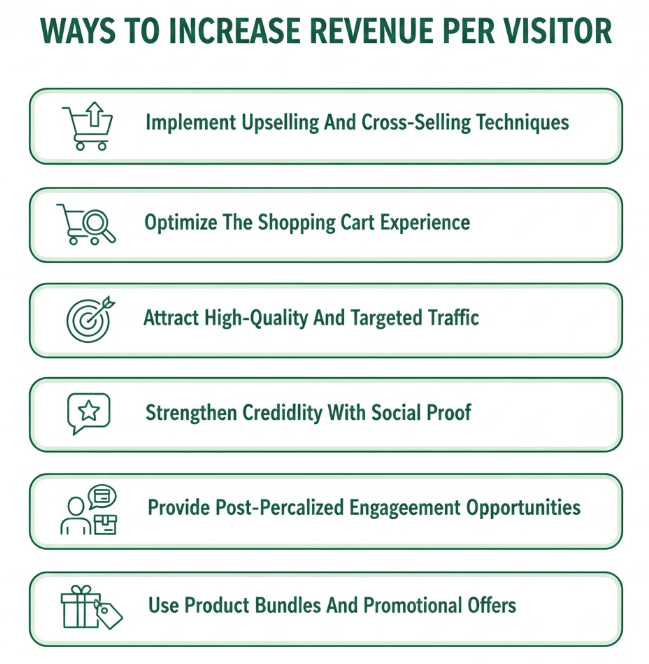
Increasing your revenue per visitor is about maximizing the value of every visitor to your site. This can be achieved by either encouraging more visitors to make a purchase (improving conversion rate) or persuading those who do buy to spend more (increasing average order value). The most effective strategies often do both. Let’s explore some of the most proven strategies.
Upselling and cross-selling are two of the most direct and effective strategies for increasing your average order value and, consequently, your revenue per visitor. Upselling encourages customers to purchase a more expensive, premium version of a product, while cross-selling suggests related or complementary items.
These techniques work because they tap into a customer's existing purchase intent. When a shopper has already decided to buy from your e-commerce store, they are often receptive to suggestions that enhance their purchase. The key is to make these recommendations relevant and valuable, not pushy.
You can implement these techniques at various points in the customer journey:
By strategically implementing upselling and cross-selling, you can significantly increase each customer's spend, directly boosting your RPV.
A smooth, frictionless shopping cart and checkout process is critical to converting interested visitors into paying customers. High cart abandonment rates are a major drain on revenue per visitor, as they represent lost sales from shoppers who were just steps away from completing a purchase. Optimizing this final stage of the shopping experience can significantly increase your conversion rate.
The average cart abandonment rate across all industries is over 70%, indicating a significant opportunity to improve on most e-commerce sites. Small changes can make a big difference in reducing friction and encouraging customers to complete checkout.
Consider implementing these optimizations:
By creating a seamless checkout, you reduce cart abandonment and ensure that more visitors who add items to their cart finalize their purchase, directly improving your RPV.
The quality of your website traffic is a fundamental driver of your revenue per visitor. Attracting targeted traffic—visitors who are genuinely interested in your products and have the intent to buy is far more valuable than simply increasing your overall visitor count. These high-quality visitors are more likely to convert and spend more, leading to a higher RPV.
Your visitor acquisition efforts should be laser-focused on reaching your ideal customer profile. This requires a deep understanding of your audience and the channels they use. An ecommerce business that invests in attracting the right people will see a much better return on its marketing spend.
To attract more high-quality and targeted traffic, you should:
By focusing on attracting visitors already primed to buy, you'll naturally see an increase in your conversion rate and AOV, which will drive up your online sales and revenue per visitor.
In an increasingly crowded online marketplace, trust is a valuable currency. Social proof is the idea that people conform to others' actions, assuming those actions reflect the correct behavior. For e-commerce brands, it's a powerful tool for building credibility and influencing purchasing decisions.
When potential customers see that others have purchased and enjoyed your products, it reduces their hesitation and gives them the confidence to buy. Statistics show that the vast majority of consumers trust online reviews as much as personal recommendations. Integrating social proof throughout your online store can have an immediate impact on your conversion rate and RPV.
Here are some effective ways to leverage social proof:
By using social proof to build trust, you make it easier for visitors to make a purchase decision, helping convert more browsers into buyers and boosting your revenue per visitor.
In the modern era of e-commerce, customers expect a personalized shopping experience. Generic, one-size-fits-all approaches no longer cut it. Providing personalized product recommendations is a highly effective way to increase engagement, improve the customer experience, and increase revenue per visitor.
Personalization works by showing customers products that are relevant to their unique tastes and browsing history. This not only helps them discover items they might love but also makes them feel understood by your brand. A well-executed personalization strategy can significantly increase both your conversion rate and average order value.
To implement this on your e-commerce store, consider the following:
By delivering a tailored shopping experience through personalization, you can create a more engaging journey that encourages more purchases and increases the value of every visitor.
Also Read: Want Creative Gift With Purchase Ideas for Customers?
Creating attractive product bundles and using strategic promotional offers are excellent ways to increase your average order value (AOV) and boost your revenue per visitor. Product bundling involves grouping several related items and selling them as a single unit, often at a slight discount compared to buying each item individually.
This strategy appeals to customers seeking value and convenience. For an ecommerce business, it's a great way to increase the perceived value of an offer, move more inventory, and introduce customers to products they might not have discovered otherwise. The key is to create bundles that make sense and offer a clear benefit to the shopper.
Here are a couple of product bundling ideas:
By leveraging product bundling and smart promotional offers, you can effectively encourage customers to spend more per transaction, directly increasing your AOV and RPV.
Also Read: How Lifetime Technologies went from a Single Additive to System Kits.
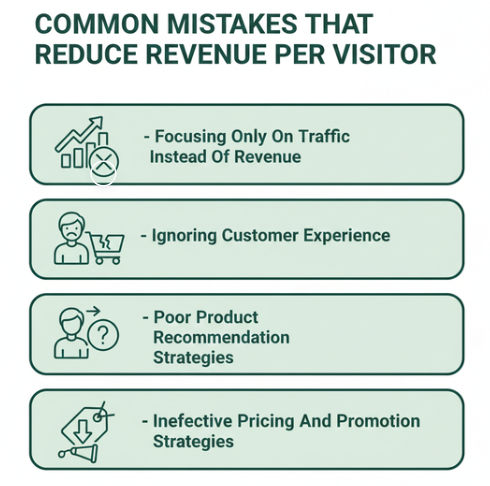
While many e-commerce businesses focus on strategies to increase revenue per visitor, it's just as important to be aware of the common mistakes that can actively reduce it. These pitfalls can undermine your best efforts, leading to high bounce rates, increased cart abandonment, and ultimately, a lower RPV. Let's examine some of these common mistakes.
One of the most common e-commerce mistakes is a hyper-focus on driving traffic above all else. While traffic is necessary, it's a vanity metric if it doesn't translate into revenue. Chasing high traffic numbers without considering the quality of those visitors can lead to a low revenue per visitor and a poor return on your marketing investment.
This tunnel vision creates significant blind spots. You might celebrate a surge in website visitors from a viral social media post, but if those visitors have no purchase intent, they won't contribute to your bottom line. It's not about how many people visit your site; it's about how many of the right people visit.
To avoid this mistake, you must shift your perspective from traffic to revenue.
By focusing on revenue-driven outcomes, you ensure that your marketing efforts are aligned with real business growth, not just inflated traffic reports.
Neglecting the customer experience is a surefire way to damage your revenue per visitor. In today's competitive market, a poor user experience is unforgivable. A confusing website design, slow loading times, or a complicated checkout process will frustrate visitors and send them straight to your competitors.
These issues directly contribute to high cart abandonment rates and low conversion rates, which are the primary components of RPV. Every point of friction in the customer journey is a potential lost sale. If visitors can't easily find what they're looking for or struggle to complete a purchase, your RPV will inevitably suffer.
An ineffective product recommendation strategy can do more harm than good, actively reducing your revenue per visitor. When recommendations are irrelevant or poorly timed, they can feel spammy and distract the customer, potentially leading them away from their original purchase intent. This can lower your conversion rate and damage the user experience.
Many e-commerce sites make the mistake of using generic, one-size-fits-all recommendation widgets that don't account for individual user behavior. Showing a visitor products they have no interest in is a wasted opportunity to increase their order value or guide them to a product they might love.
To avoid this pitfall, your product recommendation strategy must be intelligent and personalized.
A thoughtful recommendation strategy can significantly lift your RPV by effectively cross-selling and upselling, but a poor one will only create noise and drive customers away.
Your pricing and promotional strategies have a direct and powerful influence on your revenue per visitor. A common mistake is to implement these strategies without carefully considering their impact on customer behavior and overall profitability. For example, relying too heavily on deep discounts can attract price-sensitive shoppers who make small purchases and are unlikely to become loyal customers.
While a sale might temporarily boost your online sales volume, it can simultaneously lower your average order value and devalue your brand in the long run. This can lead to a lower RPV over time, as you train your customers to wait for discounts. An ecommerce business must find a balance between offering attractive deals and maintaining healthy profit margins.
Also Read: How Metalbird drove consistent growth across 8 stores.
One of the most powerful and direct ways to increase your revenue per visitor is by raising your average order value, and product bundling is a proven strategy to achieve this. With Kefi's Product Bundle Builder, you can empower your e-commerce store to create compelling product bundles that encourage customers to spend more per transaction. Our tool makes it easy to group related products, offer them as a convenient package, and present them as an irresistible deal.
By using Kefi to implement a product bundling strategy, you can create various types of promotional offers, from "buy more, save more" deals to curated "starter kits." These bundles not only increase the perceived value for the customer but also simplify their shopping experience. As customers add these higher-value bundles to their carts, your average order value will rise, which, in turn, will have a direct, positive impact on your overall revenue per visitor, helping you maximize the profitability of every visitor to your site.
Book a Demo to see how Kefi Product Bundle Builder works.
Understanding and optimizing Revenue Per Visitor (RPV) is crucial for the sustained growth of your e-commerce business. By evaluating store performance and connecting marketing efforts to revenue outcomes, you can make informed decisions that enhance customer experience and improve financial results. As you implement strategies such as upselling, improving website design, and using personalized recommendations, remember to avoid common pitfalls that can hinder revenue potential. Embracing these practices will not only boost RPV but also foster customer loyalty. For deeper insights and personalized strategies, don't hesitate to get a free consultation with our experts to elevate your e-commerce performance today.
RPV, or revenue per visitor, measures how much revenue each website visitor generates on average. It helps businesses evaluate how effectively their traffic converts into sales and provides insight into overall ecommerce performance.
RPV in ecommerce shows how well a store monetizes its website traffic. By analyzing this metric, merchants can understand whether their marketing efforts, product offerings, and user experience are effectively generating revenue.
Revenue per visitor connects website traffic directly to revenue outcomes. It helps businesses determine whether the visitors they attract through advertising, SEO, or social media campaigns are contributing meaningful revenue.
Average revenue per visitor focuses on the revenue generated from every website visitor, not just those who make a purchase. This makes it a valuable metric for evaluating both conversion performance and traffic quality.
Revenue per visitor helps businesses understand the financial value of their website traffic. By monitoring this metric, ecommerce stores can identify opportunities to improve conversion rates, increase order value, and optimize marketing strategies.
Merchants track RPV ecommerce metrics by dividing total revenue by the number of website visitors over a specific period. Ecommerce analytics tools and Shopify apps like Kefi can also help increase RPV through bundle offers and promotional strategies.
Large ecommerce enterprises use RPV to evaluate marketing channels, customer segments, and campaign performance. This metric helps them allocate budgets more effectively and focus on strategies that generate the highest revenue per visitor.
RPV in retail helps both online and omnichannel businesses measure how effectively they convert shoppers into revenue. Retailers use this metric to evaluate traffic quality, pricing strategies, and customer engagement.
Businesses calculate RPV by dividing total revenue by the total number of visitors to their website during a specific time period. This simple formula helps measure how much value each visitor contributes to overall sales.
Businesses can increase revenue per visitor by improving conversion rates, offering product bundles, and encouraging larger purchases. Shopify merchants often use apps like Kefi to create bundle offers and promotions that help increase both average order value and RPV.
.svg)
