
In the competitive world of e-commerce, turning online shoppers into loyal customers is the ultimate goal. A well-executed discount strategy can be the key to unlocking significant growth, boosting sales, and improving your bottom line. Offering the right kind of value at the right time not only encourages immediate purchases but also enhances customer satisfaction. This guide explores the most effective bundle and discount strategies that successful e-commerce store owners use to drive revenue and build a thriving online business.
A bundle discount is a promotional strategy where you offer customers a special price for purchasing multiple items together. Instead of buying each product at its full price, shoppers save by opting for a grouped deal. This technique is a cornerstone for many businesses looking to boost online sales and increase the average order value (AOV). For example, a brand might offer a skincare set with a cleanser, toner, and moisturizer at a lower combined price than if each item were bought separately.
This approach not only provides tangible value to customers but also simplifies their journey. By presenting curated product bundles, you guide their purchase decisions and introduce them to complementary items they might not have considered. The result is a win-win: customers feel they've gotten a great deal, and your business benefits from a higher order value and potentially clears out slower-moving inventory. To execute bundle discounts effectively, tools like Kefi’s Product Bundle Builder make it easy to create customizable bundles, apply smart pricing rules, and track performance. With the right setup, you can turn simple product groupings into a powerful revenue growth strategy.
Bundle discounts are a remarkably versatile tool, effective across a wide range of platforms from large marketplaces to niche online stores. Their success isn't limited to a single industry; businesses use them to clear inventory, increase order values, and run compelling marketing campaigns. By implementing bundles on the right platform, you can tap into existing customer behaviors and deliver personalized deals.
Let's examine five platforms that have successfully integrated bundle discounts into their core strategy, demonstrating how this approach can be adapted to various business models. These examples offer valuable insights into creating effective product recommendations and promotions.

Source: Shopify
Shopify provides a flexible ecosystem for merchants to implement sophisticated bundle discounts. Store owners can use built-in features or, for more advanced capabilities, turn to third-party apps like Fast Bundle. This allows them to create a variety of offers, such as "Buy X, Get Y," mix-and-match bundles, and volume discounts, directly on their product pages.
The platform's user-friendly interface makes it simple to customize these deals, enhancing the user experience for site visitors. By strategically placing bundles, merchants can guide shoppers through the customer journey, encouraging larger purchases and improving the checkout process. These tools are highly recommended for e-commerce conversion rate optimization, as they simplify the creating offers.
Furthermore, integrating bundles increases average order value and encourages repeat business by offering excellent value. When combined with strong social proof, such as customer reviews, these discount strategies become even more powerful, building trust and motivating site visitors to convert.

Source: Amazon
Amazon masterfully uses bundle discounts with its "Frequently Bought Together" feature, one of the platform's most recognized promotional tools. This functionality prompts shoppers to add complementary items to their cart, simplifying their purchase decisions and increasing the overall order size. It acts as a powerful step in the conversion funnel, moving website visitors from browsing to buying.
This strategy is effective because it leverages data to suggest relevant products, creating a seamless shopping experience. For sellers, it's an excellent way to promote related items and boost sales without aggressive marketing. The suggestions appear organic and helpful, which builds on the trust signals Amazon has established with its massive user base.
Seeing that other customers frequently purchase items together, reinforced by product reviews, provides powerful social proof. This encourages shoppers to add more to their carts, confident that they are making a good choice. By integrating these bundles directly into the product page, Amazon effectively shortens the path to conversion.

Source: Staples
Staples, a leading office supply retailer, effectively uses a volume-based discount strategy to cater to both small businesses and large corporations. Their pricing structure is built around discount tiers that reward customers for placing larger orders on essential items like paper, ink cartridges, and pens. This encourages customers to stock up on supplies in a single purchase.
For example, a customer buying a single ream of paper might pay the full price. However, if they purchase a case of 10 reams, they receive a small discount per ream. This bulk pricing becomes even more attractive when they order 20 or more reams, resulting in a much larger per-unit discount.
This model incentivizes customers to consolidate their purchases and place larger orders to maximize their savings. By clearly defining these discount tiers, Staples makes it easy for customers to understand the value of buying in bulk, driving higher transaction values, and fostering loyalty.

Source: Etsy
On Etsy, a marketplace for handmade and vintage goods, sellers often use bundle discounts to attract buyers and sell more items. A common tactic isto offerg deals like "Buy 2, Get 1 Free" or a percentage discount on purchases of three or more items. This strategy helps shop owners move inventory while offering shoppers a better deal on curated collections.
To make these bundles effective, sellers must use high-quality product images and compelling product descriptions. Since buyers can't physically see the items, clear visuals and detailed text are crucial for communicating the value of the bundle. This is especially important for mobile users, who make up a significant portion of Etsy's traffic and need a clean, easy-to-navigate experience.
By creating attractive bundles, sellers can boost conversions and increase their average order value. The key is to make the offer clear and the products complementary. Simplifying the buying process, with minimal form fields at checkout, ensures that interested shoppers can easily take advantage of the deal, turning browsing into a sale.

Source: The Body Shop
The Body Shop, a well-known beauty and skincare brand, frequently employs "Buy 3, Get 2 Free" promotions. This type of bundle encourages customers to explore a wider range of products than they might have otherwise. It’s a powerful strategy for increasing the number of items per transaction and introducing shoppers to new favorites.
These promotions are heavily advertised both in-store and online through channels such as email marketing. Fast page speed and effective mobile optimization are critical for their e-commerce site, ensuring customers can quickly browse products and take advantage of offers without frustration. Slow site speed can lead to abandoned carts, undermining the campaign's success.
By combining compelling discounts with a seamless user experience, The Body Shop enhances customer loyalty and drives sales. Features like live chat can further support shoppers by answering product questions and helping them build their perfect bundle. This integrated approach demonstrates how bundling, supported by strong technical performance and marketing, can be highly effective.
Bundle discounts are highly effective because they tap into a core psychological driver: perceived value. When customers see an opportunity to get more for less, they feel they are making a smart purchasing decision. This sense of value encourages them to take the desired action, adding more items to their cart, which directly increases the average order value for your ecommerce store. It's a simple yet powerful way to guide them through the conversion funnel.
Furthermore, bundles improve the overall customer experience. Instead of having to search for complementary items, shoppers are presented with curated product recommendations that solve a complete problem or meet a specific need. For example, a "new parent" bundle with diapers, wipes, and baby lotion is more convenient than buying each item separately. This convenience not only increases sales but also helps move slow-moving inventory by pairing it with best-sellers, all while fostering customer loyalty through exclusive, value-packed deals.
Choosing the right type of bundle discount is crucial for meeting your business goals. Different bundle structures appeal to different customer motivations and can be used to strategically guide their purchase decisions. The goal is to create offers that not only seem valuable but also simplify the shopping experience.
From grouping related products to rewarding larger purchases, each bundle type serves a unique purpose. Understanding these options allows you to create targeted promotions that increase average order value and streamline the checkout flow. Here are some of the most effective types of bundle discounts to consider.
Product bundles involve grouping several related items together and selling them as a single unit. This is one of the most common and effective bundling strategies, as it simplifies the customer journey and provides clear value. A classic example is the "Buy X, Get Y" offer, which incentivizes shoppers to add more items to their cart to unlock a discount or free product.
This approach is excellent for introducing new customers to a wider range of your products and can lead to a higher conversion rate. By pairing a popular item with a lesser-known one, you can increase the visibility of your entire catalog.
Key examples of product bundles include:
Price-based bundles reward customers for reaching a specific spending threshold. This strategy is designed to increase the total value of the shopping cart by giving shoppers a clear goal to aim for. For instance, offering "$10 off a purchase of $50 or more" motivates customers to add extra items they might otherwise have been hesitant to buy.
This type of bundle is effective because it gives customers a sense of control over their savings. The pricing is transparent, and the reward is tangible. To ensure success, the checkout process must be seamless, with multiple payment methods available, including credit cards and digital wallets, and fast page load times to prevent cart abandonment.
Examples of price-based bundles include:
Category bundles encourage shoppers to explore products within a specific collection or group. This strategy is perfect for cross-selling and introducing customers to the breadth of your offerings in a particular area. For example, a promotion like "Buy any 3 skincare items, get a free face mask" prompts shoppers to browse the entire skincare line.
This approach works especially well for industries with distinct product categories, such as fashion, beauty, or home goods. The key is to make the offer easy to understand and redeem, creating a positive shopping experience. For this to be effective, your website must perform well on mobile devices and have a fast site speed to allow for effortless browsing between products.
Common category bundle examples are:
Also Read: What are the Various Types of Bundles You Can Create?
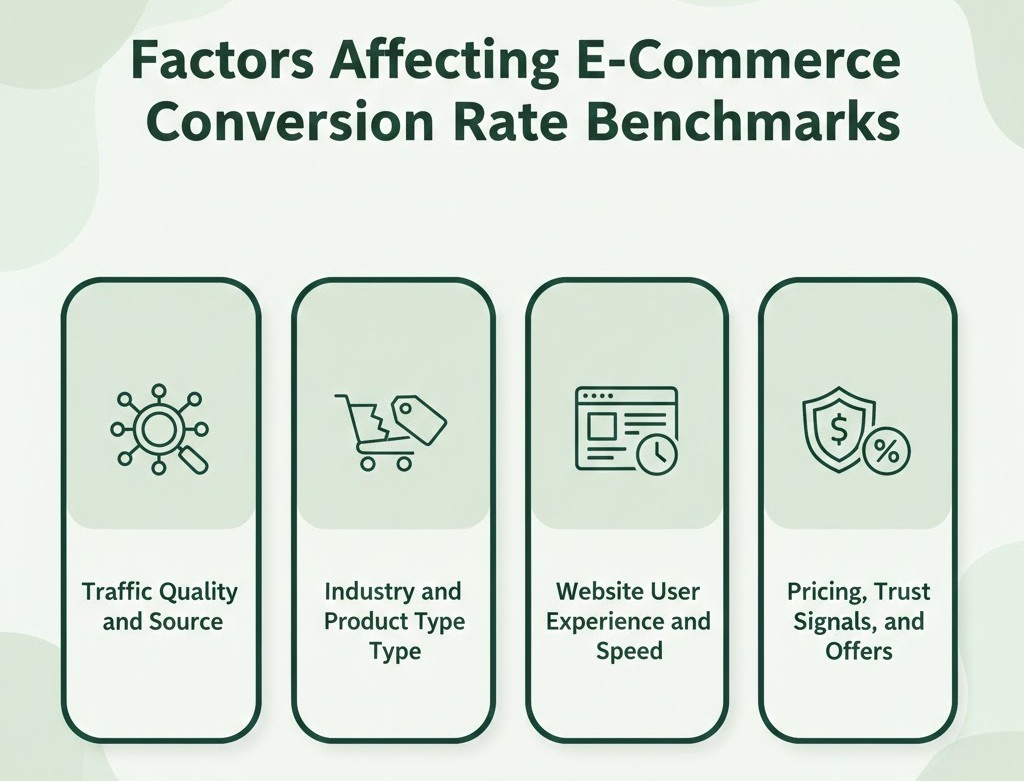
Understanding what influences your conversion rate is the first step toward improving it. An e-commerce website's performance is not determined by a single factor but by a combination of elements that shape the user's journey. Effective conversion rate optimization strategies require a deep dive into these variables. Several key factors can significantly impact your benchmarks, from the quality of your traffic to the speed of your site. Let's explore these critical elements.
The quality of your site visitors directly impacts your conversion rate. Not all traffic is created equal. Visitors who arrive via a referral link from a trusted source are more likely to convert than those who click a generic display ad. The source of your traffic determines the intent of the number of visitors.
Your marketing campaigns play a crucial role in attracting the right audience. A well-targeted campaign that speaks to a specific need or interest will attract high-quality leads who are already partway through the conversion funnel. In contrast, broad campaigns may increase the number of visitors but result in a lower conversion rate because the audience is less qualified.
Therefore, it's essential to analyze which channels organic search, social media, email, or referrals—are driving the most valuable traffic. Focusing your efforts on these high-performing sources will naturally improve your conversion rate, as you'll attract site visitors more inclined to make a purchase.
Conversion rates naturally vary significantly across different e-commerce industries and product types. For example, an e-commerce site selling low-cost, everyday items like pet supplies or craft materials will typically see higher conversion rates. The purchase decision is simple, and the financial commitment is small, leading to more impulse buys.
In contrast, industries selling high-ticket items like furniture, electronics, or luxury goods often have lower conversion rates. The user behavior in these sectors involves a much longer consideration period, extensive research, and comparison shopping. Customers are less likely to make an immediate purchase, which naturally lowers the transaction-to-session ratio.
Because of these differences, conversion rate optimization strategies must be tailored to the specific industry. A fashion retailer might focus on visual product recommendations and social proof, while a B2B software company would prioritize detailed case studies and trust signals. Understanding your industry's benchmark is crucial for setting realistic goals and measuring the success of your online sales efforts.
A seamless user experience (UX) is non-negotiable for a high-converting e-commerce site. If your website is slow, confusing to navigate, or not optimized for mobile devices, you will lose customers. Site speed, in particular, has a direct correlation with conversion rates; studies show that even a one-second delay in page load time can significantly increase bounce rates.
Mobile optimization is equally critical, as a majority of online traffic now comes from smartphones. A clunky mobile experience, a complicated shopping cart, or a convoluted checkout flow will lead to frustration and abandonment. Every element of your site should be designed to make the path to purchase as smooth as possible.
Investing in UX and performance is one of the highest-ROI activities for any online store. A faster, more intuitive website builds trust and keeps shoppers engaged, directly leading to more completed purchases.
Your pricing strategy and the trust you build with customers are fundamental to converting visitors into buyers. While competitive pricing is important, shoppers are often influenced more by perceived value and trustworthiness than by the lowest price alone. Clear, upfront pricing without hidden fees at checkout is essential.
Trust signals are visual cues that reassure customers that it is safe to buy from you. These include security badges, clear return policies, customer reviews, and testimonials. Social proof, in the form of positive reviews, is particularly powerful, as shoppers trust their peers' experiences more than brand messaging.
Offers like discounts and free shipping can be the final nudge a customer needs to complete a purchase. Unexpected costs, especially for shipping, are a leading cause of cart abandonment.
Also Read: How Squaties Scaled Order Volume via Performance Bundling.
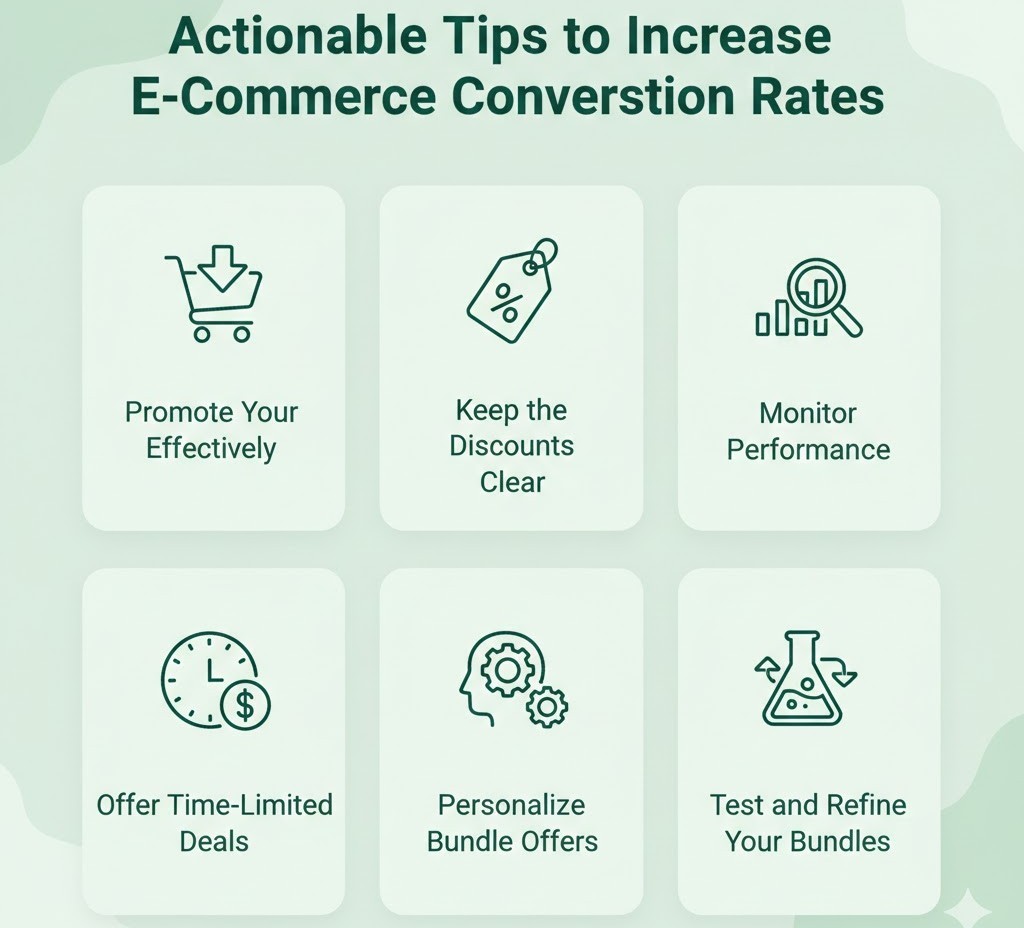
Now that you understand the factors influencing conversions, it's time to put your knowledge into practice. Effective conversion optimization is an ongoing process of testing, learning, and refining. By implementing proven best practices, you can systematically reduce cart abandonment and turn more visitors into customers.
The following tips provide a roadmap for improving your site's performance. From promoting your offers effectively to leveraging A/B testing for data-driven decisions, these strategies will help you create a higher-converting online store.
Creating great product bundles is only half the battle; you need to make sure your customers know about them. Effective promotion is key to driving interest and sales. Use all available channels to highlight your bundle deals and create excitement around your offers.
Start by featuring your bundles prominently on your homepage with eye-catching banners. Use your social media platforms to share engaging visuals of the bundled products and explain the value of the deal. Email marketing is another powerful tool for reaching your existing customer base with targeted campaigns about bundles they might be interested in.
To maximize visibility and drive action, consider these tactics:
Clarity is crucial when it comes to discounts. If shoppers are confused about how an offer works or what they need to do to get it, they are likely to abandon the purchase. Vague or complicated promotions create friction in the conversion funnel and can erode trust. Your offers should be simple, direct, and easy to understand at a glance.
Clearly state the discount details next to the relevant product images. For example, instead of a generic "Save on Bundles," use specific language like "Buy 2, Get 1 Free" or "Save 20% When You Buy This Set." This transparency helps shoppers quickly assess the value and take the desired action without hesitation.
To ensure your discounts are as clear as possible:
Also Read: How to Master Bundle Pricing Strategy for Business Success?
To know if your bundle strategies are working, you must track their performance. Continuous monitoring allows you to understand what resonates with your customers and what doesn't, enabling you to make data-driven decisions for future conversion optimization efforts. Without data, you are simply guessing.
Use tools like Google Analytics to track key metrics, including conversion rate, average order value, and revenue generated from your bundles. Pay close attention to which bundles are performing best and try to identify patterns. Are product bundles more popular than category bundles? Do certain discount levels drive more sales?
For more granular insights, conduct A/B tests to compare different bundle configurations, pricing, or promotional messaging. Run these tests long enough to achieve statistical significance, which will give you confidence that the results are reliable. This iterative process of testing and analyzing is the foundation of a successful CRO program.
Also Read: How The Chosen Cultivated a Community through Curated Merchandise Kits.
Creating a sense of urgency is a powerful psychological tactic to encourage immediate purchases. Time-limited deals, or flash sales, motivate shoppers to act quickly for fear of missing out on a great offer. This is an effective way to drive a surge in sales for your online store and clear out seasonal inventory.
Promote your limited-time offers across all your marketing campaigns, including email, social media, and on-site banners. Use countdown timers on your product and checkout pages to visually reinforce the urgency. This simple addition can significantly increase conversion rates by pushing hesitant buyers to make a decision.
To implement this strategy effectively:
Personalization can dramatically improve the effectiveness of your bundle offers. By using customer data to tailor your deals, you create a more relevant and engaging customer experience. Generic offers can work, but personalized recommendations show customers that you understand their needs and preferences.
Analyze user behavior, such as past purchases and browsing history, to suggest bundles that are likely to appeal to them. For example, if a customer frequently buys a specific type of product, you can offer them a bundle that includes that item along with complementary products they haven't tried yet. This is a great way to upsell existing customers and introduce new customers to more of your catalog.
Here are two ways to personalize your bundles:
The key to long-term success with product bundles is continuous testing and refinement. What works today may not work tomorrow, and there is always room for improvement. A structured approach to conversion optimization, centered on A/B testing, will help you discover what truly resonates with your audience.
Experiment with different aspects of your bundles. Test various product combinations to see which pairings are most popular. Play with different discount percentages and pricing structures to find the sweet spot between customer value and your profit margins. Even small changes to how a bundle is presented can significantly impact its performance.
Consider these A/B testing ideas:
Also Read: How Puur Scaled Average Order Value via Intelligent Accessory Pairing.

While bundling can be a powerful sales driver, it's not without its risks. When poorly executed, these strategies can backfire, leading to margin erosion, customer confusion, and even lower conversion rates. It’s important to approach bundling with a clear strategy to avoid these common pitfalls.
Understanding the potential mistakes will help you design more effective and profitable campaigns for your e-commerce site. From over-discounting to failing to track performance, awareness of these errors is the first step toward avoiding them.
One of the most significant risks of any discount strategy is margin erosion. If you offer discounts too frequently or make them too steep, you can train your customers to wait for a sale, devaluing your products in the long run. This can severely eat into your profit margins and is a common mistake in conversion optimization.
A sustainable bundling strategy requires careful consideration of your pricing and costs. Before launching any offer, calculate the potential impact on your margins to ensure it remains profitable. The goal is to increase overall revenue and order value, not just to move units at any cost.
To avoid devaluing your brand and eroding margins:
Creating product bundles that don't make sense to the customer is a surefire way to fail. If the items in a bundle don't have a logical connection, shoppers won't see the value, and the offer will fall flat. A poorly matched bundle can confuse the customer journey and disrupt the conversion funnel rather than streamline it.
The best bundles consist of products that are naturally used together or that complement each other. Think about the customer's needs and how you can provide a complete solution. For example, bundling a laptop with a printer is logical; bundling a laptop with a pair of socks is not.
To create compelling bundles:
Launching a bundle and then forgetting about it is a missed opportunity for conversion optimization. Without monitoring performance, you have no way of knowing if your strategy is successful, which bundles are resonating with site visitors, and where there is room for improvement. Data is your most valuable asset in refining your approach.
Regularly use tools like Google Analytics to track how your bundles are performing. Look at metrics like sales volume, average order value, and profit margins for each bundle. This data will provide clear insights into what is working and what isn't, allowing you to make informed decisions.
If a bundle is underperforming, don't be afraid to change it or discontinue it. You can run A/B tests to try different product combinations or discount levels to see if you can improve its performance. The key is to adopt a mindset of continuous improvement, driven by data rather than assumptions.
One of the biggest mistakes brands make is creating bundles that are too complex to understand. If customers need to read lengthy instructions to figure out how the offer works, they are more likely to abandon the purchase. Confusing tiered discounts, unclear pricing, or too many customization steps can create friction in the buying process.
Bundling should simplify the decision, not complicate it. The goal is to make it easier and faster for customers to say yes. A clean presentation with clear savings and straightforward messaging will always outperform a complicated setup.
To avoid overcomplication:
Also Read: How SportsStop Dominated the Diamond and Field with High-Velocity Bundling.
Implementing these diverse and powerful discount strategies can seem complex, but with the right tool, it becomes seamless. The Kefi Product Bundle Builder is designed to help you execute effective conversion optimization tactics effortlessly. Our platform empowers you to create all the bundle types discussed, from product and category bundles to price-based incentives, without requiring any technical expertise. This allows you to focus on strategy while we handle the implementation.
By using Kefi, you can easily design and launch customized bundles that increase your average order value (AOV) and guide customer purchase decisions. Our intuitive interface lets you test different offers, personalize recommendations, and monitor performance to maximize your results. Ultimately, Kefi helps you build a more profitable business by enhancing the customer experience and increasing customer lifetime value, making it one of the most effective strategies for e-commerce conversion rate optimization.
Book a Demo to see how Kefi Product Bundle Builder works.
Leveraging bundle discounts can significantly enhance your sales strategy and elevate your conversion rates. By understanding the diverse types of bundles and applying actionable tips effectively, you can create enticing offers that resonate with your customers. It's crucial to monitor performance, personalize your strategies, and avoid common pitfalls that could undermine your efforts. Staying informed on industry benchmarks and continuously refining your approach will set you apart in a competitive market. With the right tools and insights, you can transform your bundling strategies into a powerful driver of growth for your business. If you're ready to elevate your sales game, reach out for personalized guidance and start implementing these strategies today!
Key KPIs include conversion rate, average order value (AOV), cart abandonment rate, and profit margin per sale. Also, monitor the number of visitors interacting with your offers. Tracking these metrics will help you measure the real impact of your conversion optimization efforts and refine your strategies.
Measure your baseline conversion rate using Google Analytics before making changes. Then, run A/B tests to compare the original version against your new one. If the new version shows a statistically significant increase in visitors taking the desired action, your CRO efforts are successful.
To boost conversions, use high-quality images, offer personalized product recommendations, and simplify your checkout flow. Ensure fast site speed, especially on mobile. Display trust signals like customer reviews and security badges prominently. Finally, create urgency with time-limited offers to encourage immediate purchases.
The top bundles and discount strategies to boost sales include volume discounts, frequently bought together offers, tiered pricing, and limited-time bundle deals. These tactics encourage higher cart value and faster purchase decisions. Using a solution like Kefi Product Bundle Builder makes it easy to create high-converting bundles and automate discount rules for maximum impact.
E-commerce conversion rate optimization is the process of improving your store to convert more visitors into buyers. It focuses on testing pages, checkout flow, and offers to increase revenue without increasing traffic.
To learn how to increase the conversion rate of e-commerce, improve site speed, simplify checkout, and add trust signals. Strategic bundling with tools like Kefi Product Bundle Builder can also drive higher purchase intent.
Factors affecting e-commerce conversion rate benchmarks include traffic source, device type, pricing, and website usability. Trust signals and checkout experience also significantly impact performance.
.svg)
