

In a competitive market, generic loyalty programs are no longer enough to capture and retain customer attention. A one-size-fits-all approach fails to recognize the unique values and behaviors of different customers. Loyalty segmentation is the key to unlocking a more personalized and effective strategy. By analyzing your customer data and grouping your audience into meaningful segments, you can tailor the customer experience, enhance customer retention, and build lasting relationships that drive sustainable growth for your brand.
Loyalty segmentation is the process of dividing your customer base into distinct groups or customer segments based on their loyalty behaviors and engagement with your brand. Instead of treating all customers the same, this method allows you to identify specific groups, from first-time buyers to your most dedicated advocates. It moves beyond simple demographics to analyze purchase patterns, interaction frequency, and overall spending habits. This strategy helps you understand the nuances of your customer journey.
By creating these specific groups, you can personalize your loyalty program and marketing efforts. For example, a new customer may need an incentive to make a second purchase, while a VIP customer might appreciate exclusive offers or early access to products. This targeted approach ensures that your communications and rewards are relevant and valuable to each customer, making them feel seen and appreciated by your brand.
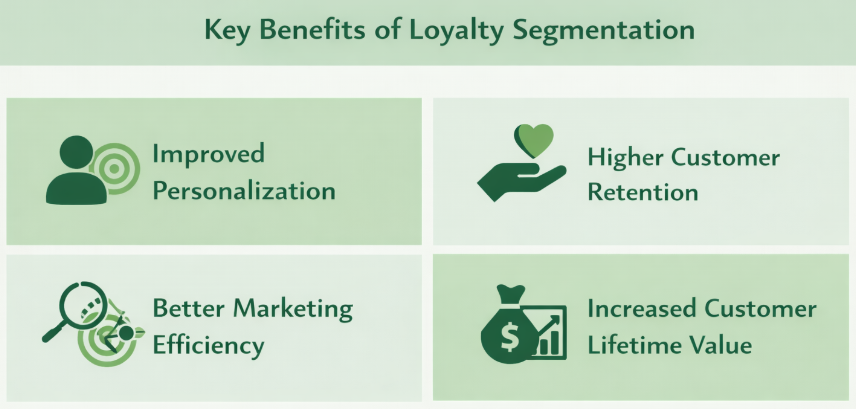
Implementing a robust segmentation strategy offers numerous advantages that directly impact your bottom line. By understanding the distinct needs of your loyal customers, you can tailor your marketing efforts to be more effective and efficient. This leads to stronger relationships and a better return on your investment.
The following sections will explore these benefits in greater detail.
Personalization has become an expectation, and loyalty segmentation helps brands deliver it effectively. By grouping customers based on behaviors and preferences, businesses can move beyond generic messaging and create relevant experiences such as targeted product recommendations, customized discounts, and tailored communication. When customers receive offers aligned with their interests, they feel valued and understood. This strengthens their connection with the brand, boosts engagement and conversions, and ultimately drives repeat purchases and long-term loyalty.
Loyalty segmentation plays a key role in improving customer retention by enabling more relevant and meaningful engagement. When customers feel recognized through personalized interactions, they are more likely to stay loyal. It also helps identify at-risk customers and re-engage them with targeted campaigns or special offers. By nurturing relationships across all segments, brands create consistent positive experiences that reduce churn, encourage repeat purchases, and turn occasional buyers into loyal advocates.
Loyalty segmentation improves marketing efficiency by helping businesses focus on the most relevant customer groups. Instead of broad campaigns, brands can create targeted strategies that resonate with specific segments, reducing wasted spend and increasing engagement. For example, high-spending but infrequent customers can receive tailored offers instead of generic discounts. This leads to better conversion rates, improved ROI, and more effective use of marketing resources.
Loyalty segmentation helps increase customer lifetime value by identifying and nurturing both high-value customers and growth opportunities in other segments. High-value customers can be retained with exclusive rewards, while others can be encouraged to spend more with targeted incentives such as bundles or thresholds. By moving customers into higher-value segments, businesses can maximize revenue and build stronger, long-term relationships that support sustainable growth.
Also Read: How to Master Customer Revenue Optimization Strategies?
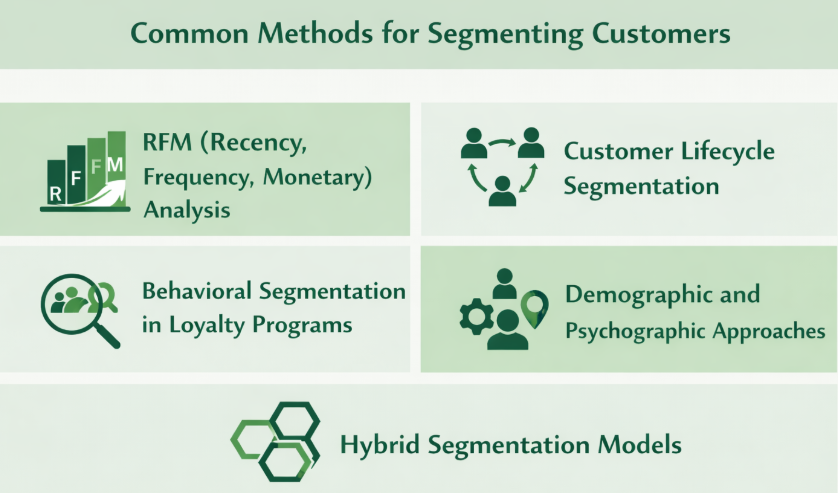
To effectively group customers, you need a clear segmentation strategy grounded in data analytics. There are several proven methods for dividing your customer base into distinct groups, each offering unique insights. These approaches use everything from purchase history and behavioral data to demographics to create meaningful segments.
Let's explore some of the most common methods.
RFM analysis segments customers based on how recently they purchased, how often they buy, and how much they spend. This method provides a clear view of customer value, helping to identify key groups such as loyal customers, high-value buyers, and those at risk of churn. By using these insights, businesses can tailor campaigns more precisely and deliver relevant offers that match each segment’s behavior and purchasing patterns. It also helps prioritize high-impact segments so that marketing efforts are focused on the segments that drive the most revenue. As a result, brands can make smarter, data-backed decisions that improve both engagement and profitability.
Customer lifecycle segmentation groups customers by their stage in the brand journey, ranging from new to loyal or inactive. Each stage requires a different engagement strategy, such as onboarding for new users or win-back campaigns for lapsed ones. By aligning communication with these stages, businesses can deliver more relevant experiences, guide customers toward deeper loyalty, and reduce the chances of churn. This approach ensures that no customer segment is overlooked at any stage of the journey. It also helps create a consistent and seamless experience that strengthens long-term relationships with the brand.
Behavioral segmentation focuses on customer actions, such as browsing, purchasing, and engagement, across channels. This approach helps businesses understand what drives customer behavior and tailor rewards accordingly. For example, customers can be rewarded for reviews, referrals, or social activity. By aligning loyalty programs with actual behavior, brands can create more engaging and relevant experiences that strengthen customer relationships. It also allows businesses to adapt quickly to changing customer habits and preferences over time. This makes loyalty programs more dynamic, effective, and aligned with real customer intent.
Demographic and psychographic segmentation combines customer attributes with their motivations and preferences. While demographics provide basic insights such as age and location, psychographics reveal values, interests, and lifestyles. Together, they help businesses create more targeted and relatable marketing strategies that connect with customers on both practical and emotional levels. This deeper understanding allows brands to craft messaging that resonates more strongly with different audience groups. As a result, campaigns feel more relevant, leading to higher engagement and stronger brand affinity.
Hybrid segmentation combines multiple methods, such as RFM, behavioral, and demographic data, to create a more complete view of customers. This approach uncovers deeper insights and allows for highly targeted campaigns. By addressing multiple aspects of customer behavior and preferences, businesses can deliver more personalized experiences, improve engagement, and build stronger loyalty strategies. It also enables brands to identify niche segments that may otherwise go unnoticed with a single method. This comprehensive approach leads to smarter decision-making and more effective long-term customer engagement.
Also Read: How a Premier Portuguese Winery Cultivated a +16.80% AOV Lift.
Successfully implementing loyalty segmentation requires a clear, step-by-step plan. It begins with defining what you want to achieve and ends with continuous optimization. A strategic approach ensures that your segmentation efforts are not just an academic exercise but a practical tool that drives business results. By following a structured process, you can turn raw customer data into actionable insights.
Before you begin analyzing data, you must first establish clear objectives for your segmentation strategy. What do you hope to accomplish? Your goals will guide every subsequent step of the process, from the data you collect to the segments you create. Without clear goals, your efforts may lack direction and fail to produce meaningful results. Your objectives should align with broader business goals, such as increasing revenue or improving customer satisfaction.
Are you trying to increase customer retention, boost average order value, or re-engage dormant customers? Each of these goals requires a different approach. For example, if your primary goal is to retain high-value customers, you might use RFM analysis to identify your top spenders and create a VIP program for them. If your goal is to increase purchase frequency, you might focus on lifecycle segmentation to nurture new customers.
Defining your objectives helps you focus your efforts and provides a benchmark for measuring success. A clear value proposition for each segment will emerge once you know what you are aiming for. This initial step ensures your segmentation strategy is purposeful and tied to tangible business outcomes.
Once your objectives are defined, the next step is to collect and analyze the necessary customer data. Effective segmentation relies on comprehensive and accurate information. You need to pull data from various sources to build a complete picture of your customers. This includes transactional data, engagement metrics, and demographic information. The richer your data, the more insightful your segments will be.
Key data sources to consider include your e-commerce platform, CRM system, email marketing tool, and loyalty program software. The most important data points for loyalty segmentation are purchase history (recency, Frequency, monetary value), behavioral data (website visits, email opens, product views), and any zero-party data customers have shared, such as preferences or survey responses.
After gathering the data, you need to analyze it to identify patterns and trends. This analysis will reveal how different customer groups behave and interact with your brand. These valuable insights will form the foundation for creating your customer segments in the next step.
With your data gathered and analyzed, it's time to choose the variables you will use to group your customers and create meaningful segment profiles. The variables you select should directly relate to the objectives you defined in Step 1. Common variables include purchase frequency, average order value, product categories purchased, and engagement level with your loyalty program.
Using these variables, you can start grouping customers into distinct, meaningful groups. For example, you might create segments such as "VIPs," "Recent First-Time Buyers," "Discount Seekers," or "At-Risk Customers." The goal is to create specific segments that are large enough to be meaningful but distinct enough to warrant a tailored marketing approach. Avoid creating too many segments, as this can become difficult to manage.
For each segment, develop a detailed profile or persona. This should include:
These profiles will help your team visualize and understand each customer group, making it easier to tailor strategies for them.
Also Read: What are the Best Loyalty Apps for Shopify Growth?
Not all customer segments are created equal. Once you have defined your distinct groups, the next step is to evaluate and prioritize them based on their value to your business. This will help you allocate your resources effectively, focusing your efforts on the segments that offer the highest potential return. A common way to prioritize is by assessing each segment's size, profitability, and growth potential.
Identify your most valuable customers first. These are often your loyal, high-spending segments with high retention rates. They are the bedrock of your business and deserve special attention. You should also look for segments that have high growth potential, such as new customers who show signs of becoming loyal advocates. Prioritizing these groups can yield significant long-term benefits.
By evaluating each segment, you can gain actionable insights into where to focus your marketing budget and efforts. For example, you might decide to invest heavily in a VIP program for your top segment while using automated, low-cost campaigns to re-engage at-risk customers. This strategic prioritization ensures you are making the most of your resources.
After prioritizing your segments, the next step is to develop and implement tailored marketing strategies for each one. This is where your segmentation efforts translate into tangible results. A one-size-fits-all marketing approach will not resonate with the diverse needs of your different customer groups. Instead, you need to craft personalized messages, offers, and experiences for each specific customer segment.
For your VIP segment, you might create exclusive offers, grant early access to new products, or provide personalized gifts. For new customers, you could design a welcome email series that educates them about your brand and offers an incentive for their second purchase. At-risk customers might receive a "we miss you" campaign with a special discount to encourage them to return.
The key is to align your marketing strategies with the unique characteristics and motivations of each group. This includes:
This targeted approach will lead to higher engagement, stronger relationships, and better conversion rates.
Loyalty segmentation is not a one-time project; it is an ongoing process of refinement and optimization. Customer behaviors change, market conditions shift, and your business evolves. Therefore, it is crucial to continuously monitor your segments' performance and adjust your retention strategies accordingly. Regular data analytics and performance tracking are essential for long-term success.
Track key metrics for each segment, such as retention rates, customer lifetime value, and engagement levels. Are your marketing campaigns having the desired effect? Are customers moving between segments as you intended? Use these valuable insights to identify what's working and what isn't. Customer feedback, gathered through surveys and reviews, can also provide qualitative insights to complement your quantitative data.
Based on your findings, be prepared to refine your segments, adjust your marketing messages, or try new offers. You might find that a segment needs to be split into two or that two segments have become similar enough to be merged. This continuous loop of monitoring, analyzing, and optimizing ensures that your segmentation strategy remains relevant, effective, and aligned with your business goals.
Also Read: How The Chosen Cultivated a Community through Curated Merchandise Kits.
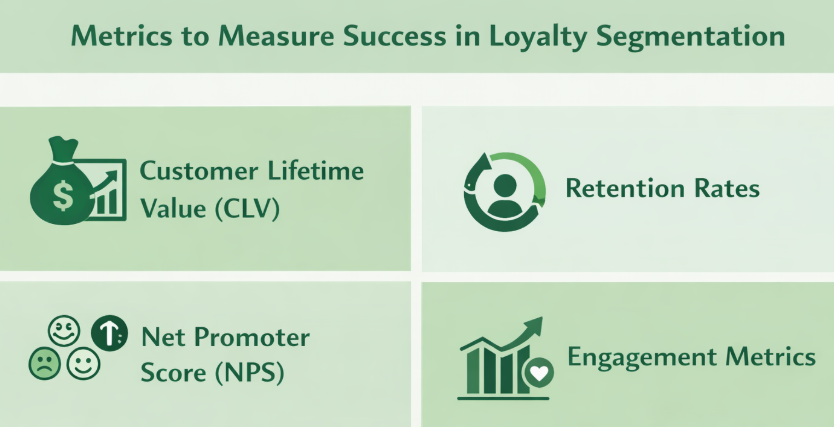
To understand the impact of your loyalty segmentation strategy, you need to track the right metrics. Measuring success goes beyond simply looking at overall revenue. You should focus on key performance indicators (KPIs) that reflect changes in customer behavior and loyalty within each segment. These metrics will provide actionable insights into the effectiveness of your tailored campaigns.
Customer Lifetime Value (CLV) is one of the most important metrics for measuring the success of your loyalty segmentation strategy, as it represents the total revenue a customer is expected to generate over the course of their relationship with your brand. A well-executed segmentation approach should lead to a noticeable increase in CLV, especially within high-value segments. By delivering personalized offers and experiences, businesses can encourage customers to spend more and purchase more frequently.
Tracking CLV across different segments helps identify which groups are becoming more profitable and which need further optimization. Monitoring key components such as average order value, purchase frequency, and customer lifespan provides a clear view of how segmentation efforts are driving long-term growth and profitability.
Retention rates are a direct indicator of customer loyalty and a crucial KPI for evaluating the effectiveness of loyalty segmentation. This metric measures the percentage of customers who continue to engage and make purchases over time, making it essential for understanding long-term relationships. By analyzing retention rates across different segments, businesses can assess whether personalized strategies are successfully keeping customers engaged.
For example, you can evaluate if VIP customers are staying longer or if re-engagement campaigns are reducing churn among at-risk groups. Higher retention rates typically reflect stronger customer satisfaction and more meaningful brand connections, ultimately leading to a more stable and profitable customer base.
Net Promoter Score (NPS) is a widely used metric for measuring customer satisfaction and loyalty by assessing how likely customers are to recommend your brand. It is based on a simple survey question and categorizes respondents into Promoters, Passives, and Detractors. Tracking NPS across different customer segments provides valuable insights into how each group perceives your brand and experiences.
A successful loyalty segmentation strategy should lead to higher NPS scores, particularly among your most valuable customers. Additionally, analyzing feedback from NPS responses helps identify the key drivers behind customer sentiment, allowing businesses to refine their strategies and improve overall customer experience.
Engagement metrics measure how actively customers interact with your brand and loyalty program, offering important insights beyond just purchase behavior. These metrics help evaluate how well your personalized campaigns are resonating with different customer segments. By tracking indicators such as email open rates, click-through rates, and loyalty program activity, businesses can understand what captures attention and drives interaction.
Monitoring engagement at the segment level allows you to identify gaps and optimize communication strategies accordingly. Consistently high engagement signals strong customer interest and connection, which often translates into increased loyalty and future purchases.
Also Read: How Lifetime Technologies went from a Single Additive to System Kits.
Many of the world's leading brands have mastered the art of loyalty segmentation to create exceptional customer experiences. By examining their use cases, you can gain inspiration for your own strategy. These companies use purchase history, behavioral data, and other insights to group their loyal customers and deliver highly personalized marketing campaigns.
Let's look at how some top brands are successfully implementing loyalty segmentation.

Source: Amazon Prime
Amazon is a master of loyalty segmentation, using its vast amount of customer data to create highly personalized shopping experiences. The company heavily relies on purchase history and browsing behavior to segment its customers. This allows Amazon to provide hyper-relevant product recommendations, which are a key driver of its sales and customer retention. When you visit the site, you are immediately shown products related to your past searches and purchases.
One of the most prominent examples of Amazon's segmentation is its Prime membership program. Prime members are one of its most valuable customer segments, characterized by high purchase frequency and loyalty. To cater to this group, Amazon offers a suite of exclusive benefits and perks that go far beyond shopping.
These benefits for Prime members include:
By creating this premium tier, Amazon successfully nurtures its most loyal customers, significantly increasing their lifetime value.

Source: Starbucks
Starbucks has built one of the most successful loyalty programs in the world, largely due to its sophisticated use of segmentation. The Starbucks Rewards program uses data on purchase frequency and spending habits to create a personalized customer experience. Members earn "Stars" for every purchase, which they can redeem for free drinks and food. This simple system encourages repeat visits and higher spending.
The program is tiered, which is a form of segmentation in itself. As customers earn more Stars, they unlock new levels with better benefits. This gamified approach motivates customers to increase their purchase frequency to reach the next tier. Starbucks also uses customer data to send personalized and exclusive rewards.
These personalized offers include:
By tailoring its rewards to individual habits, Starbucks keeps its loyal customers engaged and ensures they feel valued, which is key to its high retention rates.

Source: Sephora
Sephora's Beauty Insider program is a prime example of effective loyalty segmentation in the beauty industry. The program segments its vast customer base into tiers based on annual spending: Insider, VIB (Very Important Beauty Insider), and Rouge. Each tier offers progressively better rewards, which incentivize customers to spend more to climb the ladder. This tiered structure effectively caters to different levels of loyalty and spending.
Sephora uses purchase history to provide personalized product recommendations and offers. For example, if a customer frequently buys skincare products from a specific brand, Sephora can send them targeted promotions for new products from that same brand. This level of personalization makes customers feel understood and enhances their shopping experience.
The program also offers experiential rewards, especially for its top-tier Rouge members, such as early access to new products and exclusive events. By creating these specific customer segments and tailoring perks to their spending levels and purchase frequency, Sephora fosters a strong sense of community and exclusivity, which keeps its customers loyal.

Source: Nike
Nike uses loyalty segmentation to build a strong community around its brand and drive sales. The Nike Membership program is not just about discounts; it's about providing exclusive access and experiences to its most loyal customers. Nike segments its members based on their interests, purchase history, and engagement with the Nike app. This allows the brand to deliver highly personalized content and offers.
For example, a member who frequently buys running shoes will receive content about running, invitations to local running clubs, and early access to new running gear. This targeted approach makes members feel like they are part of an exclusive club that understands their passion. This sense of community is a powerful driver of loyalty and helps increase conversion rates.
Key benefits for Nike members include:
By segmenting its audience and providing value beyond transactions, Nike has cultivated a dedicated following of loyal customers.

Source: Marriott
In the hospitality industry, Marriott's Bonvoy loyalty program is a standout example of successful segmentation. The program has a tiered structure that segments its members based on the number of nights they stay each year. The tiers range from Silver Elite to Ambassador Elite, with each level offering increasingly valuable perks. This encourages travelers to consolidate their stays with Marriott to achieve a higher status.
Marriott uses customer preferences and past booking data to provide a personalized experience. For example, if a member frequently requests a room on a high floor or a specific type of pillow, Marriott's system can note these preferences and try to accommodate them on future stays. These valuable insights allow the brand to make each guest feel recognized and valued.
The exclusive perks for elite members include room upgrades, late checkout, and access to members-only lounges. By rewarding its most frequent and loyal guests, Marriott builds strong relationships and ensures they continue to choose Marriott for their travels, maximizing their lifetime value.
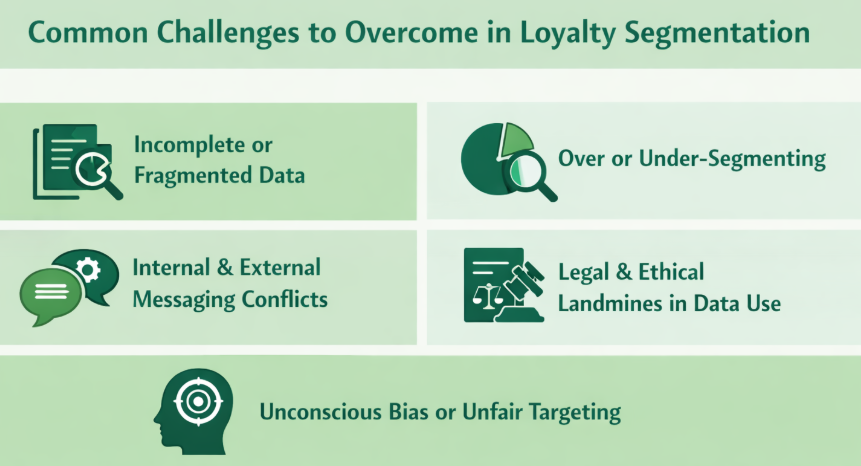
While loyalty segmentation offers significant benefits, it is not without its challenges. Implementing a successful segmentation strategy requires overcoming several common hurdles, from data issues to ethical considerations. Being aware of these potential pitfalls can help you navigate them more effectively. A proactive approach is needed to address challenges related to data quality, strategy, and execution.
Let's explore some of these common challenges and how to address them.
One of the biggest challenges in loyalty segmentation is dealing with incomplete or fragmented customer data spread across multiple systems, such as CRM platforms, e-commerce tools, and marketing software. These data silos prevent businesses from building a unified customer view, leading to inaccurate segments and weak insights. To overcome this, companies need to consolidate data using tools such as Customer Data Platforms (CDPs) or enhanced integrations. Regular data cleaning and validation are also essential to remove duplicates and errors. With a more unified and reliable dataset, businesses can create more accurate segments and drive better personalization and retention strategies.
Striking the right balance in segmentation is another common challenge, as both over-segmentation and under-segmentation can reduce effectiveness. Creating too few broad segments limits personalization, while too many niche segments can become difficult to manage and execute. The key is to build meaningful groups that are distinct yet large enough to target efficiently. Starting with a manageable number of segments and refining them over time based on performance is a practical approach. Regular analysis helps identify whether segments should be merged or split, ensuring the strategy remains both actionable and scalable.
Running multiple campaigns across different segments can lead to overlapping or conflicting messages, confusing customers, and diluting the brand experience. For instance, a loyal customer receiving both exclusive and generic offers may question the value of the loyalty program. Internally, a lack of coordination between teams can further amplify this issue. To avoid this, businesses should maintain a centralized campaign calendar and ensure clear communication across teams. Implementing strategies such as message frequency limits and campaign prioritization helps maintain consistency, ensuring customers receive relevant, cohesive communication across all touchpoints.
Handling customer data responsibly is critical, especially with increasing regulations and growing privacy concerns. Businesses must be transparent about what data they collect and how it is used, ensuring proper consent is obtained before personalization efforts begin. Providing customers with control over their data preferences builds trust and strengthens relationships. Beyond compliance, ethical considerations also play a key role—brands should avoid using sensitive data in ways that may feel intrusive or discriminatory. A privacy-first and transparent approach not only reduces legal risks but also enhances customer confidence and long-term loyalty.
Unconscious bias in segmentation can lead to unfair targeting and missed opportunities, particularly when certain customer groups are unintentionally deprioritized. For example, focusing only on high spenders may exclude other valuable segments, such as highly engaged customers with lower purchase value. This can create an imbalanced experience and limit overall growth potential. To address this, businesses should regularly review their segmentation strategies for fairness and inclusivity. Incorporating engagement-based rewards and ensuring all segments receive value helps create a more balanced and positive customer experience, ultimately strengthening brand loyalty across a wider audience.
Also Read: How Metalbird drove consistent growth across 8 stores.
Creating an effective loyalty segmentation plan is simplified with the right tools. With Kefi Loyalty Program, VIP Tierr features, you can effortlessly implement sophisticated loyalty strategies. Our platform allows you to segment customers based on a wide range of criteria, including points balance, spending habits, and custom tags, giving you the power to create truly personalized experiences. You can easily turn data into actionable insights for your campaigns.
Kefi helps you design a tiered VIP program that rewards your most valuable customers with exclusive rewards and perks. This not only increases retention but also incentivizes other customers to climb the ranks. You can set up rules to automatically move customers between tiers based on their behavior, making your program dynamic and engaging. With Kefi, you have all the tools you need to build a powerful segmentation strategy that drives growth and fosters lasting customer loyalty.
Book a Demo to see how Kefi Loyalty Program, VIP Tier works.
Mastering loyalty segmentation can significantly enhance your marketing strategy and customer engagement. By understanding the diverse needs and behaviors of your customer base, you can personalize your approach, improve retention rates, and ultimately increase customer lifetime value. Implementing effective segmentation methods allows for targeted communication that resonates with your audience, fostering loyalty and driving business success. As you refine your loyalty segmentation strategy, remember to continuously monitor and optimize your segments to adapt to changing consumer behaviors. If you're ready to elevate your loyalty program, consider exploring Kefi Loyalty’s VIP Tier solutions for tailored insights and strategies that can take your business to the next level.
Advanced loyalty segmentation provides marketing teams with valuable insights, leading to more efficient resource allocation and higher conversion rates. It allows for hyper-personalized campaigns that improve customer satisfaction and drive retention. Ultimately, a strong segmentation strategy results in a higher ROI on marketing efforts and stronger customer relationships.
Behavioral segmentation is a method used within loyalty segmentation to group customers based on their actions. By analyzing customer data like purchase frequency and engagement, loyalty programs can create distinct groups. This segmentation strategy allows for customized rewards and communications that align with customer preferences, making the program more effective.
Common methods for grouping customers include RFM analysis (Recency, Frequency, Monetary), lifecycle-stage segmentation (new, active, lapsed), demographic segmentation, and behavioral data analysis. The choice of method for your segmentation strategy depends on your specific business goals and the data available to you.
The key steps are: define your goals, gather and analyze customer data, select segmentation variables to create profiles, prioritize segments, tailor marketing strategies for each segment, and continuously monitor and optimize. This structured approach ensures your segmentation strategy is effective and aligned with your business objectives.
A loyalty segmentation example could group customers into segments such as VIPs, frequent buyers, at-risk customers, and new users based on their purchase behavior and engagement. Each group then receives tailored offers, such as exclusive rewards for VIPs or win-back campaigns for inactive users. This approach helps improve personalization and retention.
Customer segmentation loyalty programs allow brands to target specific groups with relevant offers instead of generic campaigns. This increases engagement, conversion rates, and overall ROI by ensuring each customer receives messaging that matches their behavior and preferences. It also helps build stronger, long-term relationships.
Behavioral segmentation in loyalty programs focuses on customer actions like purchase frequency, browsing habits, and engagement levels. It helps brands understand what drives customer decisions and tailor rewards accordingly. This leads to more relevant experiences, higher engagement, and stronger brand loyalty.
Brand loyalty segmentation helps identify different levels of customer commitment, from new buyers to loyal advocates. By targeting each group with personalized experiences and rewards, businesses can strengthen relationships and reduce churn. This ensures customers feel valued at every stage of their journey.
The best analytics tools for loyalty tier segmentation are those that combine customer data, track behavior, and provide actionable insights for creating meaningful segments. Tools that integrate with your store and marketing stack are especially valuable. For businesses looking for a seamless solution, the Kefi Loyalty Program is a strong option, as it offers built-in segmentation, tier management, and performance tracking on a single platform.
.svg)
