

Let's have a deep dive into this
If you're comparing BOGOS and EasyGift, you're probably trying to answer a simple question: which app will help your store generate more revenue? Both apps can increase average order value, but they take very different approaches. You might be looking for a straightforward way to automate free gift campaigns, or you may need a platform that supports bundles, BOGO offers, upsells, and discounts from a single dashboard.
As your promotional strategy grows, choosing the right app becomes more important. The right solution can help you increase cart value, improve conversions, and get more from the traffic you're already bringing to your store without adding unnecessary operational complexity.
BOGOS and EasyGift are both built for Shopify merchants, but they solve different problems. EasyGift focuses on automated free gift offers, while BOGOS supports a broader mix of promotions, including BOGO deals, bundles, volume discounts, and upsells. This comparison explores their features, pricing, customization options, and use cases to help you decide which app is the better fit for your business.
BOGOS is a Shopify promotion app designed for merchants who want to run multiple promotion types from a single platform. Alongside free gift campaigns, it supports BOGO offers, bundles, volume discounts, upsells, and cart-based incentives, giving merchants more ways to increase cart value and revenue.
For example, a merchant might run a free gift campaign during a product launch, switch to bundles during a seasonal sale, and use volume discounts to encourage larger purchases, all without adding separate apps.
BOGOS is also a Built for Shopify app with a 5.0-star rating from more than 3,858 reviews on the Shopify App Store. It integrates with Shopify Flow, Shopify POS, subscriptions, and headless storefronts, making it a popular choice for merchants that want to manage gifting, bundles, discounts, and upsells from a single solution.
EasyGift is a Shopify app focused on automating free gift and discounted product offers. Merchants can create rules based on cart value, specific products, collections, customer groups, and other purchase conditions, allowing gifts to be added automatically when shoppers qualify for an offer.
This approach can be particularly useful for brands that rely on gift-with-purchase campaigns to increase cart value or encourage customers to reach spending thresholds. For example, a beauty brand might offer a free sample when shoppers spend $75, while a food and beverage store could reward customers with a complimentary product when they purchase from a specific collection.
One of EasyGift's biggest strengths is its advanced rule engine. Merchants can create campaigns based on customer tags, order history, spending behavior, specific products, collections, geographic markets, and scheduled promotion windows. This makes EasyGift a popular choice for brands that want highly targeted gift campaigns and precise control over who receives an offer, when it appears, and how it is applied.
The biggest difference between BOGOS and EasyGift is promotional scope. Both apps help merchants run gift-based incentives, but they are designed for different promotion strategies. BOGOS supports a wider range of campaigns, while EasyGift focuses primarily on automating free gift offers based on specific purchase conditions.
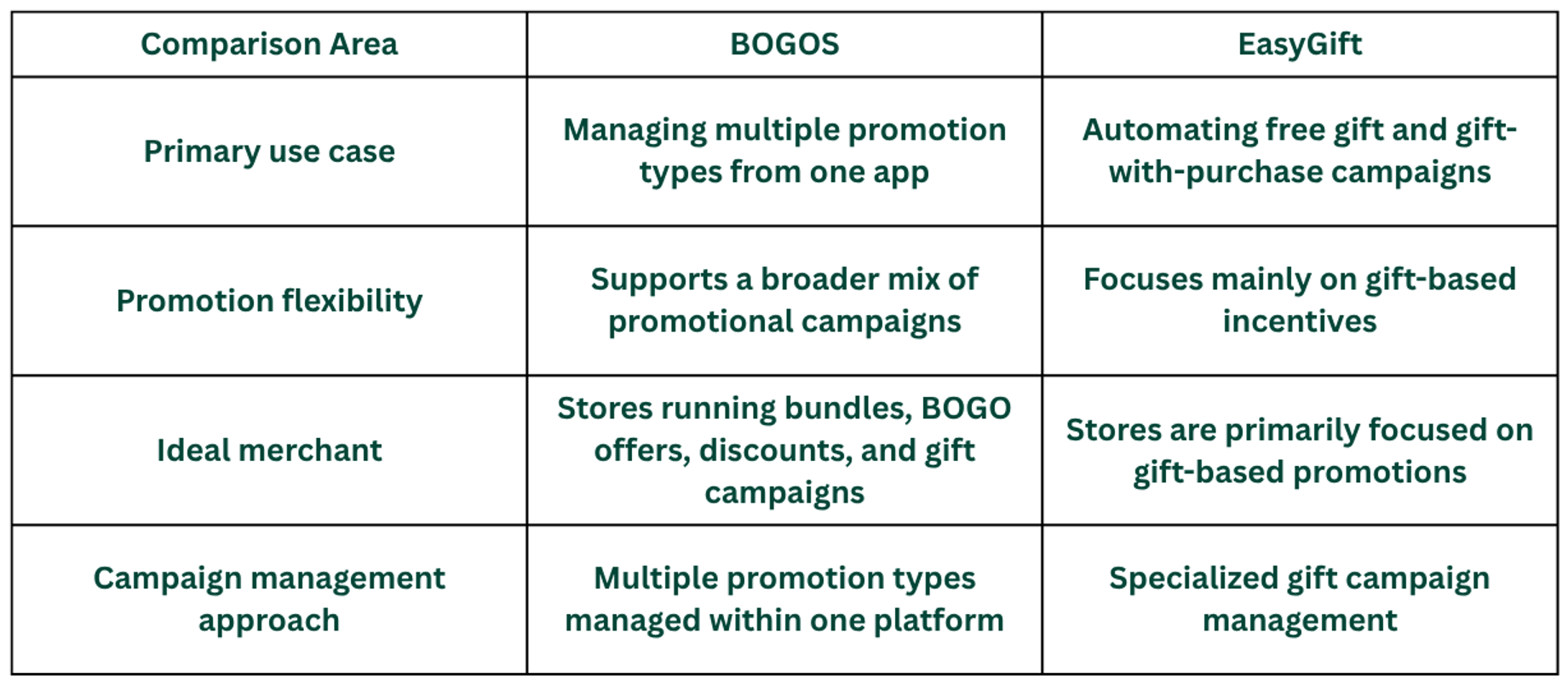
For example, a merchant preparing for Black Friday may want to combine BOGO offers, bundles, and spend-based incentives within the same campaign strategy. In that scenario, a broader promotion platform can reduce the need for multiple tools. A merchant that relies primarily on gift-with-purchase campaigns may place greater value on advanced gift qualification rules and automation.
The decision often comes down to how many promotion types your store plans to run. Merchants looking for flexibility across different campaigns may prefer BOGOS, while those focused on gift incentives may find EasyGift's specialized approach a better fit.
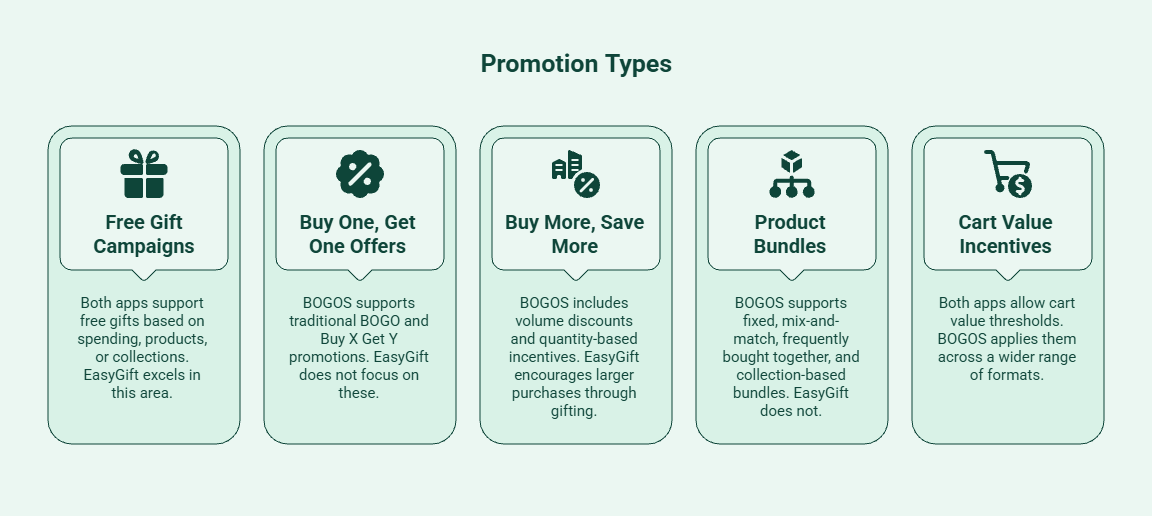
Both apps help merchants increase cart value through promotional incentives, but they support different campaign formats. BOGOS is designed to support a wider range of promotions, while EasyGift focuses primarily on gift-based campaigns and advanced qualification rules.
Both BOGOS and EasyGift support free gift campaigns triggered by spending thresholds, qualifying products, or collection-based conditions. EasyGift is built specifically around this type of promotion, making it well-suited for merchants that rely heavily on gift-with-purchase offers. BOGOS also supports free gifts but includes them within a broader set of promotional tools.
For example, a beauty brand might offer a free sample when customers spend $75, while a food and beverage store could provide a complimentary product when shoppers purchase from a specific collection. Both apps can automate these rewards, but EasyGift offers more advanced control over customer qualification and gift eligibility rules.
BOGOS supports traditional BOGO and Buy X Get Y promotions, making it a stronger choice for merchants that regularly run quantity-based offers. While EasyGift can automate gift rewards tied to qualifying purchases, BOGO campaigns are not its primary focus.
Common BOGO examples include:
These campaigns are often used to increase unit sales, move inventory, and encourage customers to purchase more products in a single transaction. For merchants that run Buy X Get Y offers throughout the year, BOGOS provides greater flexibility and campaign variety.
BOGOS includes promotion types built around volume discounts and quantity-based incentives, allowing merchants to reward customers for purchasing more items. EasyGift can encourage larger purchases through spending thresholds and gift qualification rules, although its core functionality remains centered on gifting rather than tiered discount structures.
For example, a supplement brand might offer 10% off when customers buy two products, 15% off when they buy three, and 20% off when they buy four or more. These promotions help increase average order value while giving shoppers a clear incentive to purchase larger quantities.
This is one of the clearest differences between the two apps. BOGOS supports several bundle formats, allowing merchants to group products together and encourage larger purchases through curated offers.
Bundle types supported by BOGOS include:
For example, a skincare brand might bundle a cleanser, serum, and moisturizer into a complete routine, while a supplement brand could create a wellness package featuring multiple products at a discounted price. These types of offers can increase average order value while helping customers discover related products.
EasyGift can pair gifts with qualifying purchases, but bundle creation is not a core part of its functionality. For merchants that rely heavily on bundling as an upsell and cross-sell strategy, BOGOS offers significantly more flexibility.
Both apps allow merchants to create promotions based on cart value thresholds. EasyGift uses these conditions to trigger gifts and rewards automatically, while BOGOS applies cart value and quantity-based conditions across a wider range of promotional formats.
For example, a merchant might offer a free gift when customers spend $100, unlock an additional discount at $150, or reward larger purchases with quantity-based savings. Because BOGOS combines these incentives with bundles, BOGO offers, and volume discounts, it provides more flexibility for merchants building multi-layered promotional campaigns.
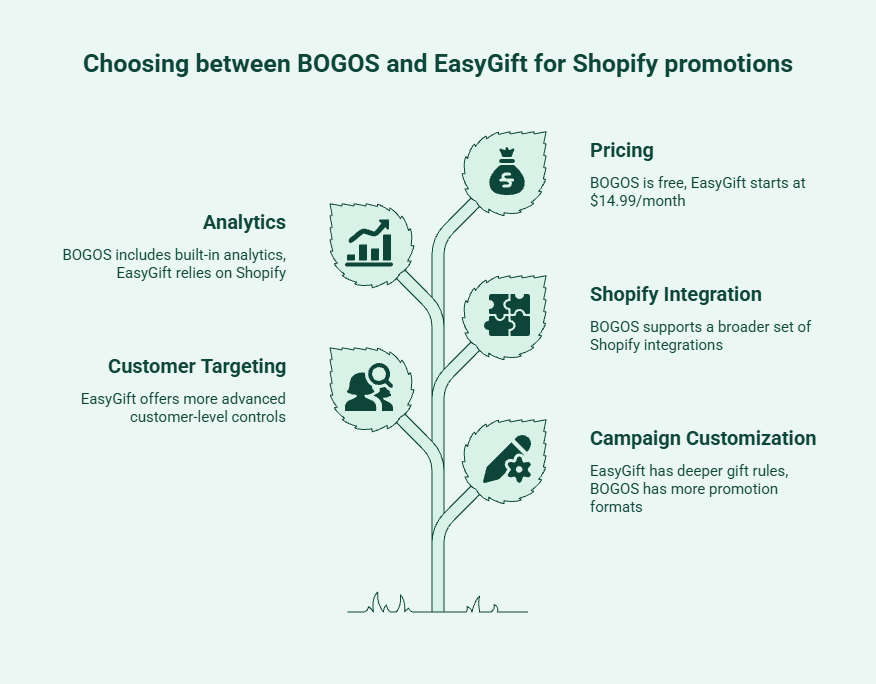
Both apps help Shopify merchants run promotions, but they prioritize different capabilities. BOGOS focuses on managing multiple promotion types from a single platform, while EasyGift specializes in advanced gift automation and customer-specific reward rules.
Both apps support campaign customization, but they approach it differently.
EasyGift focuses on rule-based customization. Merchants can trigger gifts based on cart value, products, collections, customer tags, spending history, customer IDs, geographic markets, and scheduled promotions. This makes it well-suited for targeted gifting campaigns.
BOGOS focuses on promotion customization. Merchants can customize bundles, BOGO offers, volume discounts, progress bars, gift displays, and promotional widgets across different campaign types.
In short, EasyGift offers deeper gift qualification rules, while BOGOS offers more flexibility across promotion formats.
Customer targeting is one of EasyGift's strongest differentiators. According to its Shopify App Store listing, merchants can build campaigns using customer tags, order history, spending thresholds, customer IDs, and market-specific conditions.
For example, a merchant could reward VIP customers, offer gifts to shoppers who spend more than $500, or run promotions for specific regions.
BOGOS also supports targeting and qualification rules, but EasyGift provides more advanced customer-level controls for gift campaigns.
Both apps work without custom development, but BOGOS supports a broader set of Shopify integrations.
Notable integrations include:
BOGOS is also a Built for Shopify app, which can be appealing for merchants that want deeper Shopify compatibility. EasyGift focuses on straightforward setup for gift automation through app embeds and rule-based configuration.
BOGOS includes built-in analytics that help merchants measure promotion performance, customer engagement, and revenue impact.
EasyGift focuses more on campaign execution than reporting. Merchants can still evaluate results through Shopify analytics, but reporting is not a primary differentiator.
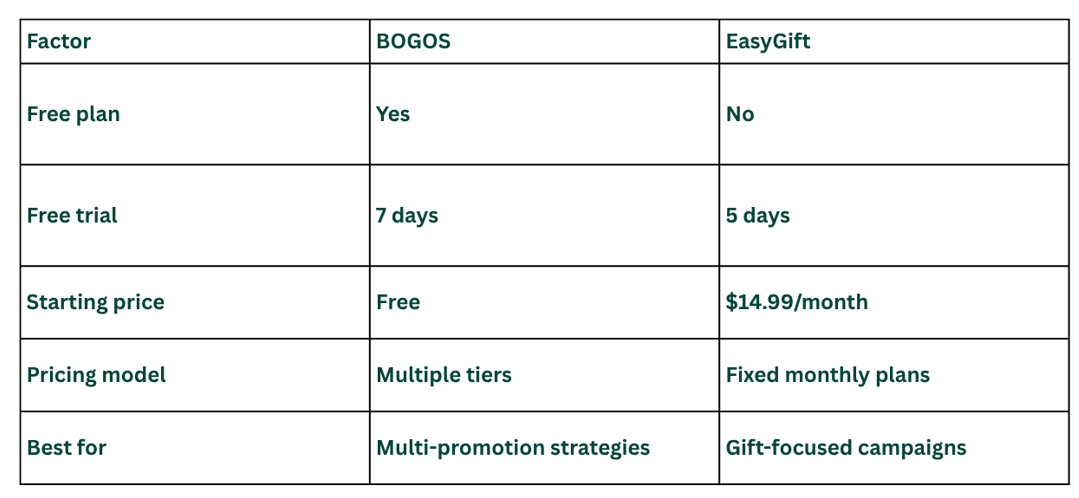
BOGOS may provide better value for merchants running bundles, upsells, volume discounts, and gifts from one platform. EasyGift offers a lower entry price and predictable costs for stores focused primarily on gift automation.
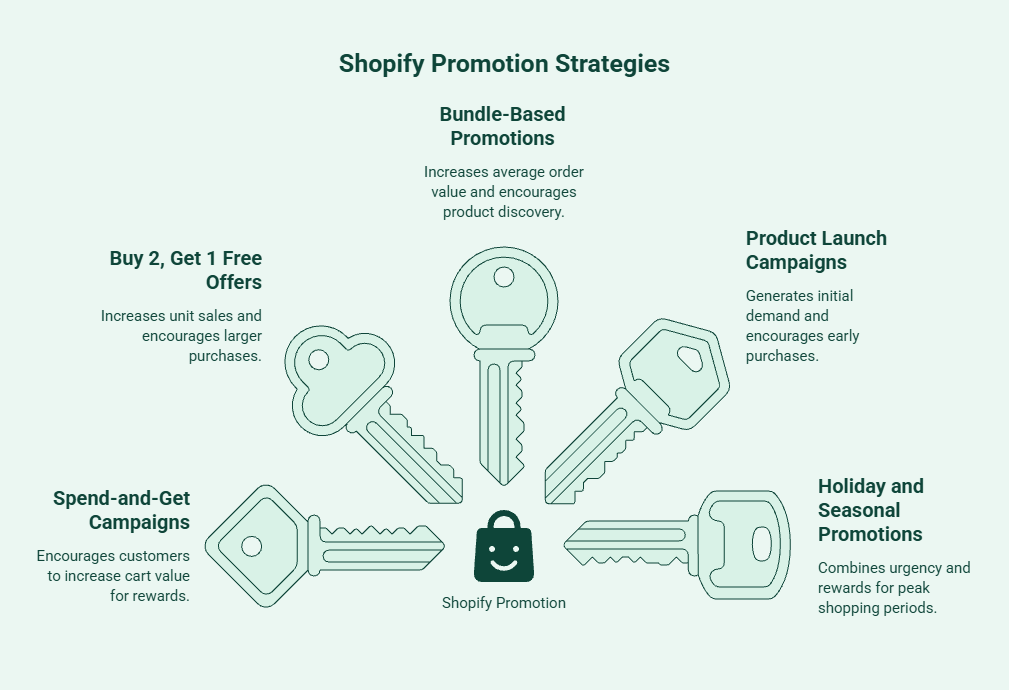
Different promotional goals require different campaign structures. While both apps can support revenue-driving offers, their strengths become more apparent when applied to specific merchant scenarios. Looking at common Shopify promotions can provide a clearer picture of how each platform fits different campaign requirements.
Spend-and-get campaigns encourage customers to increase their cart value in exchange for a reward. EasyGift is well-suited to this scenario because merchants can automatically add gifts when spending thresholds are met and remove them if shoppers no longer qualify.
BOGOS supports similar spend-based gifting campaigns and allows merchants to combine them with additional promotional elements, such as progress bars, complementary offers, and other cart incentives. This can be useful for stores that want to build broader promotional experiences around spending thresholds.
Buy-2-get-1-free campaigns are commonly used to increase unit sales and encourage larger purchases. BOGOS supports Buy X Get Y promotion structures, allowing merchants to create quantity-based incentives across products and collections.
EasyGift can support similar campaigns by automatically adding a qualifying reward item when customers meet predefined purchase conditions. This approach works well when the primary objective is automated gift fulfillment rather than a broader promotional strategy.
Many Shopify merchants use bundles to increase average order value and encourage product discovery. BOGOS supports bundle and mix-and-match promotions that allow multiple products to be grouped within a single offer.
EasyGift can support product pairings through gift-qualification rules, enabling customers to receive related items when specific products are purchased. While the campaign structures differ, both approaches can be used to increase basket size through related-product incentives.
Product launches often rely on incentives to encourage early purchases and generate initial demand. EasyGift can automatically reward customers with launch gifts based on specific products, collections, or spending thresholds, making it useful for straightforward launch incentives.
BOGOS allows merchants to combine launch gifts with additional promotional formats such as bundles, Buy X Get Y offers, and other cart-building campaigns. This can be helpful when launch strategies involve multiple promotional objectives across different products.
Seasonal campaigns often combine urgency, higher spending thresholds, and promotional rewards. EasyGift allows merchants to schedule gift campaigns in advance and automatically apply rewards during peak shopping periods, helping simplify campaign management during busy sales events.
BOGOS supports seasonal promotions across multiple campaign types, allowing merchants to combine gifting, bundles, cart incentives, and other promotional formats within a single strategy. This can be valuable for stores running more complex holiday campaigns across multiple collections and product categories.
Across these scenarios, EasyGift is most often used for automated gift-based campaigns, while BOGOS supports a wider mix of promotion formats within a single strategy. These differences become more noticeable as promotional strategies grow in complexity and require multiple campaign types to work together.
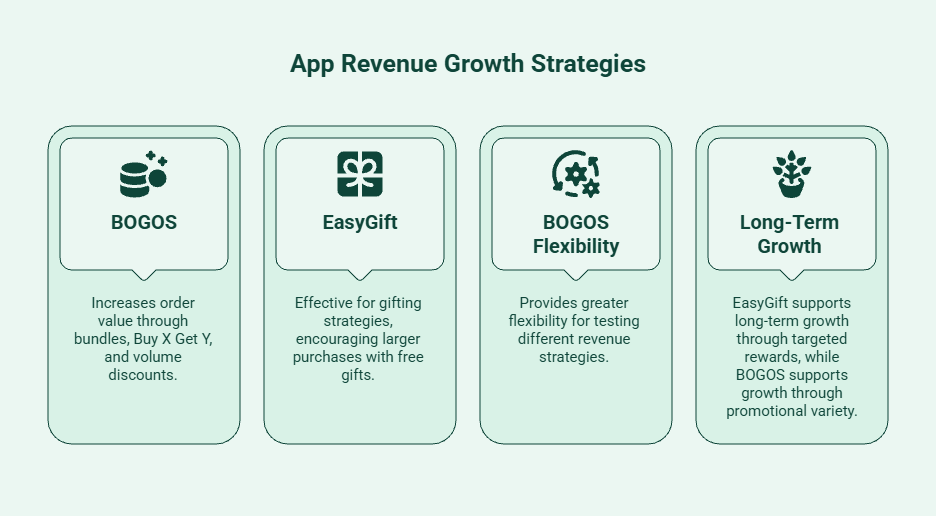
Revenue growth depends on more than running a single promotion. Most Shopify merchants increase revenue by growing average order value, improving product discovery, and creating more opportunities for repeat purchases. While both apps can support these goals, they do so in different ways.
For merchants focused primarily on gift-based incentives, EasyGift offers strong targeting and automation capabilities. For merchants looking to increase revenue through bundles, upsells, BOGO offers, and gifting campaigns, BOGOs create more opportunities throughout the customer journey. Platforms like Kefi Commerce help merchants bring these strategies together, making it easier to manage and optimize promotions as customer needs and business goals evolve.
The right choice depends on whether your promotion strategy is centered on automated gifting or a broader mix of offers such as bundles, BOGO campaigns, upsells, and volume discounts. While both apps can help increase customer engagement and order value, they are designed to support different promotional priorities.
EasyGift may be a better fit if you:
BOGOS may be a better fit if you:
As stores grow, promotional needs often become more complex. A brand that starts with simple gift campaigns may later introduce bundles, quantity discounts, seasonal promotions, or upsell offers to support revenue growth.
When evaluating BOGOS and EasyGift, consider not only the campaigns you run today but also the promotions you expect to launch in the future. Choosing a platform that aligns with both your current requirements and long-term growth strategy can help reduce the need to switch tools as your business evolves.
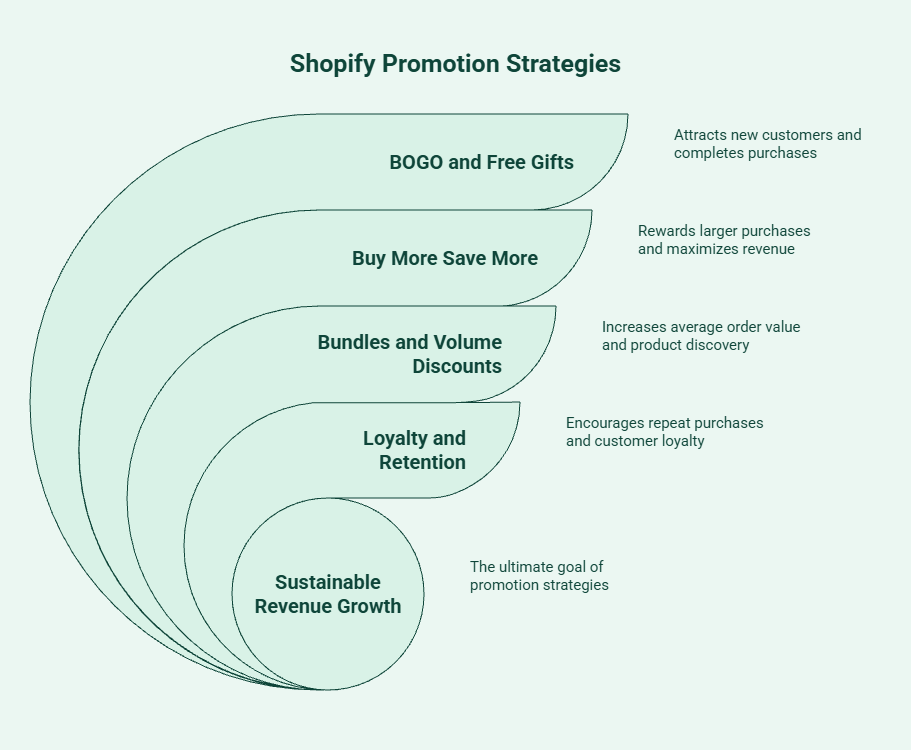
BOGO and free gift campaigns can increase conversions and average order value, but they are rarely the only promotions a growing Shopify brand needs. As customer expectations evolve, many merchants expand their strategy to include retention incentives, bundles, volume discounts, and other offers designed to support both immediate sales and long-term growth.
Acquiring customers is only part of the challenge. Retaining them often requires promotions that feel relevant beyond the first purchase. Rewarding repeat buyers, recognizing loyal customers, and creating personalized incentives can help strengthen customer relationships while encouraging additional purchases over time.
Bundles and volume discounts encourage customers to purchase more products in a single transaction. These promotions can increase average order value, improve product discovery, and help merchants introduce customers to complementary products they may not have otherwise considered.
Buy More Save More campaigns reward customers for increasing order quantities or spending more. Unlike gift-based promotions, these offers directly encourage larger purchases and can be particularly effective for consumable products, repeat-purchase categories, and stores looking to maximize revenue per order.
Different promotions solve different growth challenges:
As stores grow, relying on a single promotion type often limits opportunities to engage different customer segments and buying behaviors. A broader strategy allows merchants to match incentives to specific business goals throughout the customer journey.
Many Shopify brands eventually outgrow single-purpose promotion tools. As campaigns expand across gifting, bundles, loyalty programs, and upsells, managing multiple apps can create operational complexity and fragmented customer experiences.
Kefi Commerce helps merchants bring these strategies together within a single revenue growth platform, making it easier to run coordinated campaigns that support both immediate sales and long-term retention.
With Kefi Commerce, merchants can:
For example, a beauty brand could reward first-time buyers with a free gift, increase cart value through product bundles, and encourage repeat purchases with loyalty rewards. Instead of managing separate tools, merchants can coordinate these campaigns through a single platform.
By bringing promotions, loyalty, and retention strategies together, Kefi Commerce helps merchants create more opportunities for sustainable revenue growth as their business scales.
The right choice depends on the type of promotions you run and how your strategy is likely to evolve. While both apps can help increase revenue, they are designed for different use cases.
For merchants focused primarily on gift automation, EasyGift is the stronger fit. For merchants looking to combine gifting with bundles, BOGO offers, and upsells, BOGOS provides greater promotional flexibility.
BOGOS and EasyGift both help Shopify merchants increase revenue, but they are built for different goals. EasyGift is the stronger choice for stores focused on automated gifting, customer-specific rewards, and advanced qualification rules. BOGOS is better suited to merchants who want to combine gifting with bundles, BOGO offers, volume discounts, and upsells from a single platform.
The decision ultimately comes down to your promotion strategy. If free gifts are your primary growth lever, EasyGift is likely the better fit. If you want the flexibility to run multiple promotion types as your store grows, BOGOS offers a broader set of revenue-driving opportunities.
BOGOS supports multiple promotion types, including BOGO offers, bundles, upsells, and volume discounts, while EasyGift focuses primarily on automated free gift campaigns with detailed customer targeting and qualification rules.
BOGOS is generally the better choice for automated promotions and bundles because it supports BOGO offers, bundles, volume discounts, upsells, and Buy X Get Y campaigns within a single platform. EasyGift is better suited to automated free gift campaigns and rule-based gifting.
BOGOS stands out for its broader promotion toolkit, including bundles, Buy X Get Y offers, volume discounts, upsells, and checkout incentives. EasyGift stands out for its advanced gift automation, customer-specific targeting rules, and automatic gift qualification management.
BOGOS offers broader upselling and cross-selling features through bundles, Buy X Get Y offers, volume discounts, and checkout upsells. EasyGift focuses on gift-based incentives and discounted add-ons triggered by cart conditions and customer qualification rules.
BOGOS provides stronger analytics for tracking free gift promotions, offering reporting on campaign performance, customer engagement, and promotional results. EasyGift focuses more on gift automation and eligibility rules than on detailed analytics and reporting.
Both apps receive positive reviews from Shopify merchants. BOGOS is frequently praised for its wide range of promotion types, ease of use, and responsive support, while EasyGift is often recognized for reliable gift automation, flexible targeting rules, and straightforward campaign management
Both apps offer customer support, but BOGOS is frequently praised for responsive live chat support and hands-on assistance. EasyGift provides support through email, documentation, and help resources, with a stronger focus on campaign setup and troubleshooting.
.svg)
