.png)
Let's take a closer look.
Most Shopify stores don't have a traffic problem. They have a conversion problem. According to Adobe for Business, the average e-commerce conversion rate ranges between 2% and 4%, meaning the vast majority of visitors leave without making a purchase.
Shopify conversion rate optimisation focuses on converting more visitors into customers. Instead of increasing marketing spend, CRO helps improve the experience shoppers have once they arrive on your store. Small changes to product pages, navigation, checkout flows, and promotional offers can lead to more orders, stronger revenue performance, and better returns from existing traffic.
The stores that consistently outperform competitors are often not the ones attracting the most visitors. They are the ones removing friction, building trust, and presenting compelling offers at the right moment. Understanding where conversions are being lost and which optimisation opportunities create the biggest impact can help you unlock more revenue from the traffic you already have.
Shopify conversion rate optimisation (CRO) is the process of increasing the percentage of visitors who take action on your store. For most merchants, that action is a purchase. The goal is not to attract more traffic but to generate more revenue from the traffic you already have.
Every visitor who leaves without buying represents a missed revenue opportunity. CRO helps identify what is preventing shoppers from converting, whether that's poor product discovery, weak trust signals, checkout friction, or offers that fail to create enough purchase motivation.
For Shopify merchants, CRO is not limited to design changes or checkout improvements. It also includes offer strategy, merchandising, bundles, cart incentives, product discovery, and post-purchase experiences that influence both conversion rate and average order value. The most effective stores continuously test and optimize these touchpoints to create a smoother buying journey and stronger revenue performance.
The formula is simple:
Conversion Rate = (Total Conversions ÷ Total Visitors) × 100
For example, if your store receives 1,000 visitors and generates 50 orders, your conversion rate is 5%.
This metric provides a baseline for measuring optimization efforts. If conversions increase after improving product pages, checkout experiences, or promotional campaigns, you'll have a clearer picture of what's driving results.
A good Shopify conversion rate depends on your industry, product type, and customer behavior. While many ecommerce stores target 2% to 3%, stores consistently converting above 3% are generally considered strong performers.
According to Shopify's ecommerce conversion rate benchmarks, average conversion rates vary significantly across industries:
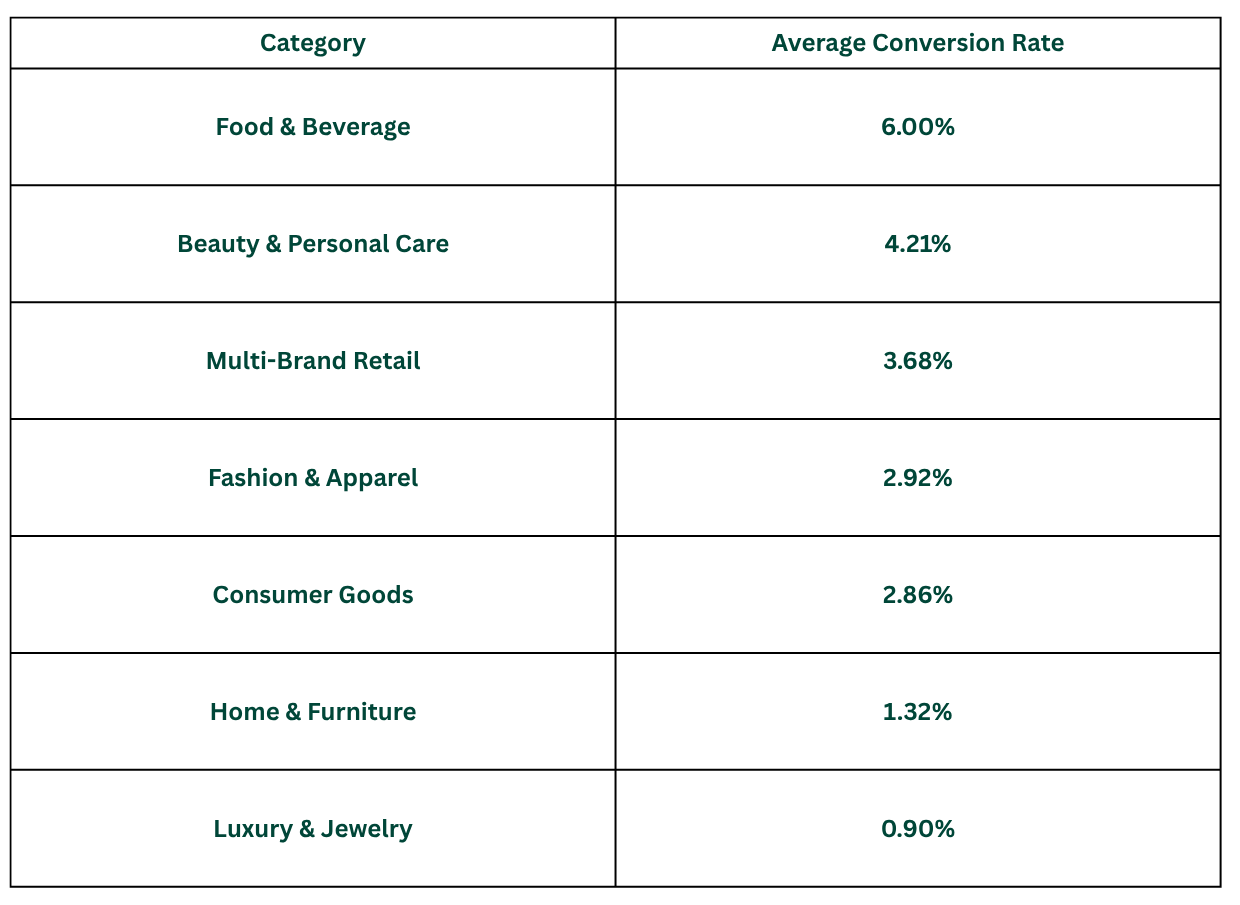
Benchmarks provide useful context, but your biggest opportunity often comes from improving your own baseline. Moving from a 2% conversion rate to 3% can create a significant revenue lift without increasing traffic or ad spend.
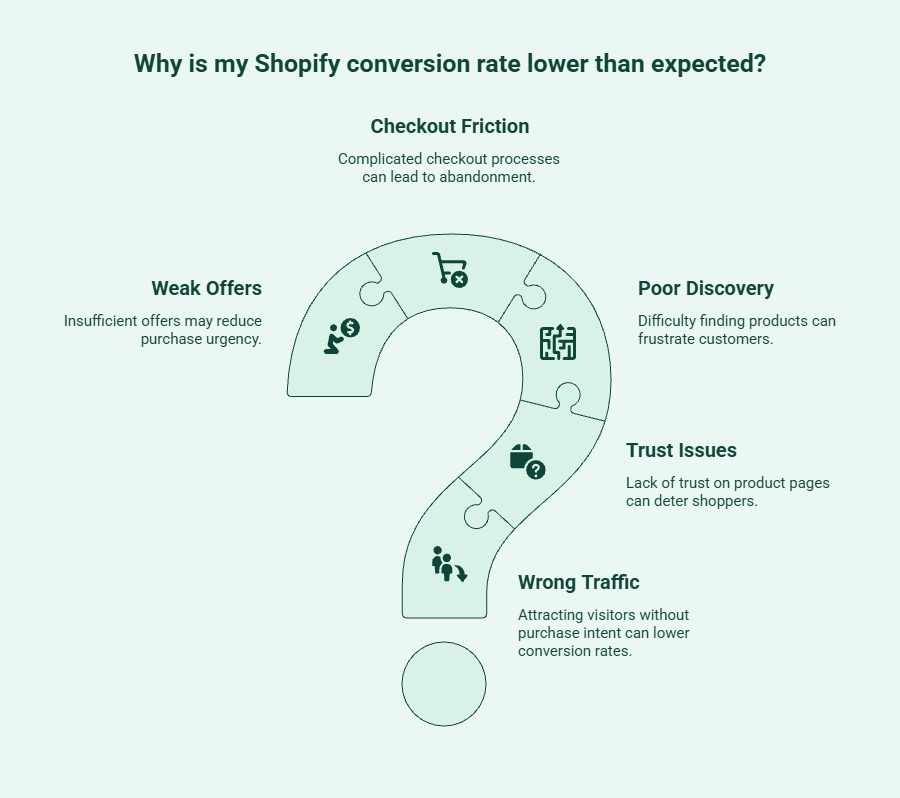
A low conversion rate doesn't always mean a lack of demand. Shoppers may be interested but encounter friction, trust issues, poor product discovery, or weak offers. Identifying where customers hesitate is often the first step toward improving conversions and revenue.
Imagine paying for 1,000 visitors and watching most of them leave within seconds. The problem may not be your store. It may be the audience you're bringing in.
A shopper searching for a specific solution behaves very differently from someone casually scrolling social media. If your ads, keywords, or campaigns attract people who were never likely to buy, conversion rates will stay low no matter how good your store looks. Before changing product pages or checkout flows, look at whether your traffic sources are bringing visitors with genuine purchase intent.
A shopper clicks on a product, likes what they see, and starts looking for reasons to buy. Then the questions begin.
Is this product worth the price? How long will shipping take? What happens if it doesn't fit? Has anyone else purchased it?
When product pages fail to answer these questions quickly, hesitation takes over. Strong images, reviews, clear product details, and transparent policies reduce uncertainty. The faster shoppers gain confidence, the easier it becomes for them to move toward checkout.
Not every visitor arrives knowing exactly what they want. Many need help finding the right product, comparing options, or narrowing down choices.
If shoppers have to dig through collections, repeat searches, or click through multiple pages to find relevant products, frustration builds quickly. High-converting stores make discovery feel effortless through intuitive navigation, relevant recommendations, and merchandising that guides shoppers toward products they are most likely to purchase.
Cart abandonment often starts long before a customer closes the page. It starts the moment checkout feels more difficult than expected.
Unexpected shipping costs, lengthy forms, mandatory account creation, or limited payment options create opportunities for doubt. Every additional step gives shoppers another reason to pause, reconsider, or leave. The best checkout experiences remove unnecessary decisions and make completing a purchase feel simple and fast.
Many shoppers don't leave because they dislike the product. They leave because they don't feel enough urgency or value to buy right now. Think about a customer comparing similar products across multiple stores. If one store offers a bundle, a Buy More Save More promotion, or a gift with purchase, the decision becomes easier. Strategic offers do more than increase perceived value. They help turn hesitation into action while creating opportunities to increase average order value.
This is why many Shopify merchants use Kefi Commerce to present relevant offers at key decision points, helping turn more browsing sessions into completed purchases.
If conversion rates are underperforming, start with the pages that influence product discovery, purchase decisions, and checkout completion. These areas typically have the biggest impact on revenue:
For many Shopify merchants, the biggest CRO opportunities are found on collection, product, cart, and checkout pages because they directly influence product discovery, purchase decisions, and order value.
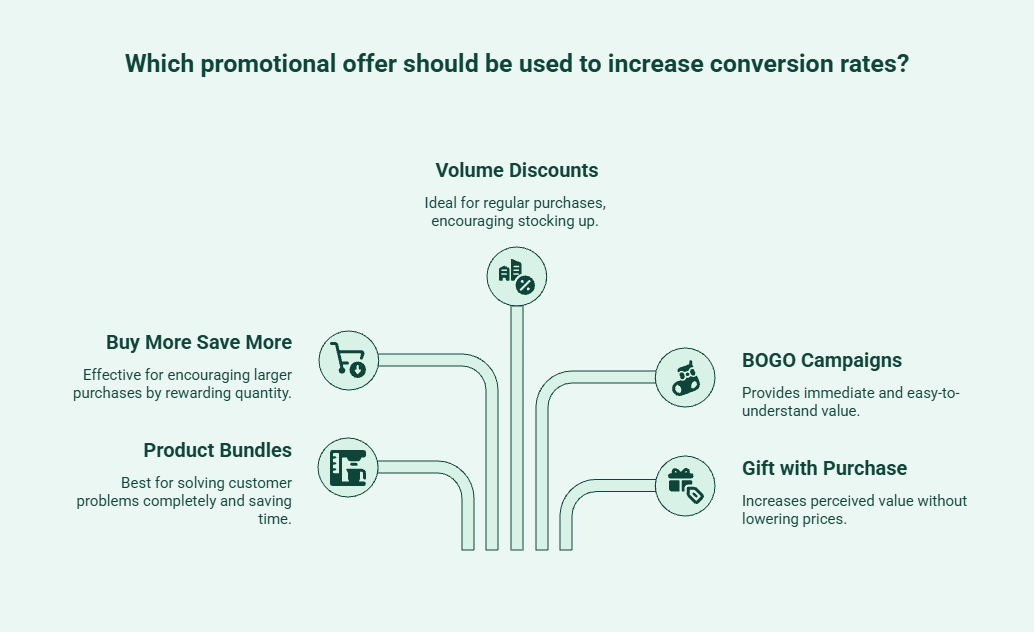
Strategic offers can help shoppers move from consideration to purchase. Bundles, upsells, Buy More Save More promotions, and gift-with-purchase incentives increase perceived value, reduce hesitation, and create opportunities to grow both conversion rates and average order value.
Product Bundles work best when they help customers solve a problem more completely. Instead of asking shoppers to purchase multiple products separately, bundles present a ready-made solution.
For example, a customer shopping for a coffee machine may also need coffee pods, filters, and a cleaning kit. Offering these products together as a bundle saves time, simplifies the decision, and increases the perceived value of the purchase.
To make bundles more effective:
Some shoppers are already interested in buying multiple units but need a stronger reason to increase quantity. Buy More Save More promotions make that decision easier by rewarding larger purchases.
For example, a customer planning to buy two protein bars may choose four when they see an offer such as "Buy 4, Save 15%." The customer gets better value, while the merchant increases order size.
To improve performance:
Volume discounts are particularly effective for products that customers purchase regularly. Instead of returning later to reorder, shoppers are encouraged to buy more during a single transaction.
For example, a skincare brand might offer 10% off two moisturizers and 20% off three. Customers stock up for future use, while the merchant increases revenue without additional acquisition costs.
For stronger results:
BOGO promotions work because the value is immediate and easy to understand. Shoppers don't need to calculate savings or compare discount tiers. They instantly see what they receive.
For example, a sock brand running a "Buy One Pair, Get One Free" campaign gives customers a simple reason to purchase now instead of waiting for a future sale.
To maximise impact:
Sometimes a small incentive is enough to push a shopper from consideration to action. A gift with purchase increases perceived value without lowering the product's listed price.
For example, a cosmetics brand offering a free travel-size serum on orders above $75 gives shoppers an extra reason to complete their purchase and may encourage them to add another item to reach the threshold.
To make the offer more effective:
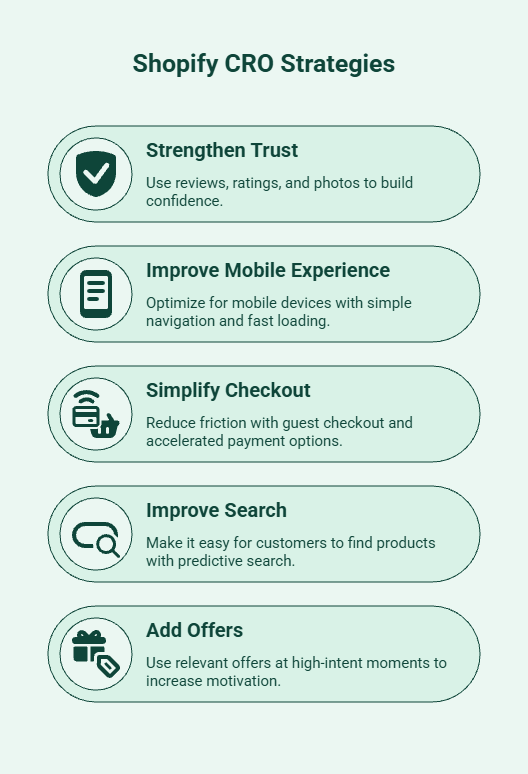
The fastest CRO wins usually come from reducing friction at key decision points in the buying journey. Small improvements to trust, product discovery, checkout experiences, and promotional offers can often increase conversions faster than a full store redesign.
Imagine discovering a product you've never purchased before. The price looks reasonable, but you're unsure whether the quality matches the promise. Most shoppers look for reassurance before they buy.
That's why reviews, ratings, and customer photos often influence conversion rates more than additional marketing copy. They answer questions shoppers already have and reduce the uncertainty that slows purchase decisions.
Focus on surfacing proof where hesitation happens:
Many merchants focus on desktop design while most of their traffic comes from mobile devices. The result is a shopping experience that technically works but feels frustrating on a smaller screen.
Mobile shoppers are often browsing during short windows of attention. If product pages take too long to load, key information is buried, or buttons are difficult to tap, they leave before reaching checkout.
Prioritize the experience that matters most:
Few conversion problems are more expensive than losing a shopper who was already ready to buy.
When customers reach checkout, they have already evaluated the product and decided it fits their needs. Unexpected shipping costs, long forms, or additional steps create opportunities for second thoughts.
Look for friction that delays completion:
Even small checkout improvements can recover revenue that would otherwise be lost to abandonment.
Not every visitor arrives knowing exactly what they want. Many are still comparing options, exploring categories, or searching for a specific solution.
The longer shoppers spend trying to find relevant products, the more likely they are to leave. High-converting stores reduce that effort by helping customers discover the right products faster.
Consider ways to shorten the path to purchase:
Not every shopper needs a discount. Sometimes they need a stronger reason to buy now instead of continuing to compare alternatives. Relevant offers can increase purchase motivation while creating opportunities to grow average order value.
Consider adding offers where buying intent is already high:
When presented at the right moment, these offers can help turn hesitation into action. This is why many Shopify merchants use platforms such as Kefi Commerce to surface relevant promotions throughout the buying journey.
The easier it is for customers to find what they need, the fewer opportunities there are for them to abandon the journey before purchasing. Many Shopify merchants use merchandising and offer-based platforms such as Kefi Commerce to surface relevant products, recommendations, and promotions that keep shoppers moving toward a purchase.
Conversion rate and average order value (AOV) both influence revenue, but they solve different growth challenges. Conversion rate helps more shoppers complete a purchase, while average order value (AOV) increases the amount each customer spends per order.
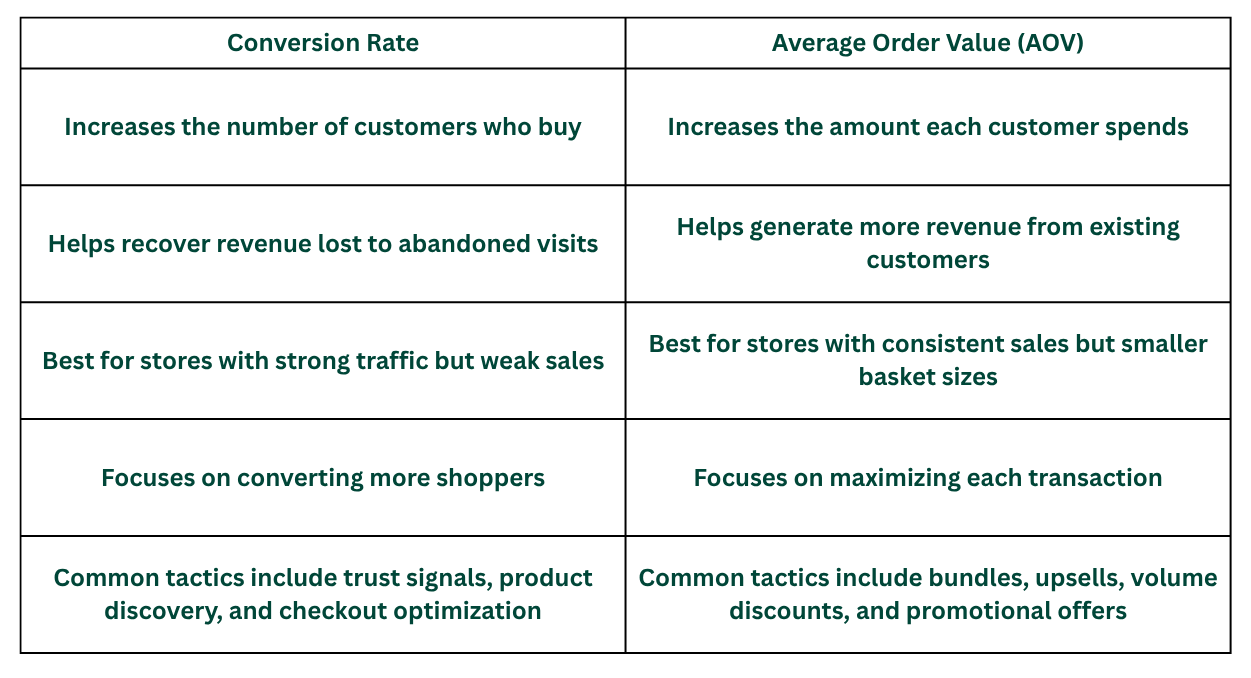
Focus on conversion rate if:
In these situations, reducing friction usually has a bigger impact than increasing basket size.
Focus on Average order value if:
This is where bundles, Buy More Save More offers, volume discounts, and gift-with-purchase promotions can increase revenue without requiring more traffic.
Most merchants should focus on their biggest bottleneck first. If shoppers aren't buying, improve conversions. If customers already buy consistently, focus on increasing basket size. The strongest Shopify stores improve both over time to generate more revenue from the same traffic.
Different CRO tools solve different problems. Some help merchants understand shopper behavior, while others help improve trust, product discovery, testing, or purchase motivation.
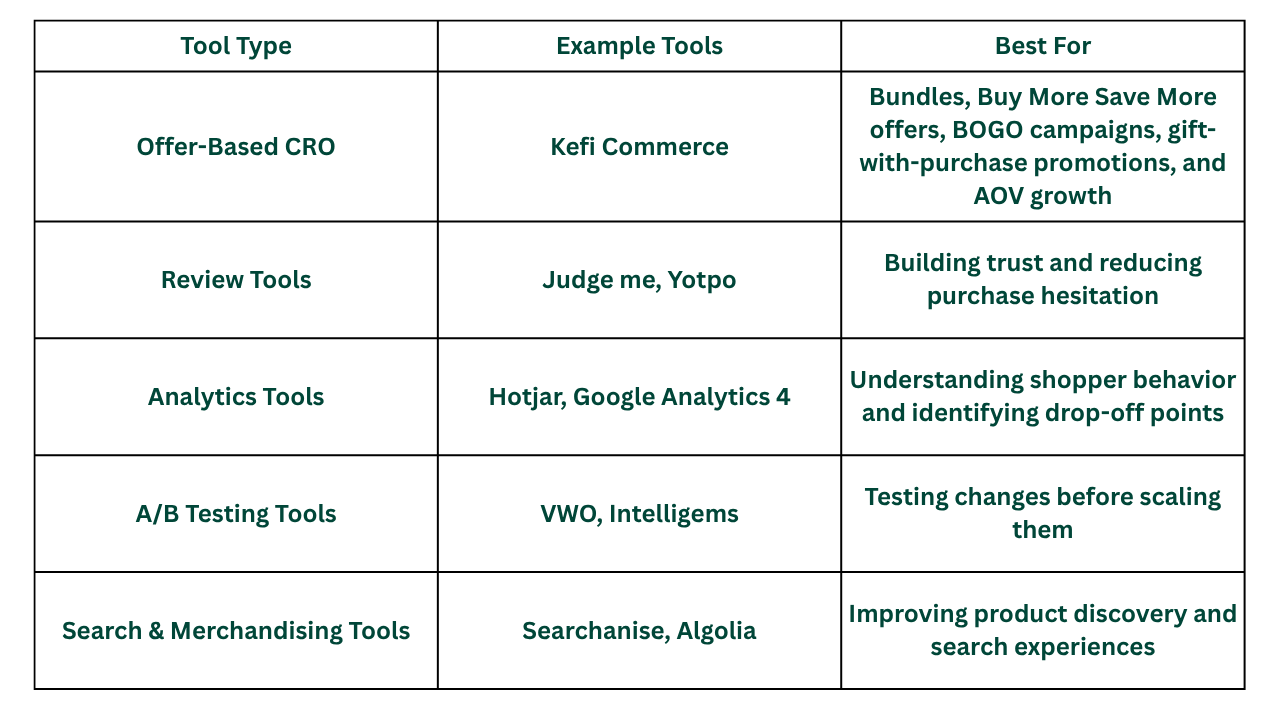
Most CRO tools help merchants identify problems. Kefi Commerce helps merchants influence purchase decisions.
For example, if shoppers are comparing products but not buying, bundles, Buy More Save More offers, BOGO campaigns, and gift-with-purchase promotions can motivate additional purchases. If customers already convert but basket sizes remain small, these same offer strategies can help increase average order value.
Kefi Commerce helps merchants:
Because these offers appear at high-intent moments throughout the buying journey, they can support both conversion growth and revenue growth from existing traffic.
Many conversion problems are self-inflicted. Merchants often focus on the wrong areas, add unnecessary complexity, or optimize based on assumptions instead of customer behavior.
Avoid these common mistakes:
The most successful Shopify merchants focus on one bottleneck at a time, measure the outcome, and continuously improve the shopping experience based on what customers actually do, not what they assume customers want.
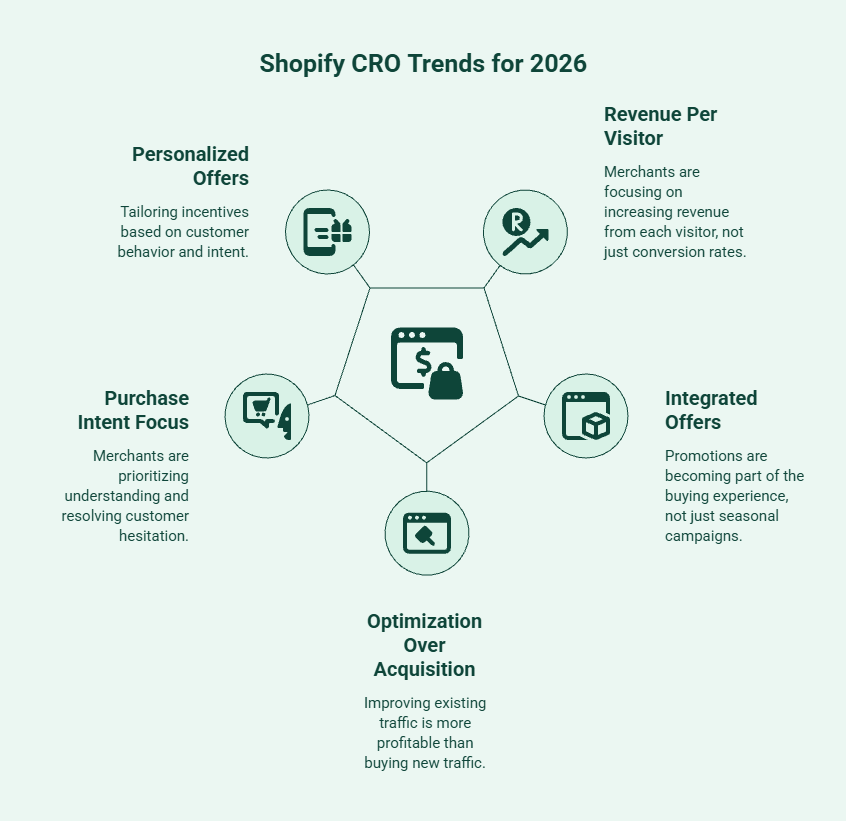
The biggest shift in 2026 isn't a new CRO tactic. It's how merchants think about growth. Instead of optimizing individual pages in isolation, leading Shopify brands are looking for ways to generate more revenue from every website visitor who reaches their store.
A higher conversion rate doesn't always create more revenue.
For example, a store may increase conversions from 2% to 3% by offering steep discounts. Meanwhile, another store keeps its conversion rate steady but increases its average order value through bundles, generating more revenue overall.
As a result, more merchants are evaluating revenue per visitor alongside conversion rate.
Promotions are no longer limited to seasonal campaigns.
For example, a skincare brand might display a complete routine bundle directly on the product page, while a supplement store may offer "Buy 3, Save 20%" before customers reach checkout. These offers become part of the buying journey rather than an afterthought.
Many merchants are finding that improving existing traffic is more profitable than buying more traffic.
For example, instead of increasing ad spend by 20%, a merchant may improve product discovery, simplify checkout, and introduce targeted bundles. The result is more revenue from the same number of visitors.
Most stores already have enough reports and dashboards. The challenge is turning insights into action.
For example, if shoppers repeatedly view a product but rarely purchase it, the issue may not be traffic. It could be missing reviews, unclear product information, or a weak offer. Merchants are focusing more on identifying these moments of hesitation and resolving them quickly.
Merchants are moving beyond one-size-fits-all promotions. Instead of showing the same offer to every shopper, they're tailoring incentives based on customer behavior and purchase intent.
For example, a returning customer may see a bundle offer, while a first-time visitor receives a gift-with-purchase incentive. Shoppers who repeatedly view a product could be shown a Buy More Save More offer, while customers with higher cart values may be encouraged with free shipping thresholds.
As merchants collect more first-party data, personalized offers based on customer segments, browsing behavior, cart activity, and product preferences will become a bigger part of conversion optimization. This helps create more relevant shopping experiences while improving both conversion rates and average order value.
Shopify conversion rate optimization is about helping more shoppers complete a purchase by removing friction throughout the buying journey. Improvements to site speed, product discovery, trust, checkout experiences, and purchase incentives can often generate more revenue without increasing traffic.
The most effective merchants focus on their biggest growth constraint first. Once the buying journey through the sales funnel is optimized, strategies such as bundles, Buy More Save More offers, and gift-with-purchase promotions can help increase both conversion rate and average order value.
Popular Shopify CRO apps include Kefi Commerce for promotions, Judge.me for reviews, Searchanise for product discovery, Hotjar for behavior insights, and VWO for A/B testing, as well as other Shopify apps. The best choice depends on your store's biggest conversion challenge.
Measure CRO success by tracking conversion rate, user behavior metrics such as add-to-cart rate, checkout completion rate, friction points in the average order value, and revenue per visitor. Compare performance before and after changes to identify which optimizations drive meaningful business results.
Common Shopify CRO mistakes include driving more website traffic before fixing conversion issues for e-commerce businesses, overusing discounts, adding too many upsells, ignoring product discovery, and making changes without measuring their impact on conversions and revenue.
AI helps Shopify stores personalize product recommendations, improve search results, optimize merchandising, and surface relevant offers based on shopper behavior. This reduces friction, improves product discovery, and can increase both conversion rates and average order value
B2B Shopify CRO focuses on reducing friction in longer buying cycles. Clear pricing, bulk-order options, account-based purchasing, quick reordering, and quantity discounts often have a bigger impact than urgency-driven promotions commonly used in B2C stores.
Artificial intelligence helps Shopify store owners personalize experiences, improve product discovery, and predict the next desired action. Using Shopify Analytics, AI can optimize recommendations, reduce customer acquisition costs, and surface relevant offers that increase conversions and credit card purchases.
.svg)
